






Spain national football team players: the squad after four Nations League wins, and Yamal’s 11 goals
Spain won all four Nations League games in September and October and are already in the quarter-finals. Here are the 30 players de la Fuente called up, with caps, goals and clubs.
Jul 17, 2026 · Updated Oct 18, 2026
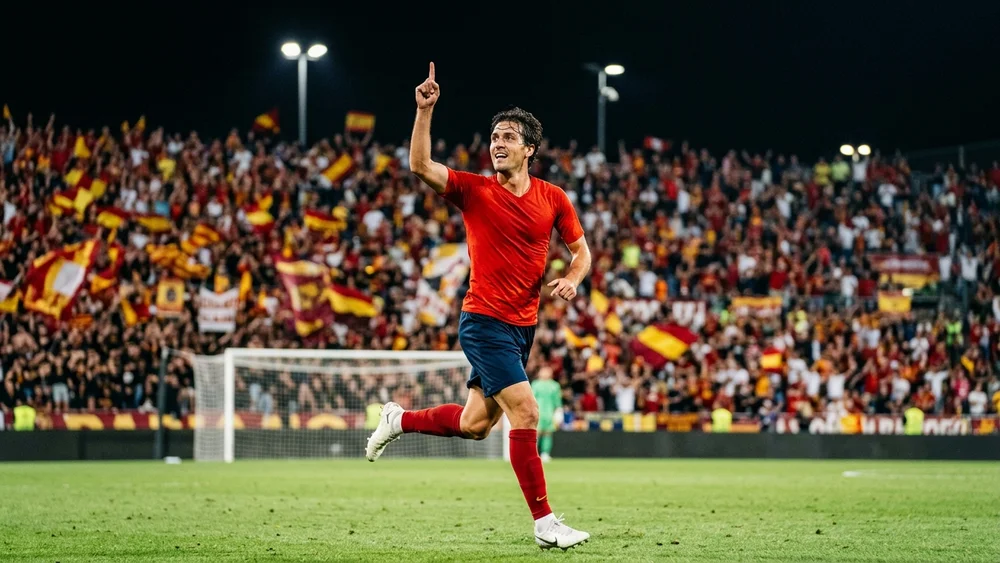
Luis de la Fuente named his first squad since the World Cup on 18 September, and Spain won all four Nations League games that followed. They beat England at Wembley, Croatia home and away and Czechia in Oviedo, scored 12 goals, and were through to the quarter-finals with two group games to spare. Their unbeaten run now stands at 42 matches.
This page lists the Spain national football team players from that window: the 26 de la Fuente named and the four he called in as injuries piled up. Caps and goals are correct to 6 October 2026, the night of the last game in Split.
The current Spain national football team squad
Six of the original 26 left before the window was over. Pedro Porro, Eric García, Álex Grimaldo, Nico Williams and Ferran Torres were injured, and Fabián Ruiz went home on the day of the Czechia game for the birth of his first child. Iván Fresneda, Robin Le Normand, Fran García and Carlos Espí came in. The final column is appearances across the four matches.
| Pos | Player | Caps | Goals | Club | Sep-Oct apps |
|---|---|---|---|---|---|
| GK | Unai Simón | 69 | 0 | Athletic Bilbao | 3 |
| GK | David Raya | 14 | 0 | Arsenal | 1 |
| GK | Josep Martínez | 1 | 0 | Inter Milan | 0 |
| DF | Aymeric Laporte | 57 | 2 | Athletic Bilbao | 3 |
| DF | Marc Cucurella | 35 | 1 | Real Madrid | 3 |
| DF | Robin Le Normand | 28 | 1 | Atlético Madrid | 1 |
| DF | Pedro Porro | 24 | 2 | Tottenham Hotspur | 0 |
| DF | Pau Cubarsí | 23 | 0 | Barcelona | 3 |
| DF | Eric García | 22 | 0 | Barcelona | 0 |
| DF | Álex Grimaldo | 14 | 0 | Atlético Madrid | 0 |
| DF | Dean Huijsen | 8 | 0 | Real Madrid | 1 |
| DF | Marc Pubill | 6 | 1 | Atlético Madrid | 3 |
| DF | Fran García | 3 | 0 | Real Betis | 1 |
| DF | Iván Fresneda | 1 | 0 | Sporting CP | 1 |
| MF | Rodri (c) | 74 | 5 | Barcelona | 4 |
| MF | Dani Olmo | 61 | 12 | Barcelona | 3 |
| MF | Mikel Merino | 55 | 15 | Arsenal | 4 |
| MF | Pedri | 53 | 6 | Barcelona | 4 |
| MF | Fabián Ruiz | 52 | 7 | Paris Saint-Germain | 2 |
| MF | Martín Zubimendi | 30 | 3 | Arsenal | 3 |
| MF | Álex Baena | 28 | 4 | Atlético Madrid | 4 |
| MF | Fermín López | 10 | 0 | Barcelona | 3 |
| FW | Ferran Torres | 66 | 25 | Paris Saint-Germain | 1 |
| FW | Mikel Oyarzabal | 64 | 31 | Real Sociedad | 3 |
| FW | Nico Williams | 38 | 7 | Athletic Bilbao | 2 |
| FW | Lamine Yamal | 37 | 11 | Barcelona | 4 |
| FW | Yéremy Pino | 27 | 4 | Crystal Palace | 2 |
| FW | Víctor Muñoz | 5 | 1 | Liverpool | 3 |
| FW | Roberto Fernández | 1 | 0 | Espanyol | 1 |
| FW | Carlos Espí | 0 | 0 | Real Madrid | 0 |
De la Fuente used 25 of the 30. Josep Martínez, called up for the first time, sat on the bench for all four games, and Espí, brought in from the under-21s, never made a matchday squad.
How Spain’s four Nations League games went
| Date | Fixture | Result | Spain scorers |
|---|---|---|---|
| 26 September | England v Spain, Wembley | Won 3-2 | Yamal, Baena, Oyarzabal |
| 29 September | Spain v Croatia, Seville | Won 4-1 | Yamal 2, Pubill, Nico Williams |
| 3 October | Spain v Czechia, Oviedo | Won 3-1 | Yamal, Rodri, Merino |
| 6 October | Croatia v Spain, Split | Won 2-1 | Merino 2 |
Spain trailed in two of the four. At Wembley Lamine Yamal scored in the second minute, England went in 2-1 up through Anthony Gordon and Harry Kane, and Kane then missed a penalty that would have made it 3-1. Álex Baena and Mikel Oyarzabal scored in the next 20 minutes, both off the bench. In Split, with Croatia back in front of their own fans after a stadium ban, Ivan Perišić headed Croatia ahead, was later sent off, and Mikel Merino, on at half-time, scored twice.
The two home games were more comfortable. In Seville, where Rodri showed the World Cup trophy to a full stadium before kick-off, Yamal scored twice in a 4-1 win and Marc Pubill headed his first goal for Spain. In Oviedo Yamal played only the first half and still scored, and Rodri got his first Spain goal since Euro 2024.
Split the 12 goals by who started and the bench comes out level with the first eleven. Six came from starters and six from substitutes: Baena and Oyarzabal at Wembley, Nico Williams against Croatia in Seville, and all three of Merino’s.
Who are Spain’s key players?
Lamine Yamal scored in each of the first three games and finished the window with four of Spain’s 12 goals. He is 19 and has 37 caps and 11 international goals. He is still behind Oyarzabal, the squad’s leading scorer on 31, and Ferran Torres on 25, but at his current rate he will not be for long.
Rodri is the captain and was named the best player at the World Cup. He played in all four games this autumn and was rested from the start for one of them.
Merino is the other name the window pushed up. He came off the bench in all four matches, scored three times, and his 15 international goals are now three more than Dani Olmo’s 12, the most by anyone in the squad outside the forward line.
Pedri and Baena also played in all four. Unai Simón kept goal in three, with David Raya starting in Oviedo.
Who is missing from the World Cup squad?
Marcos Llorente retired from international football on 3 September with 27 caps. Gavi, the goalkeeper Joan García and Borja Iglesias were left out of the 18 September list. Dean Huijsen and Fermín López, neither of whom went to the World Cup, came back in, and Josep Martínez and Roberto Fernández were called up for the first time.
Fresneda and Fernández both made their debuts in Oviedo, from the start. They are the only two new caps of the window.
When de la Fuente named the World Cup squad in May, the headline was that it contained no Real Madrid players. That has gone completely now. Cucurella moved there in the summer, Huijsen is back in the squad, and Espí came in from the under-21s, so three of the 30 play for Real Madrid. Barcelona still supply the most, with seven.
Spain’s Nations League group
| Team | P | W | D | L | GD | Pts |
|---|---|---|---|---|---|---|
| Spain | 4 | 4 | 0 | 0 | +7 | 12 |
| England | 4 | 3 | 0 | 1 | +11 | 9 |
| Croatia | 4 | 1 | 0 | 3 | -10 | 3 |
| Czechia | 4 | 0 | 0 | 4 | -8 | 0 |
Croatia can reach nine points at most, so Spain are certain of a top-two finish and a place in the quarter-finals, which are two-legged and played in March 2027. First place is still open. England, who beat Croatia 7-0 in Rijeka, have the better goal difference by four, and the group ends with Spain against England in Madrid.
What is next for Spain?
Czechia away in Prague on 12 November, then England at the Metropolitano in Madrid on 15 November. Spain were still first in the FIFA ranking published on 7 October, ahead of Argentina and France. Their last defeat was to Colombia in March 2024.
De la Fuente’s contract runs to Euro 2028, and the Spanish federation has said it wants to keep him to around 2030, when Spain co-host the World Cup with Portugal and Morocco.
How Spain won the 2026 World Cup
| Round | Opponent | Result |
|---|---|---|
| Group | Cape Verde, Saudi Arabia, Uruguay | 7 points, 2 wins and a draw |
| Round of 32 | Austria | Won 3-0 |
| Round of 16 | Portugal | Won 1-0 |
| Quarter-final | Belgium | Won 2-1 |
| Semi-final | France | Won 2-0 |
| Final | Argentina | Won 1-0 after extra time |
Spain conceded a single goal in eight matches, to Charles De Ketelaere in the quarter-final. Unai Simón went 650 minutes at World Cups without being beaten before that goal, the longest such run in the tournament’s history, breaking Walter Zenga’s 517 minutes from 1990.
The final was goalless for 98 minutes and barely a contest for most of them. Argentina did not register a single shot in the 90, a first for a World Cup final, and Ferran Torres scored in the 106th minute in front of 80,663 at MetLife Stadium in East Rutherford. It was Spain’s second World Cup, 16 years after the first.
What is Spain’s record in major tournaments?
Two World Cups, in 2010 and 2026, and four European Championships, in 1964, 2008, 2012 and 2024, which is more than any other country. They also won the Nations League in 2023. Spain and France are the only two nations to have won all three of those competitions.
Spain have also knocked France out at the semi-final stage of three consecutive major tournaments: Euro 2024, the 2025 Nations League and the 2026 World Cup. The one recent scar belongs to Portugal, who beat Spain on penalties in the 2025 Nations League final in Munich. Thirteen months later Spain put them out of the World Cup.
For the sides Spain will be measured against, see our squad guides to Brazil and Germany.