








Croatia national football team: full squad and key players
Slaven Bilic has taken charge, Luka Modric is expected to bow out in October, and a 19-year-old defender has just moved for 50 million pounds. Here is Croatia’s squad in full, with every club and cap count.
Jul 29, 2026
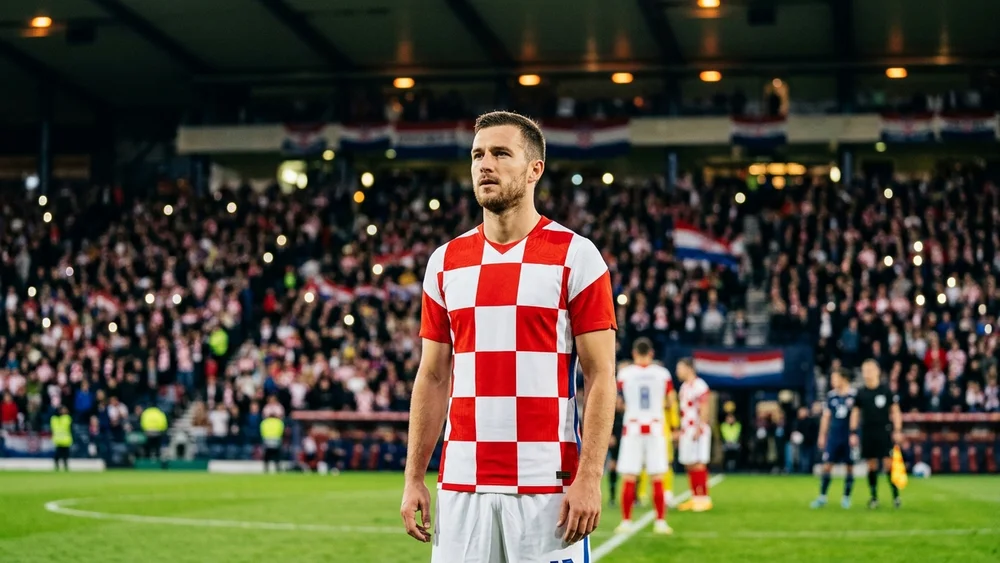
Croatia’s 26 players for the 2026 World Cup were named on 18 May, and that list is still the clearest picture of the national team: Luka Modric captaining the side at 40, Josko Gvardiol holding the back line together, and a group of midfielders born in the 2000s who are no longer being eased in. The squad came home from North America after a round-of-32 defeat to Portugal, and within two weeks the manager had gone and the captain was reported to be following him.
Here is the full 26-man squad with clubs and positions, the players worth knowing, the coaching change, and where Croatia go from here.
Croatia’s full squad for the 2026 World Cup
Zlatko Dalic named this group on 18 May 2026. The caps column below shows where each player stood when the tournament began, and the clubs are the ones they represented at it. That second point matters more than usual this year, because the summer window has already broken the squad up: Luka Vuskovic, the youngest player in it, has since joined Brighton from Tottenham in a club-record deal.
| No. | Player | Position | Club | Caps |
|---|---|---|---|---|
| 1 | Dominik Livakovic | Goalkeeper | Dinamo Zagreb | 75 |
| 12 | Ivor Pandur | Goalkeeper | Hull City | 0 |
| 23 | Dominik Kotarski | Goalkeeper | Copenhagen | 4 |
| 2 | Josip Stanisic | Defender | Bayern Munich | 31 |
| 3 | Marin Pongracic | Defender | Fiorentina | 20 |
| 4 | Josko Gvardiol | Defender | Manchester City | 48 |
| 5 | Duje Caleta-Car | Defender | Real Sociedad | 38 |
| 6 | Josip Sutalo | Defender | Ajax | 33 |
| 22 | Luka Vuskovic | Defender | Hamburg | 5 |
| 25 | Martin Erlic | Defender | Midtjylland | 13 |
| 7 | Nikola Moro | Midfielder | Bologna | 10 |
| 8 | Mateo Kovacic | Midfielder | Manchester City | 113 |
| 10 | Luka Modric (captain) | Midfielder | AC Milan | 198 |
| 13 | Nikola Vlasic | Midfielder | Torino | 63 |
| 15 | Mario Pasalic | Midfielder | Atalanta | 85 |
| 16 | Martin Baturina | Midfielder | Como | 19 |
| 17 | Petar Sucic | Midfielder | Inter Milan | 17 |
| 18 | Kristijan Jakic | Midfielder | Augsburg | 17 |
| 19 | Toni Fruk | Midfielder | Rijeka | 7 |
| 21 | Luka Sucic | Midfielder | Real Sociedad | 21 |
| 9 | Andrej Kramaric | Forward | Hoffenheim | 116 |
| 11 | Ante Budimir | Forward | Osasuna | 38 |
| 14 | Ivan Perisic | Forward | PSV Eindhoven | 154 |
| 20 | Igor Matanovic | Forward | Freiburg | 9 |
| 24 | Marco Pasalic | Forward | Orlando City | 15 |
| 26 | Petar Musa | Forward | FC Dallas | 11 |
Only two of the 26 were playing their club football in Croatia, Livakovic at Dinamo Zagreb and Toni Fruk at Rijeka. Italy supplied the largest contingent with seven, spread across Milan, Inter, Atalanta, Torino, Fiorentina, Bologna and Como.
Who are Croatia’s key players?
Luka Modric is still the reference point. He reached 200 caps against Panama in the group stage, becoming only the fourth man in the sport to get there after Cristiano Ronaldo, Lionel Messi and Kuwait’s Bader Al-Mutawa, and he finished the tournament on 202. That is a Croatian record by a distance of more than 40 games. He has been at AC Milan since leaving Real Madrid, where he won the Ballon d’Or in 2018, the year he took Croatia to a World Cup final and broke a decade of Messi and Ronaldo winning it between them.
The player Croatia now build the defence around is Josko Gvardiol. The Manchester City centre-back was 24 at the tournament with 48 caps behind him, and he got there the hard way: he fractured his tibia against Chelsea on 4 January 2026, had surgery, and only made it back for the closing weeks of the club season.
Holding up the other end of the experienced midfield is his City team-mate Mateo Kovacic, now on 117 caps, with Atalanta’s Mario Pasalic and his 85 caps the third of that generation.
Petar Sucic and Martin Baturina are the two who most obviously represent the next decade, and Dinamo Zagreb produced both. Sucic, 22, joined Inter in 2025 for a reported 16.5 million euros with add-ons and scored against Ghana in the group stage. Baturina, 23, went to Como in the same window in a deal reported at up to 25 million euros, and scored in the opening defeat to England. Neither had 20 caps when the tournament started. Luka Sucic of Real Sociedad is Petar’s cousin, grew up in Austria rather than Croatia, and gives Bilic a third midfielder from the same age bracket.
The headline act of that youth group is Luka Vuskovic. Born in February 2007, he was the youngest player in the squad by more than three years and had five caps before making a single senior appearance for the club that owned him. He spent last season on loan at Hamburg, made the Bundesliga team of the year, and Brighton have now paid Tottenham an initial 46 million pounds rising to a reported 50 million to sign him on a five-year deal. It is a club-record fee for Brighton, and a fair measure of what the rest of Europe makes of him.
Ivan Perisic and Andrej Kramaric are the veterans in attack, and they sit second and third on Croatia’s all-time scoring list. Perisic is on 39 goals in 158 caps, having scored Croatia’s goal against Portugal at 37 years old. Kramaric has 36 in 119. Ante Budimir came off the bench to score the only goal against Panama, heading in a Stanisic cross just before the hour.
Who is Croatia’s head coach?
Slaven Bilic. The Croatian Football Federation’s executive board approved his appointment unanimously and presented him in Zagreb on 13 July 2026, replacing Zlatko Dalic, who stepped down after the World Cup. It is Bilic’s second spell in the job. He ran the national team from 2006 to 2012 before club posts at West Ham, West Bromwich Albion, Watford and, most recently, Al Fateh in Saudi Arabia, which he left in August 2024. He had been out of work for close to two years.
Dalic goes as the most successful coach the country has had. In nine years he took Croatia to the 2018 World Cup final and third place in 2022, and got them through 2026 qualifying without losing a game, seven wins and a draw.
How did Croatia do at the 2026 World Cup?
They went out in the round of 32, beaten 2-1 by Portugal in Toronto on 2 July. Perisic put Croatia ahead just before the hour, Ronaldo equalised from the penalty spot after Vlasic fouled Renato Veiga, and Goncalo Ramos headed the winner four minutes into stoppage time. Gvardiol had an equaliser disallowed late on, one of several efforts ruled out across a match that was still being argued over days afterwards.
Croatia had reached the knockouts by finishing second in Group L on six points. England beat them 4-2 in Arlington on 17 June, then Budimir’s goal saw off Panama in Toronto and Petar Sucic and Vlasic delivered a 2-1 win over Ghana in Philadelphia.
That is a step down from the two tournaments before it. Croatia finished third at France 1998, when Davor Suker took the Golden Boot with six goals in seven matches, lost the 2018 final 4-2 to France, and came third again in Qatar in 2022. They were ranked 13th in the world in late July 2026.
Who is Croatia’s all-time top goalscorer?
Davor Suker, with 45 goals in 68 appearances between 1992 and 2002. Nobody has come close since, and the two active players nearest to him are both the wrong side of 35. Modric holds the appearance record on 202 caps, which is 44 clear of Perisic in second.
| Record | Player | Total |
|---|---|---|
| Most caps | Luka Modric | 202 |
| Most goals | Davor Suker | 45 |
| Second-highest scorer | Ivan Perisic | 39 |
| Third-highest scorer | Andrej Kramaric | 36 |
| Fourth-highest scorer | Mario Mandzukic | 33 |
What comes next for Croatia?
The Nations League, and a group that offers no easing-in period. Croatia were drawn in League A alongside Spain, England and Czechia, so Bilic’s first competitive assignment includes a rematch with the side that beat them in the World Cup opener. Four of the six group games are packed into the window running from 24 September to 6 October, with the last two in mid-November.
The bigger question is Modric. Several reports since the World Cup say he has told Bilic he intends to retire from international football after the home fixture against Spain in October, with the game in Split shaped as a farewell. Neither the player nor the federation has confirmed it, so it is a strong expectation rather than a settled fact. If it holds, Croatia lose their captain and record appearance holder in the same autumn they change manager, and the midfield belongs to the Sucic cousins and Baturina.
For more on the side that ended their tournament, see our guide to the Portugal national football team squad, or read back on how the round-of-32 tie was settled.