








No ball rules in cricket: every type, the free hit, and what a no ball actually costs
A no ball costs the fielding side a penalty run, an extra delivery and a free hit on which the batter can only be run out. Every situation the Laws call one, and what the ball-by-ball record says the mistake really costs.
Feb 1, 2022 · Updated Aug 26, 2026
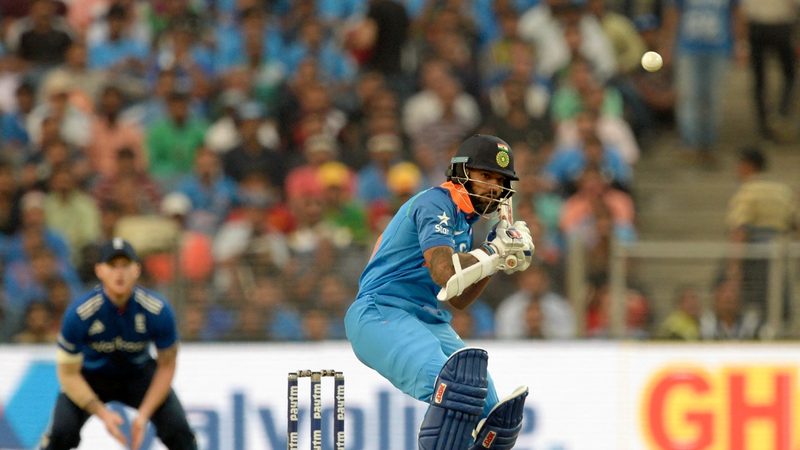
A no ball is an illegal delivery. The bowler’s side is docked one run the instant it is called, the ball does not count as one of the six in the over, and in limited-overs cricket the next delivery is a free hit on which the batter cannot be bowled, caught, stumped or given lbw. Law 21 of the Laws of Cricket sets out a dozen separate ways to bowl one, and cross-references six more Laws that produce the same call.
The part almost every explainer leaves out is what it actually costs. To find out, we counted every delivery in the Cricsheet ball-by-ball archive across men’s Tests, ODIs, T20Is and the IPL. In every limited-overs format the answer lands in the same narrow band: a no ball and the free hit that follows it concede about three and a half runs more than the legal delivery they replaced.
No ball rules in cricket: the four things that happen
Four consequences follow the call, and they are separate from each other.
- One penalty run is awarded the instant the call is made, under Law 21.15, and it stands even if a batter is then run out. It is scored as a No ball extra and debited to the bowler.
- The delivery does not count as one of the over. Law 21.17 keeps it out, so it has to be bowled again.
- The ball stays live. Law 21.14 is explicit that it does not become dead on the call, so the batters can run and the striker can hit a boundary.
- A free hit follows, in limited-overs cricket only. This one is not in the Laws at all. It comes from the playing conditions that governing bodies bolt on top of them, and it does not exist in Test cricket.
Law 21.13 adds a detail that catches people out: a no ball overrides a wide. You cannot be given both for the same delivery, so a ball that is both too high and too wide is signalled as a no ball.
What does a no ball actually cost?
Free hits have applied to every type of no ball, rather than front-foot ones alone, since October 2015. Taking that as the start date, here is what the fielding side gives up. The baseline column is the average runs conceded off a legal delivery in the same competitions over the same period.
| Format | Off the no ball | Off the free hit | Sequence total | Legal ball |
|---|---|---|---|---|
| ODI | 2.13 | 2.13 | 4.26 | 0.86 |
| T20I | 2.44 | 1.97 | 4.41 | 1.20 |
| IPL | 2.59 | 2.37 | 4.96 | 1.42 |
Subtract the last column from the third and the three formats agree to within a third of a run: 3.40 in ODIs, 3.21 in T20Is, 3.54 in the IPL. That is the real price of overstepping, and it is roughly two and a half deliveries’ worth of runs handed over for nothing.
The free hit is worth more in one-day cricket than in T20, which looks wrong until you check it against the baseline. An ODI free hit goes at 2.13 against a background rate of 0.86, a multiplier of 2.5. In the IPL it is 2.37 against 1.42, a multiplier of 1.7. A T20 batter is already attacking every ball, so removing the risk of getting out changes less about how he plays.
It is not free money either. Across all 5,560 free-hit deliveries in the sample, between 17.6 and 24.2 per cent were dot balls, depending on the format. The boundary rate ran from 26.6 per cent in T20Is to 35.5 per cent in the IPL.
Can you be stumped off a no ball?
No, and the same answer covers bowled, caught and lbw. Law 21.18 says that when a no ball has been called, neither batter can be out under any Law except Law 34 (hit the ball twice), Law 37 (obstructing the field) and Law 38 (run out). Stumped is not on that list. Because a free hit carries the dismissal rules of the no ball that created it, the same three exceptions are all that apply there too.
The archive backs this up about as firmly as a rule can be backed up. Across those 5,560 free-hit deliveries, exactly 27 dismissals occurred, and every one of them was a run out: 22 in T20Is, four in the IPL and one in an ODI. Not a single catch, bowled or lbw among them.
What confuses people is that a keeper can still break the stumps with the batter out of his ground, and it will look exactly like a stumping. It is scored as a run out, because that is the only Law under which it can stand. Our page on free hit rules in cricket goes through the batting side’s rights on that delivery in more detail.
How many types of no ball are there in cricket?
There is no single correct number, which is why you will see anything from 10 to 16 quoted, our own earlier version of this page included. It depends entirely on how finely you split the sub-clauses. What is fixed is the list of situations, and it comes in two parts: twelve situations set out inside Law 21, and six other Laws that Law 21.11 hands the call to.
| Law | Offence |
|---|---|
| 21.1.1 | Bowler changes mode of delivery without telling the umpire |
| 21.1.2 | Underarm bowling, unless agreed before the match |
| 21.2 | Throwing, better known as chucking |
| 21.5.1 | Back foot touching or outside the return crease |
| 21.5.2 | Front foot entirely beyond the popping crease |
| 21.5.2 | Front foot on the wrong side of the line between the middle stumps |
| 21.6 | Bowler breaks the non-striker’s wicket while delivering |
| 21.7 | Ball bounces more than once or rolls along the ground |
| 21.7 | Ball pitches wholly or partly off the pitch |
| 21.8 | Ball stops short of the striker’s wicket, or lands so wide he would have to leave the pitch |
| 21.9 | A fielder touches the ball before the striker or his wicket does |
| 21.10 | Ball passes over head height after pitching |
| 27.3 | Wicket-keeper takes the ball in front of the stumps |
| 28.4 | More than two fielders behind square on the leg side |
| 28.5 | A fielder encroaches on the pitch |
| 41.6 | Dangerous or unfair short-pitched bowling |
| 41.7 | A full toss above the striker’s waist |
| 41.8 | A deliberate front-foot no ball |
Two entries on that list are worth reading twice. Law 41.7.1 makes any non-pitching delivery above waist height a no ball, with no judgement required about whether it was dangerous; the danger assessment in 41.7.2 governs the warning and suspension that may follow, not the call itself. And the warning sequences for short-pitched bowling and for beamers run independently of each other under Law 41.6.5, so a bowler can be one delivery from suspension on both counts at the same time.
A common entry on rival lists does not belong there at all. Throwing the ball towards the striker’s end before entering the delivery stride is not a no ball. Law 21.4 says so in terms, and directs the umpire to call dead ball instead.
The front-foot no balls the umpires used to miss
The third umpire, not the standing umpire, now judges front-foot no balls in international cricket, reviewing the landing position after every delivery and speaking up only when the line has been overstepped. The trial began in the England v Pakistan ODIs of 2016, moved to India’s home series against West Indies in December 2019, and was used in a global event for the first time at the ICC Women’s T20 World Cup in early 2020. It reached Test cricket during England’s series against Pakistan later that year and was written into the World Test Championship playing conditions from 2021. We covered the point at which it became the TV umpire’s call in one-day internationals.
One limit on it is worth knowing, because it explains why the effect is not uniform. The third umpire rules on the front foot and nothing else. Every other type on the list above, from the waist-high full toss to the keeper standing too far up, is still called live by the standing umpire exactly as it always was.
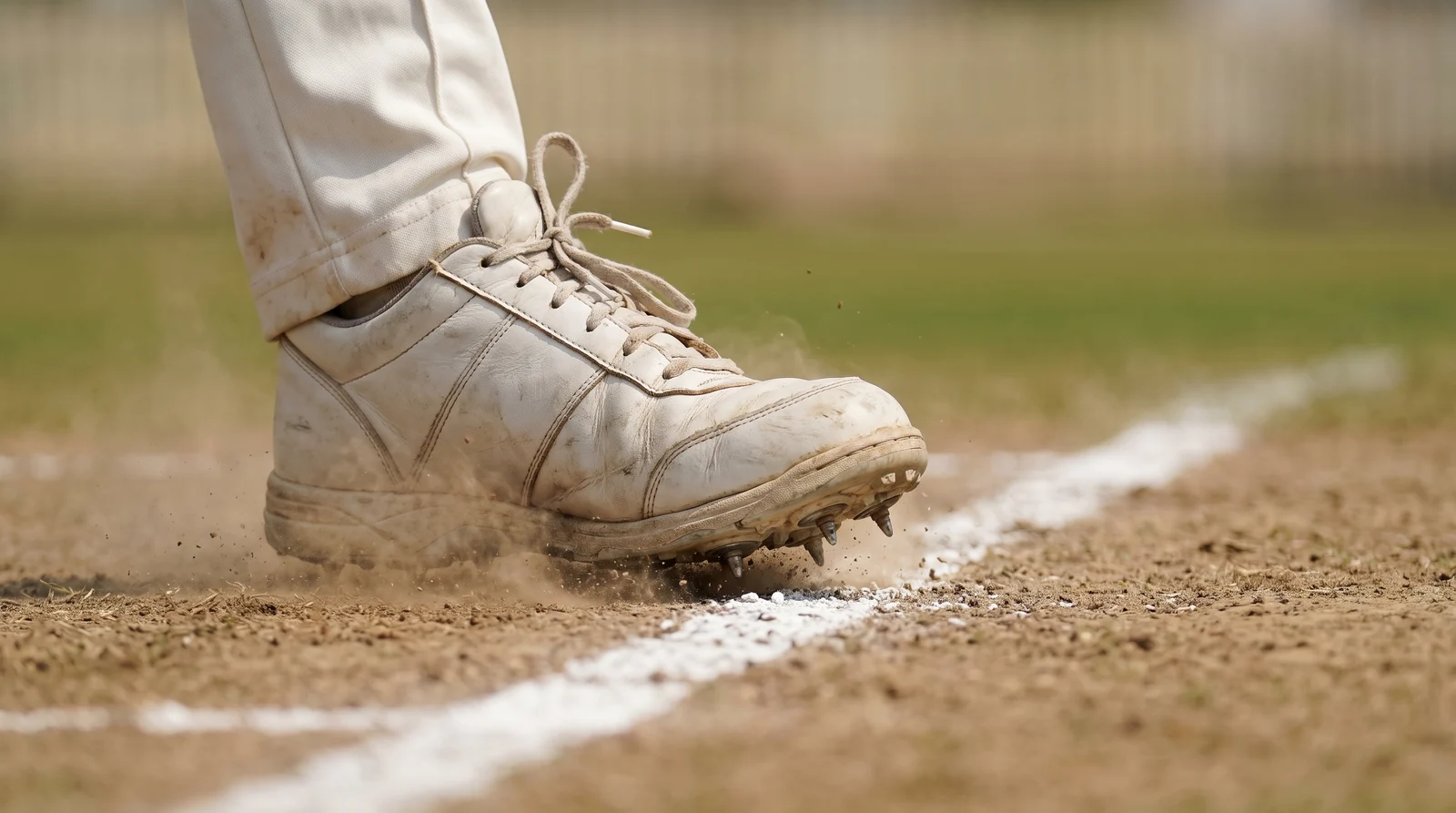
The effect on the number of no balls called is the opposite of what most people assume, and it is consistent across all four competitions. These are no balls per 100 legal deliveries, with 2020 left out as the transition year.
| Competition | 2016-19 | 2021-26 | Change |
|---|---|---|---|
| Tests | 0.311 | 0.615 | +98% |
| IPL | 0.340 | 0.467 | +37% |
| T20Is | 0.391 | 0.487 | +25% |
| ODIs | 0.201 | 0.246 | +22% |
Test cricket, where the checking is heaviest and there is no free hit to deter the bowler, has almost exactly doubled. The honest reading is that this measures no balls called, not no balls bowled. Nothing suggests bowlers started overstepping twice as often in 2021. What changed is that a delivery which used to slip past a standing umpire watching the feet and the pitch at once is now reviewed frame by frame by someone with one job.
Across the common 2016 to 2026 window the formats separate cleanly. Tests and T20Is both sit at roughly one no ball every 212 legal balls, the IPL at one every 239, and one-day internationals are by some distance the cleanest at one every 438.
Who bowls the most no balls, and who has never bowled one
Two contemporaries make the point better than a leaderboard does. James Anderson was called for a no ball once every 751 Test deliveries, a rate of 0.13 per 100. Ishant Sharma was called once every 62, a rate of 1.62. Same two decades, same job, and one was penalised twelve times as often per ball as the other. Ishant heads the Test list on volume with 314, from Morne Morkel on 256, Shannon Gabriel on 227 and Kemar Roach on 214. Rate reorders that completely: Gabriel gave away his 227 in barely half the deliveries Roach needed for 214, and Wahab Riaz conceded 147 in only 5,165 balls, a rate of 2.85 per 100.
The other end of the list is the better statistic, and one name owns it. Graeme Swann bowled 15,349 deliveries across 60 Tests and was never once called for a no ball. That one is airtight rather than approximate: the archive holds all 60 of his Tests, so it is his complete career record, not a sample of it. In the IPL, Rashid Khan and Axar Patel have both passed 3,500 deliveries without conceding one, while Jasprit Bumrah leads the competition on 40 at a modest 1.08 per 100.
For the other end of the scale, our page on the most no balls in a T20I innings collects the worst single spells the format has produced.
No ball questions people ask
Is a no ball counted in the over? No. Law 21.17 keeps it out, so the bowler has to deliver it again.
Can a batter be run out on a no ball? Yes. Run out is one of the three dismissals Law 21.18 permits, alongside hit the ball twice and obstructing the field.
Is a wide also a no ball? No, and it cannot be both. Law 21.13 makes the no ball call override the wide. The two are separate offences with separate penalties, set out on our wide ball rules page.
How many degrees of arm bend are allowed? Fifteen. That figure is not in the Laws, which simply require that the elbow is not straightened once the arm passes shoulder level. The 15-degree tolerance is an ICC regulation that gives umpires and biomechanists a measurable threshold, and it is a maximum, not a minimum.
Why is underarm bowling illegal? Law 21.1.2 bans it without prior agreement. The rule dates from the 1981 World Series match at the MCG in which Trevor Chappell rolled the final ball along the ground with New Zealand needing six to tie.
The lbw law and the Decision Review System cover the two rules most often argued over on a no ball delivery, since a batter given out to one may find the dismissal wiped off by the other.
No ball rates, free hit outcomes and bowler figures derived from the Cricsheet ball-by-ball archive: 892 men’s Tests, 2,569 ODIs, 3,528 T20Is and 1,243 IPL matches, to 22 August 2026 (IPL to 31 May 2026). Era comparisons use a 2016 floor, inside the archive’s reliable coverage for all four competitions, and individual career figures were used only where the archive’s match count matches the player’s actual career. Law references are to the MCC Laws of Cricket, 2017 Code, 3rd Edition (2022).
Featured photo: Punit Paranjpe / AFP