








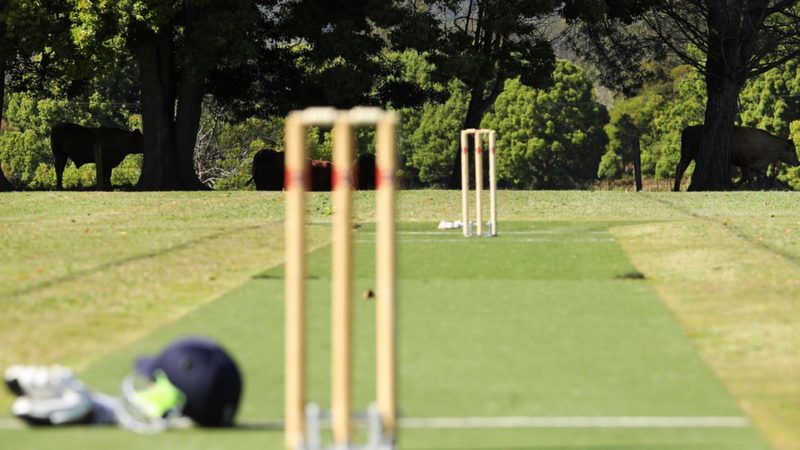
“Stumps” does three jobs in cricket, and only one of them is a piece of equipment. It is the three wooden posts at each end of the pitch; it is the shorthand for the close of a day’s play; and it is the root of stumped, one of the ten ways a batter can be out. The third one is where most explanations go wrong — and so does the second, as the Laws show below.
Everything here is from the MCC Laws of Cricket, the code every format plays under: Law 8 (The wickets), Law 29 (The wicket is down), Law 39 (Stumped) and Law 12 (Start of play; cessation of play).
The stumps themselves: what Law 8 specifies
A set of wickets is three wooden stumps with two wooden bails on top, and the whole set is 9 in wide. Every dimension is fixed to the hundredth of an inch.
| Measurement | Law 8 specification | Metric |
|---|---|---|
| Width of the set of wickets | 9 in | 22.86 cm |
| Height of the stumps above the playing surface | 28 in | 71.12 cm |
| Stump diameter, minimum | 1.38 in | 3.50 cm |
| Stump diameter, maximum | 1.5 in | 3.81 cm |
| Bail, overall length | 4.31 in | 10.95 cm |
| Bail, height above the stumps | 0.5 in | 1.27 cm |
The three stumps are named from the striker’s point of view. The one nearest the batter’s legs is leg stump, the far one is off stump and the one between them is middle — which is why the same post is off stump to a right-hander and leg stump to a left-hander facing the same bowler.
The stumps are cylindrical with dome-shaped tops, cut with grooves for the bails, and the bails must sit between them without forcing them out of the vertical.
Two clauses most fans never hear about. Law 8.5 lets the umpires dispense with the bails altogether if conditions require it — in high wind, typically — and if they do, neither end uses them until conditions allow. And Law 8.3.4 permits devices that limit how far a bail can travel off the stumps, with the approval of the governing body for the match and the ground authority — a player-safety clause, aimed at bails flying into faces.
The LED bails and stumps seen across T20 leagues are a separate matter: Law 8 sets the shape and size, and any variation on it is for the governing body running the competition to approve.
Putting down the wicket: the detail that decides replays
The stumps matter because three dismissals — bowled, run out and stumped — all turn on whether the wicket has been put down, and Law 29 defines that precisely.
The wicket is broken when at least one bail is completely removed from the top of the stumps, or one or more stumps is struck out of the ground. Two refinements follow from it, and both settle arguments:
- A bail that is merely disturbed is not enough, however clearly it moved. It has to come off.
- But a bail that falls and lodges between two stumps counts as completely removed, even though it never reached the ground.
- If one bail is already off, removing the remaining bail — or pulling any of the three stumps out of the ground — is sufficient.
Stumped: the dismissal is “stumped”, not “stumps”
This is the common mistake. Stumps is never a mode of dismissal; stumped is, and it is Law 39. Four conditions have to be met together:
- the delivery was not called No ball;
- the striker is out of their ground;
- the striker has not attempted a run; and
- the wicket is fairly put down by the wicket-keeper without the intervention of another fielder.
Drop the third condition and you have described a run out instead, which is exactly how most short definitions of stumped go wrong. The keeper does not have to break the wicket with a glove, either: if the ball rebounds on to the stumps off any part of the keeper’s person or equipment, or the keeper kicks or throws it on, that still counts as the keeper putting the wicket down.
Where both could apply, stumped takes precedence over run out — Law 39.1.2 says the striker is out Stumped even though a decision of run out would have been justified. And there is one escape: a striker who leaves their ground after receiving the delivery in order to avoid injury is not out stumped, though they can still be run out.
“Stumps” at the close of play — and the call the umpire actually makes
⚠️ Here is the correction worth keeping. Commentators and scorecards say the umpires “called stumps”, and the phrase is fine as cricket usage, but it is not in the Laws. The bowler’s end umpire calls Time, not stumps — Law 12.2 — and Law 12.3 then requires the bails to be removed from both wickets.
That call comes at the end of any session, which is why the bails come off at lunch and tea as well. The expression “stumps” survives because at the end of a day’s play the stumps themselves are pulled from the ground and carried off, and at the intervals they are not.
Two related rules shape when that moment arrives. Another over is started if the umpire, walking at normal pace, has reached position behind the stumps at the bowler’s end before the agreed time for the close — the one exception being when an interval falls due in the last three minutes. And on the final day, once one hour of playing time remains, the over in progress is completed and a minimum of 20 more must be bowled — the period thereafter is called the last hour whatever its actual duration.
One tidy-up on a figure often quoted loosely: stumps is called at the end of each day in Test cricket and in first-class cricket, and a first-class match is defined by the ICC as two innings a side over three or more days, not four or five.
Stumps in cricket: quick answers
How tall are cricket stumps? 28 in, or 71.12 cm, above the playing surface.
How wide is a set of wickets? 9 in, or 22.86 cm, across all three stumps.
How many stumps and bails are there? Three stumps and two bails at each end, so six stumps and four bails in a match.
Is “stumps” a way of getting out? No. The dismissal is stumped, under Law 39.
What is the difference between stumped and run out? Stumped requires that the striker was not attempting a run and that the keeper broke the wicket unaided. If the batter was running, it is a run out.
Do umpires really call “stumps”? In practice everyone says it, but the call in the Laws is Time.
Can a match be played without bails? Yes — Law 8.5 lets the umpires agree to dispense with them, usually in strong wind, and then neither end uses them.
More cricket rules explained: Test cricket rules, what “suspended” means, the lunch interval and the tea break. If you were after the kit rather than the Laws, see what a set of LED stumps costs.
Follow us on Telegram for the latest updates from the world of sports!
Interested in cricket betting? Click here to check out the list of top sites.
Photo credit: Alamy