








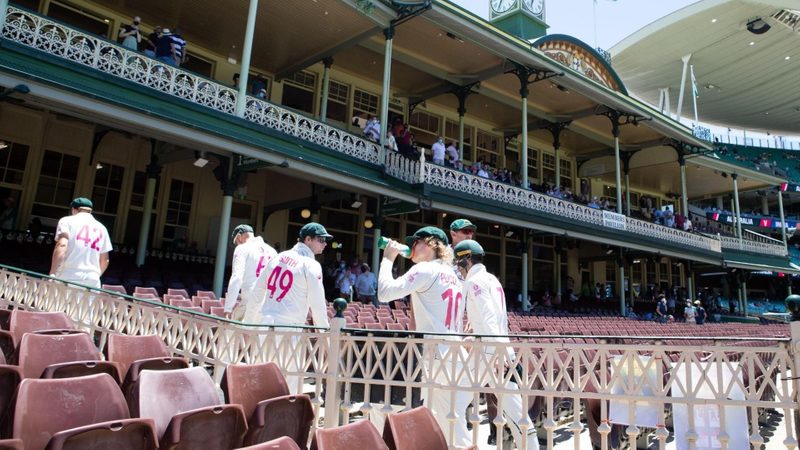
Lunch in a Test match is 40 minutes, and it is the longest break of the day. It comes at the end of the first session, normally two hours after the start, and it is one of only two scheduled intervals in six hours of play.
What follows is from the ICC Men’s Test Match Playing Conditions in force since June 2025. The interesting part is not the 40 minutes — it is the number of ways that lunch can move, and the one rule that can delay it by half an hour.
The breaks in a day of Test cricket
| Break | Length | When |
|---|---|---|
| Lunch interval | 40 minutes | After the first session |
| Tea interval | 20 minutes | After the second session |
| Combined, by regulation | 60 minutes | Fixed total |
| Drinks | 4 minutes maximum | Once in each session, at its mid-point |
| Between innings | 10 minutes | Whenever an innings ends in play |
The 40 and the 20 are not fixed individually. A home board may ask the ICC, with the visiting board’s consent, to change the length of either — provided the two together still add up to 60 minutes. That single condition is why the pair is worth reading as one allowance rather than two numbers.
Umpires may also permit extra drinks breaks in extreme heat, over and above the scheduled one per session.
When lunch moves
The scheduled time is agreed before the toss, along with the hours of play. After that, four things can shift it:
- An innings ending just before the break. If an innings finishes with 10 minutes or less left before the agreed lunch time, lunch is taken immediately — and it swallows the 10-minute between-innings interval rather than adding to it. The equivalent window for tea is 30 minutes, not 10.
- A stoppage just before the break. Same rule: if bad weather or light stops play with 10 minutes or less to go, lunch is taken there and then.
- Lost playing time. When time has been lost, the umpires and both captains may agree to move the lunch or tea interval. It takes all four.
- A long delay before tea. If play is suspended for 30 minutes or more before the scheduled tea interval, tea is pushed back by 30 minutes automatically.
The nine-down rule: when lunch is delayed by 30 minutes
This is the rule most viewers have seen without knowing it. If the batting side is nine wickets down when three minutes remain before the interval — or the ninth wicket falls inside those three minutes, or at any point up to the last ball of the over in progress at the scheduled time — the interval is not taken.
Play continues until the end of the over in progress 30 minutes after the agreed interval time, unless the innings ends first or the players have to leave the field. The idea is simple: with one wicket standing, the game should not be interrupted to let a tail-ender regroup over a meal.
Two details that decide arguments. If, after that extra half hour, a small number of runs are needed to win and both captains want to carry on, play continues until the match is decided. And a batter retiring does not count as a wicket falling for this rule.
The extra 15 minutes at lunch
Separately, the umpires may extend play by 15 minutes — a minimum of four overs — at the scheduled lunch or tea interval, if a captain asks and they believe it would produce a result in that session. Once granted, the full 15 minutes is played out even if the chance of a finish disappears, and the following session is shortened by the same amount.
That clause does not apply on top of the nine-down delay: if the interval has already been pushed back under the nine-down rule, the 15 minutes is not added as well.
Day-night Tests and the “dinner” break
⚠️ A common claim about lunch in Test cricket needs correcting. The playing conditions name only two intervals, “lunch” and “tea”, whatever time the match starts — the word “dinner” does not appear in them at all.
In day-night Tests, where play begins in the afternoon, the breaks are routinely called tea and dinner by broadcasters and by the players. That is usage, not regulation. What the regulations do allow is the redistribution described above: with ICC approval the 60 combined minutes can be split differently between the two intervals, which is how a pink-ball Test ends up with its longer break in the evening.
Lunch in Test cricket: quick answers
How long is the lunch break in Test cricket? 40 minutes.
How long is the tea break? 20 minutes. The two must total 60.
When is lunch taken? At the end of the first session, normally two hours after the day’s play begins.
Can lunch be delayed? Yes. If the batting side is nine down at the three-minute mark, play goes on for up to another 30 minutes.
How many drinks breaks are there? One scheduled in each session, at its mid-point, capped at four minutes — with more allowed in extreme heat.
Is the break called dinner in a day-night Test? On air, yes. In the playing conditions, no — they only ever say lunch and tea.
More on how the format works: how many overs there are in Test cricket, Test cricket rules explained, and our guide to the World Test Championship.
Follow us on Telegram for the latest updates from the world of sports!
Interested in cricket betting? Click here to check out the list of top sites.
Photo credit: Alamy