






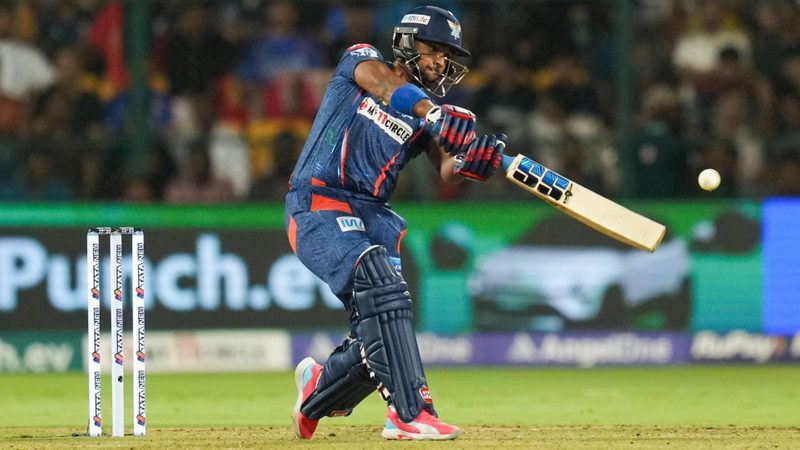
Nicholas Pooran holds the record for the most runs in a calendar year in T20 cricket: 2,331 in 2024, from 76 matches at an average of 40.89 and a strike rate of 157.39, with 170 sixes. Only one other batter has passed 2,000 in a year, Mohammad Rizwan with 2,036 in 2021.
The figures below count every T20 a player appeared in that year, so internationals, franchise leagues and domestic cricket all go into one total. That is why the list is dominated by players who spend the whole year on the T20 circuit. All numbers are from ESPNcricinfo’s records and run to 7 October 2026, so the 2026 totals are still growing.
Most runs in a calendar year in T20s: the top 15
| Player | Year | Runs | Ave | SR |
|---|---|---|---|---|
| Nicholas Pooran | 2024 | 2,331 | 40.89 | 157.39 |
| Mohammad Rizwan | 2021 | 2,036 | 56.55 | 132.03 |
| Reeza Hendricks | 2024 | 1,970 | 32.29 | 132.03 |
| Alex Hales | 2022 | 1,946 | 34.14 | 155.68 |
| Nicholas Pooran | 2025 | 1,918 | 39.95 | 149.26 |
| Sahibzada Farhan | 2025 | 1,847 | 41.04 | 152.26 |
| Jos Buttler | 2023 | 1,833 | 35.25 | 141.65 |
| Mohammad Rizwan | 2022 | 1,817 | 50.47 | 126.88 |
| Babar Azam | 2021 | 1,779 | 48.08 | 131.38 |
| Shai Hope | 2025 | 1,733 | 38.51 | 128.37 |
| Chris Gayle | 2015 | 1,665 | 59.46 | 164.52 |
| Tim Seifert | 2025 | 1,645 | 33.57 | 148.86 |
| Ishan Kishan | 2026* | 1,644 | 39.14 | 173.05 |
| Shan Masood | 2022 | 1,643 | 36.51 | 132.50 |
| Virat Kohli | 2016 | 1,614 | 89.66 | 147.12 |
* 2026 to 7 October.

Nicholas Pooran: 2,331 in 2024, 1,918 in 2025
Pooran is the only batter with two years in the top five. His 2024 had one hundred and 15 fifties, and his 170 sixes are the most of any year on the list; Chris Gayle’s 135 in 2015 are next. He followed it with 1,918 runs and 121 sixes in 2025.
Mohammad Rizwan: 2,036 in 2021
Rizwan’s 2021 was the record until Pooran passed it: 2,036 runs in 48 matches at 56.55, with a hundred and 18 fifties. He made 281 runs at the T20 World Cup that year as Pakistan reached the semi-finals. He added 1,817 in 2022, which is eighth on the list.
Reeza Hendricks and Alex Hales
Hendricks made 1,970 runs in 71 matches in 2024, third on the list. Hales made 1,946 in 2022 at a strike rate of 155.68, the year England won the T20 World Cup in Australia. His unbeaten 86 off 47 balls in the semi-final, in an unbroken stand of 170 with Jos Buttler, beat India by 10 wickets.
2025: the busiest year yet
Nine batters made 1,500 or more T20 runs in 2025, more than in any other year. Pakistan opener Sahibzada Farhan made 1,847 with four hundreds and a top score of 162 not out, Shai Hope 1,733 and Tim Seifert 1,645.
Gayle and Kohli
Chris Gayle’s 1,665 in 2015 came at a strike rate of 164.52, with three hundreds. Virat Kohli’s 1,614 in 2016 came from only 31 matches, and his average of 89.66 that year is still the highest of any 1,500-run year.
Most runs in a calendar year in T20s by Indian players
Ishan Kishan now has the most T20 runs by an Indian in a calendar year: 1,644 in 2026 so far, at a strike rate of 173.05. That took him past Kohli’s 1,614 from 2016, which had stood as the Indian record for ten years. Abhishek Sharma made 1,602 in 2025 at 202.01, the fastest scoring of any 1,500-run year by anyone.
| Player | Year | Mat | Runs | SR |
|---|---|---|---|---|
| Ishan Kishan | 2026* | 45 | 1,644 | 173.05 |
| Virat Kohli | 2016 | 31 | 1,614 | 147.12 |
| Abhishek Sharma | 2025 | 41 | 1,602 | 202.01 |
| Suryakumar Yadav | 2022 | 41 | 1,503 | 175.99 |
| Abhishek Sharma | 2026* | 45 | 1,395 | 205.44 |
| Suryakumar Yadav | 2023 | 34 | 1,338 | 166.41 |
* 2026 to 7 October. Indian internationals with 1,300 or more runs in a year.
2026 so far
Four batters are past 1,500 for 2026 with almost three months left: Kishan 1,644, Mitchell Marsh 1,544, Jos Buttler 1,523 and Tim Seifert 1,522. Buttler now has four 1,500-run years, more than anyone else.
More T20 records: every batter with 10,000 T20 runs and the most T20 hundreds by Indian players. Following the big hitters this season? See our guide to cricket betting sites.
Stats: ESPNcricinfo, all T20 matches, to 7 October 2026. Photo credit: Imago