








What is the follow-on in cricket? The Test rule, and how often captains actually use it
The follow-on lets a side that leads by 200 runs send the opposition straight back in. Here is Law 14 in full, and what 822 Tests say about how often captains actually take the option.
Jun 19, 2021 · Updated Aug 25, 2026
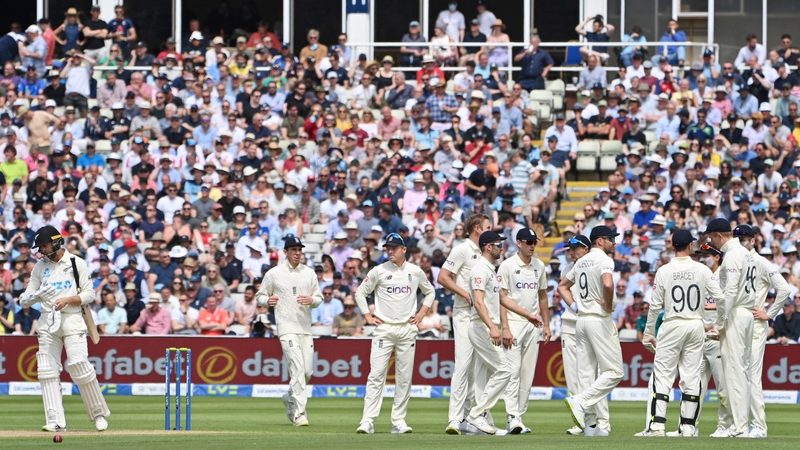
The follow-on is the rule that lets the side batting first make the opposition bat again straight away, instead of taking its own second innings. In a Test match, the option only exists if the side batting first finishes at least 200 runs ahead on the first innings. It is an option, not an obligation, and the captain who holds it turns it down about half the time.
That last part is the bit most explanations skip. To find out how often the follow-on is actually used, we counted every men’s Test in the Cricsheet ball-by-ball archive from 2006 to 15 August 2026, which is 822 matches. The follow-on was available in 157 of them. It was enforced in 77 and declined in 80.
What is the follow-on in cricket?
A Test match is played over two innings each. Normally the four innings alternate: side A bats, side B bats, side A bats again, side B bats again. The follow-on breaks that order. If side B is bowled out far enough behind, side A can send them straight back in, so side B bats innings two and three back to back and side A bats last.
The point of doing it is time. A Test lasts five days and a large share of them are drawn because the clock runs out. Making the trailing side bat again immediately removes an entire innings from the schedule and leaves the leading side needing ten wickets rather than ten wickets plus a declaration plus a chase. It is also the only route to a win by an innings, because a side that bats twice cannot win by an innings by definition.
How many runs do you need to enforce the follow-on?
Law 14 of the MCC Laws of Cricket sets the minimum lead, and it scales with the length of the match rather than being fixed at 200.
| Length of match | First-innings lead required |
|---|---|
| 5 days or more (Test cricket) | 200 runs |
| 3 or 4 days (most first-class cricket) | 150 runs |
| 2 days | 100 runs |
| 1 day | 75 runs |
The threshold is a lead of “at least” that figure, so 200 exactly is enough in a Test. The arithmetic runs off the first-innings totals only. If side A makes 503, side B avoids the follow-on by reaching 304, because 503 minus 200 is 303 and the deficit has to stay under 200.
That example is not hypothetical. India declared on 503 for 9 in the second Test against Sri Lanka at the SSC in Colombo, and when rain ended the third day on 25 August 2026 Sri Lanka were 265 for 8, still 39 runs short of the 304 they needed with two wickets left.
What happens if the first day is washed out?
This is the part of Law 14 that gets misreported, and it matters more than it sounds. If no play at all takes place on the first day, the thresholds apply according to the number of days remaining from the day play actually starts, and that day counts as a full day however late it begins. A five-day Test that loses its entire first day is therefore a four-day match for this purpose, and the lead required drops from 200 to 150.
Losing part of the first day changes nothing. It is a total washout of the opening day that moves the number, and a second lost day would move it again.
Can a captain change his mind after enforcing it?
No. Law 14 requires the captain to tell the opposing captain and the umpires that he is taking up the option, and once that notification is given the decision cannot be reversed. There is no walking it back after a session goes badly.
How often is the follow-on actually enforced?
Rarely enough that the rule now works more as a threat than an instruction. Across the 157 occasions since 2006 when a side led by 200 or more and the second innings had ended, the follow-on was enforced 77 times, or 49 per cent. The trend inside that number is the real story.
| Period | Chances | Enforced | Rate |
|---|---|---|---|
| 2006 to 2010 | 37 | 23 | 62.2% |
| 2011 to 2015 | 37 | 18 | 48.6% |
| 2016 to 2020 | 49 | 20 | 40.8% |
| 2021 to 2026 | 34 | 16 | 47.1% |
Captains in the late 2000s enforced nearly two chances in three. The rate then fell for a decade and has settled slightly under one in two. Fast-bowling workloads and higher scoring rates are the usual explanations offered, and this data cannot separate one from the other. What it does show is that the drop is real and that it happened between 2010 and 2020.
The 200-run threshold is not the number captains use
Split the same 157 chances by how big the lead was and the decision looks nothing like a rule with one cutoff. It looks like a rule with a cutoff at 200 that captains privately observe at around 300.
| Size of lead | Chances | Enforced | Rate |
|---|---|---|---|
| 200 to 249 | 57 | 15 | 26.3% |
| 250 to 299 | 30 | 10 | 33.3% |
| 300 to 399 | 50 | 34 | 68.0% |
| 400 or more | 20 | 18 | 90.0% |
A lead in the 200s, which is exactly the situation the law was written for, produces an enforcement barely a quarter of the time. Push the lead past 300 and it flips: two thirds of those get enforced, and at 400 or more it is nine in ten. Captains treat the legal minimum as a long way short of the practical one.
Does enforcing the follow-on help you win?
On the raw numbers, no, and that is the finding that surprised us most. The side that declined won 92.5 per cent of the time. The side that enforced won 83.1 per cent of the time.
| Decision | Chances | Led side won | Drawn | Led side lost |
|---|---|---|---|---|
| Enforced | 77 | 64 (83.1%) | 12 (15.6%) | 1 |
| Declined | 80 | 74 (92.5%) | 6 (7.5%) | 0 |
The obvious objection is that leads are not equal, and it is a fair one. Bigger leads get enforced more often, so enforcement should carry an advantage rather than a penalty. It does not. Hold the lead constant and the gap survives in the two bands with enough matches to mean anything. With a lead of 200 to 249, sides that enforced won 10 of 15; sides that declined won 40 of 42. With a lead of 300 to 399, enforcing won 27 of 34 and declining won 15 of 16.
The mechanism is the draw column, not defeat. Enforcing almost never loses you a Test. What it does is hand the trailing side one long, uninterrupted opportunity to bat time on a pitch that is a day fresher than the one they would face if they were chasing, while your own bowlers work through a second innings on tired legs. Twelve of the 77 enforcements ended drawn against six of the 80 declines.
Two caveats belong on this, and they cut against reading it as advice. Captains do not choose at random: a captain who enforces on a flat pitch with rain forecast has picked a harder job than the number alone shows, and some of the gap is that selection rather than the decision. And enforcing is the only way to win by an innings. Fifty-three of the 77 enforcements produced an innings victory, against none of the 80 declines, because a side that bats twice cannot win by one.
Which teams enforce the follow-on most?
Australia have had more chances than anyone and used fewer of them than anyone.
| Team | Chances | Enforced | Rate |
|---|---|---|---|
| England | 27 | 18 | 66.7% |
| South Africa | 20 | 13 | 65.0% |
| New Zealand | 16 | 10 | 62.5% |
| India | 28 | 16 | 57.1% |
| Sri Lanka | 12 | 6 | 50.0% |
| Pakistan | 9 | 3 | 33.3% |
| West Indies | 8 | 2 | 25.0% |
| Australia | 33 | 8 | 24.2% |
Thirty-three opportunities and eight enforcements is a settled policy rather than a run of individual calls, and Australian captains have been open about where it came from. It is hard to look at that number without thinking of Kolkata in 2001.
Teams that won a Test after following on
It has happened four times in nearly 150 years of Test cricket, which is why it carries the weight it does.
| Year | Match | Venue | Margin |
|---|---|---|---|
| 1894 | England beat Australia | Sydney | 10 runs |
| 1981 | England beat Australia | Headingley, Leeds | 18 runs |
| 2001 | India beat Australia | Eden Gardens, Kolkata | 171 runs |
| 2023 | New Zealand beat England | Basin Reserve, Wellington | 1 run |
Australia are on the wrong end of three of the four. Kolkata is the one that changed behaviour: Steve Waugh enforced with a lead of 274, VVS Laxman and Rahul Dravid batted through the fourth day, and Australia were bowled out on the fifth. Wellington in 2023 is the most recent and the narrowest result in the list, and it is also the only defeat after enforcement anywhere in our 157-match sample. One loss in 77 enforcements is the honest measure of the risk. It is small. It is also the reason the option gets declined.
Follow-on questions readers ask
What does follow-on mean in simple terms? Batting twice in a row. If you are bowled out far enough behind, the other captain can make you start your second innings immediately instead of taking his own.
How many runs behind is a follow-on? 200 in a Test, 150 in a three or four-day match, 100 in a two-day match and 75 in a one-day match. The trailing side avoids it by getting the deficit under that figure.
Is the follow-on compulsory? No. It is an option for the captain of the side that leads, and since 2006 it has been turned down slightly more often than it has been taken.
Does the follow-on exist in ODIs or T20s? No. Both are single-innings formats, so there is no second innings to bring forward. It applies to two-innings cricket only, which means Tests and first-class matches.
What happens if a captain declines it? The normal order resumes. The leading side bats again, usually to set a target large enough that the opposition cannot chase it, and then tries to bowl them out in the time left.
Can a side declare and still enforce the follow-on? Yes. The lead is what matters, not how the first innings ended, which is why a declaration at 503 for 9 still puts the follow-on on the table.
For more on how the rest of the format works, our explainers on the Decision Review System and the LBW law cover the two rules that decide most Test dismissals, and the Test cricket records page collects the biggest numbers the format has produced, including the leading run scorers and the leading wicket takers.
Enforcement figures derived from the Cricsheet ball-by-ball archive, covering 822 men’s Tests from 2006 to 15 August 2026.
Featured photo: Paul Ellis / AFP