








How many players are there in kabaddi? Team sizes and full court measurements
Standard style kabaddi puts seven players on the mat from a squad of twelve. Circle style uses eight, lambi fifteen and beach kabaddi four, and every form has a court sized to match.
Nov 29, 2021 · Updated Aug 5, 2026
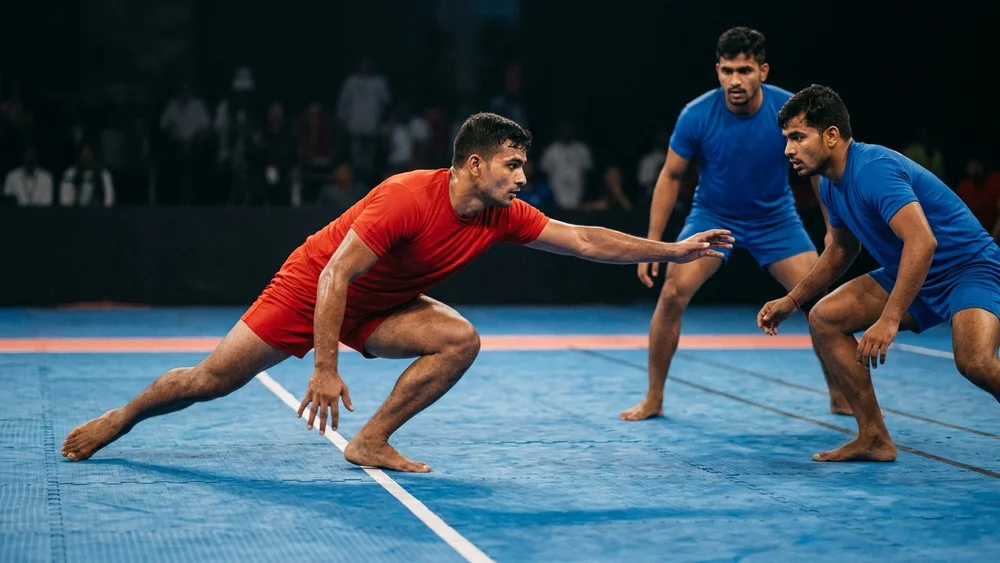
Seven. That is the number most people arrive looking for, and it holds for nearly every kabaddi match you will see televised: seven players a side on the mat at any moment, drawn from a squad of twelve. The court they play on measures 13 metres by 10 for men and 12 metres by 8 for women.
The question keeps getting asked because the answer stops being seven the moment you step outside the standard version of the sport. Circle style kabaddi, the form played across Punjab and at its own World Cup, puts eight on the field. Lambi kabaddi puts fifteen. Saunchi sets no limit at all. Beach kabaddi cuts it to four. Below are the numbers for every form, along with the full set of court measurements that go with them.
How many players are in a kabaddi team?
| Form of kabaddi | Players on the field | Squad |
|---|---|---|
| Standard style (Pro Kabaddi, World Cup, Asian Games) | 7 | 12 |
| Circle style (Punjabi kabaddi) | 8 | 14 |
| Lambi kabaddi | 15 | No fixed squad |
| Saunchi and goongi kabaddi | No fixed limit | No fixed squad |
| Beach kabaddi | 4 | 6 |
Standard style is the one that governs the sport internationally, and it is the format used by the Kabaddi World Cup, the Asian Games and the Pro Kabaddi League. Seven players from each side occupy the mat. Five more sit in the substitutes area and can be brought on during the match, which is where the squad of twelve comes from.
The number permitted on the mat never changes. A side reduced by a red card simply plays on short, because a red-carded player cannot be replaced: the offence costs a technical point to the opposition and the player takes no further part, leaving their team to finish with whoever is left.
The seven positions on a kabaddi mat
The seven are not interchangeable. Defensive units are built in a recognised shape, and the vocabulary is worth knowing because commentary assumes it.
Right and left corner. The two furthest positions on either side of the mat, occupied by the primary defenders. Corners usually initiate the tackle, and a team’s best ankle-holds tend to live here.
Right and left cover. The covers support the corners in a chain tackle and are the players who most often launch the dash at a raider from the side.
Right-in and left-in. Positioned next to the corners, the ins assist the corners and covers in completing a tackle rather than starting one.
Centre. Usually the lead raider, and usually the player least involved in defending. The centre sits in the middle of the formation and is generally kept out of the tackle so the team’s main attacking option is not lost early.
There is no rule dictating how many raiders and how many defenders a side must field. Teams pick whatever combination suits them, which is why the balance between raid-heavy and defence-heavy line-ups is a genuine tactical choice rather than a fixed template. Our guide to kabaddi skills and moves covers what each of these players actually does in a raid.
Kabaddi court measurements
The court is not one size. It changes by age group and by gender, and every marking on it moves with the court rather than staying at a fixed distance. This is the full set.
First the size of the playing area, where each half runs from the midline to the end line.
| Category | Length | Width | Each half |
|---|---|---|---|
| Men and junior boys | 13m | 10m | 6.5m |
| Women and junior girls | 12m | 8m | 6m |
| Sub-junior boys and girls | 11m | 8m | 5.5m |
Then the markings inside it. The baulk line is measured out from the midline, the bonus line from the baulk line, and the last column is the gap from the bonus line back to the end line.
| Category | Lobby | Baulk line | Bonus line | Bonus to end line | Sitting block |
|---|---|---|---|---|---|
| Men and junior boys | 1m | 3.75m | 1m | 1.75m | 8m x 1m |
| Women and junior girls | 1m | 3m | 1m | 2m | 6m x 1m |
| Sub-junior boys and girls | 1m | 3m | 1m | 1.5m | 6m x 1m |
In feet, the men’s court is roughly 43 by 33, and the women’s roughly 39 by 26. Adding the baulk distance to the bonus gap gives the bonus line’s position from the middle of the court: 4.75 metres on a men’s court, and 4 metres on every other one.
Two numbers sit outside the court itself. The playing lines should be marked 3cm to 5cm wide, and the ground the court is laid on should measure 20 metres by 20, with 17 metres by 18 treated as the minimum. That surrounding margin is not decoration. Raiders are thrown out of the court at speed, and the run-off is what stops a tackle ending in the front row.
What every line on a kabaddi court is for
Midline. Splits the court into two halves, one per team. A raider crosses it to enter enemy territory, and getting back across it is what makes a raid successful.
Baulk line. The line a raider must reach for the raid to count as a legitimate attempt. On a men’s court it sits 3.75 metres from the midline, on a women’s or junior court 3 metres. If defenders touch the raider before the baulk line is crossed, the rules on what happens next change, which is why so much of the tactical fencing in a raid happens either side of it.
Bonus line. One metre beyond the baulk line. A raider who puts one foot past it while the other foot is off the ground, and then gets home safely, earns an extra point. The bonus is only available when the defending side has six or more players on the mat, so against a depleted defence there is nothing on offer, which is why raiders stop chasing it once a defence has been thinned out.
Lobbies. The one-metre strips down each side. They are out of play until a tackle is made, at which point they come into play and become the widest part of the mat. That switch is the single most misunderstood rule in the sport among new viewers.
End line. The back boundary of each half.
Sitting block. The marked rectangle where substitutes and players who are out wait their turn, set 2 metres back from the end line. It measures 8 metres by 1 for men and junior boys, and 6 metres by 1 for every other category.
A quick way to check a court is marked correctly
The measurements are not a loose collection of numbers. Within each category they have to add up, and that gives anyone marking out a court a way to check the job before the first raid.
Take the men’s court. From the midline to the baulk line is 3.75 metres, the bonus line adds another metre, and from the bonus line to the end line is 1.75 metres. Added together that is 6.5 metres, which is exactly half of the 13-metre court. The women’s court does the same thing: 3 plus 1 plus 2 gives 6 metres, half of 12. So does the sub-junior court, where 3 plus 1 plus 1.5 gives 5.5 metres, half of 11.
If those three figures do not sum to half the court length, a line is in the wrong place. It is worth running the check, because published kabaddi court diagrams disagree with each other more than you would expect, and a fair number of them fail this test.
How many players in circle style kabaddi?
Circle style, also called Punjabi kabaddi, is a genuinely different sport rather than a regional tweak, and it fields eight players a side from a roster of fourteen. It is played on a circular pitch 22 metres in diameter, with an inner circle and a line through the middle. Raids are one against one, and nobody leaves the field, so there is no equivalent of the out-and-revival cycle that drives standard style scoring.
Circle style has its own World Cup, which is separate from the standard style tournament. If the distinction is new to you, we have a fuller explanation of how the two World Cups differ.
Beneath circle style sit the older Punjabi village forms, and they are where the player counts get loose.
Lambi kabaddi fields fifteen a side on a small circular pitch of roughly 15 to 20 feet, and there is no outer boundary at all. The raider chants throughout the attack and runs as far as the chase takes them.
Saunchi kabaddi sets no limit on numbers. It plays closer to boxing than to the mat game: the raider has to strike the defender on the chest, the defender has to catch the raider by the wrist, and grabbing any other part of the body is a foul. If the defender holds on, the defender wins the bout. If the raider makes contact and gets away, the raider does. A bamboo pole with red cloth is planted in the ground and paraded by the winner.
Goongi kabaddi also has no fixed limit, and takes its name from the silence. The raider does not chant the word kabaddi at all, and simply touches an opponent.
Beach kabaddi puts four on the sand
Beach kabaddi, contested at the Asian Beach Games, runs a squad of six with four players on the sand and two in reserve. The scoring is stripped down to suit the surface. Out and revival do not apply, so only points count, and every raid has to be productive, meaning it must end in a scoring point, a technical point, a self-out or the raider being caught. Matches run 30 minutes, in two halves of 15 with a five-minute interval.
What the Pro Kabaddi League uses
The Pro Kabaddi League plays standard style on standard dimensions, so the numbers above are the ones you are watching. Seven on the mat, five substitutes, a 13 metre by 10 metre playing surface and a field of play that runs between 17 by 18 and 20 by 20 metres. Match length is 40 minutes for men, split into two halves of 20 with a five-minute break, and each side gets two timeouts a half of 30 seconds each.
Women’s and junior girls’ matches, along with sub-junior matches of both genders, are shorter at 30 minutes, played as two halves of 15.
Frequently asked questions
How many players are there in kabaddi? Seven on the mat in standard style kabaddi, from a squad of twelve. Circle style uses eight, lambi fifteen, and beach kabaddi four.
How many substitutes does a kabaddi team have? Five in standard style. A player sent off with a red card cannot be substituted, so that team continues with fewer players.
What is the size of a kabaddi court? 13 metres by 10 for men and junior boys, 12 metres by 8 for women and junior girls, and 11 metres by 8 for sub-junior boys and girls.
How far is the baulk line from the midline? 3.75 metres on a men’s court, and 3 metres on women’s, junior girls’ and sub-junior courts.
How far is the bonus line from the baulk line? One metre, in every category.
How wide is the lobby in kabaddi? One metre on each side, in every category. The lobbies stay out of play until a tackle happens.
How big should the ground be around a kabaddi court? 20 metres by 20 is the recommended size, and it should not be smaller than 17 metres by 18.
How long is a kabaddi match? 40 minutes for men and junior boys, as two 20-minute halves with a five-minute interval. Women, junior girls and sub-juniors play 30 minutes, as two halves of 15.
If you are new to the sport and want the rules rather than the dimensions, start with our explainer on how to play kabaddi, or read how the game grew from village grounds into a professional league.