







Kabaddi, one of India’s indigenous sports, has grown in popularity over the last few years, thanks to the advent of leagues like Pro Kabaddi. India remain the sport’s leading nation: at the 2026 Asian Games in Aichi-Nagoya, India won both the men’s and the women’s gold medals, beating Iran in both finals.
Since the advent of Pro Kabaddi, the sport once regarded as a game of brute physical strength has been revolutionised, with a larger focus on player fitness, agility, temperament and strategy.
Along with these innovations, kabaddi has also had numerous transformations in terms of how the sport is played today as opposed to yesteryear.
Here we have a closer look at how the contact sport is played in today’s day and age.
How to play kabaddi
Two teams, with seven players each on the court, face off on a rectangular mat, which is divided into two equal halves by the midline.
A player from the attacking team goes into the opposite half, tries to touch as many opponents as possible and returns to their own half to score points. This play is called a raid and the attacking player is called a raider. In Pro Kabaddi each raid can last a maximum of 30 seconds, and the raider has to keep chanting the word ‘kabaddi’ throughout.
All the players that the raider touches before returning to his side are declared out and sent outside the playing area. They can only be revived when their team scores points.
Meanwhile, the defending team scores a point by stopping the raider through a tackle before he gets back to his own half.
Teams take turns to raid, and the side with the most points at the end of the match wins.
If all seven players of a side are out, the team is declared ‘all out’ and the entire squad returns to the mat. The team that inflicts the all-out earns two extra points.
Rules of kabaddi
While the rules for traditional kabaddi played on mud in rural parts of India vary, modern competitive kabaddi follows a standard blueprint used by leagues and tournaments like Pro Kabaddi, the Kabaddi World Cup and the Asian Games. The measurements below are from the rules of the World Kabaddi Federation (WKF); Pro Kabaddi adds a few rules of its own, which are marked.
Kabaddi court: size of the playing area
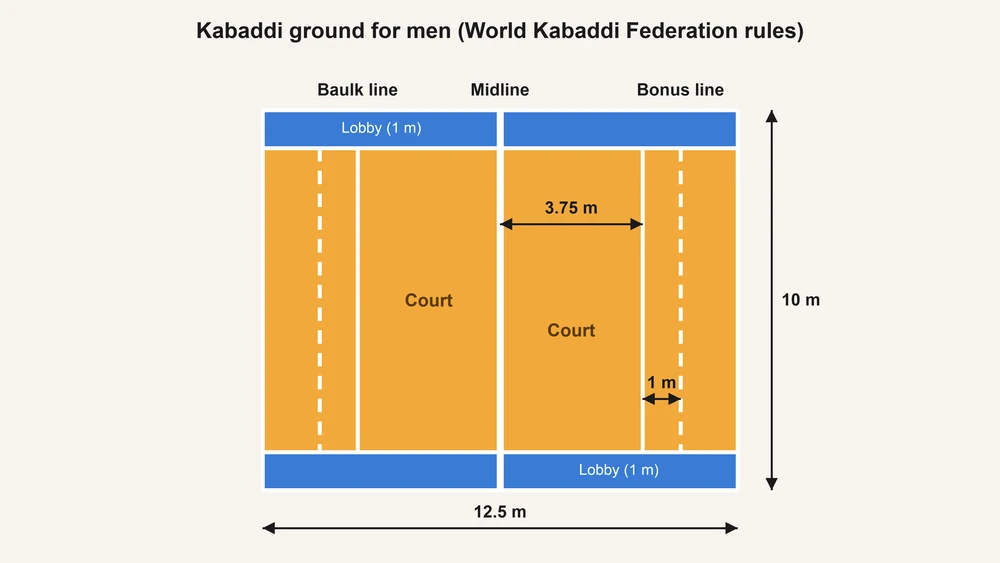
Under the WKF rules, the ground for men measures 12.5 metres x 10 metres, made up of two halves of 6.25m x 10m. That includes a 1m-wide strip on each side, called the lobby, so the play-field inside the lobbies is 12.5m x 8m. For women, the ground is 11 metres x 8 metres (two halves of 5.5m x 8m), with the same 1m lobbies. The measurements may vary slightly between competitions. The midline divides the playing area into two halves, marking each team’s territory, and raiders must cross it to start a raid.
Baulk line
The baulk line runs parallel to the midline, 3.75 metres from it in each half for men and 3 metres for women. A raider has to cross the baulk line for the raid to count. Only after that can the raider attempt to score points.
Bonus line
The bonus line is drawn 1 metre beyond the baulk line, towards the end line. It is only active when there are six or more defenders on the mat. To earn a bonus point, a raider must cross the bonus line with one foot while the other is in the air, and then get back to his half without being caught. A bonus point does not revive an out player.
Lobby
The lobby is the differently coloured strip on each side of the court. It comes into play only once the raider and the defenders have made contact with each other (called a struggle). After contact, the raider can use the lobby to aid his escape, and the defenders can use it to tackle the retreating attacker.
However, if players enter the lobby without any contact, they are out of the playing area and have to leave the mat until they are revived.
Duration of a kabaddi match
A men’s kabaddi match lasts 40 minutes, two halves of 20 minutes each, with a break of no more than five minutes; teams switch sides at half-time. Under the WKF rules, women’s matches are shorter, at two halves of 15 minutes.
What happens in a tie: the tie-breaker and Golden Raid
Under the WKF rules, a tied league match is a draw, but a tied knockout match goes to a tie-breaker:
- Both teams field the seven players who were on court at the end of the match.
- Each team gets five raids, by five different raiders, raiding alternately.
- The bonus line is no longer used; the baulk line counts as the bonus line instead.
- The out and revival rules do not apply, so only points scored count.
If the scores are still level after the five raids each, the WKF rules go to sudden death: the teams keep raiding alternately for five minutes, and the side that takes the lead after an equal number of raids wins.
Pro Kabaddi: since Season 12 (2025), Pro Kabaddi uses the same five-raid tie-breaker in every match that ends level, including league matches, so there are no more draws. If it is still tied after five raids each, the match goes to a Golden Raid: a fresh toss decides which team gets the decisive raid. If the teams are still level after the Golden Raids, the winner is decided by a toss.
How many players in kabaddi
Each team has seven players on the mat. Under the WKF rules a squad has 10 to 12 players, with three to five named as reserves. Substitutions can only be made during time-outs and at half-time, up to five players at a time, and players who are out or suspended cannot be substituted.
Kabaddi point scoring system
A raider has to touch a defender in the opposition half and then safely get back to his half to score. Each defender he touches is worth one point, and each of those defenders has to leave the mat.
A raider can also score a bonus point, as mentioned earlier, by crossing the bonus line with one foot in the air when six or more defenders are on the mat.
If the defenders tackle the raider before he gets back to his half, the defending team earns a point and the raider is out.
Every touch point or tackle point revives one out player, in the order in which they were dismissed. A raider revives as many players as the touch points he scores, while a tackle revives only one player. Bonus points and all-out points do not revive anyone.
Empty raid
If the raider returns without scoring any points, it is called an empty raid.
Do-or-die raid
In Pro Kabaddi, when a team has had two empty raids in a row, its third raid is a do-or-die raid. The raider has to score a point; if he doesn’t, he is out and the defending team gets a point.
All-out
When a team gets all the players of the opposition out, it earns two extra points, in Pro Kabaddi and under the WKF rules alike, where an all-out is called a lona. All seven players of the team that suffered the all-out then return to the mat.
Super Raid
In Pro Kabaddi, if a raider touches three or more defenders in a single raid and gets back, it is called a Super Raid. Touching two defenders and also scoring a bonus point counts as a Super Raid too.
Super Tackle
In Pro Kabaddi, if the defending team tackles a raider while it has three or fewer defenders on the mat, it is called a Super Tackle and is worth two points instead of one. The extra point does not revive a player.