








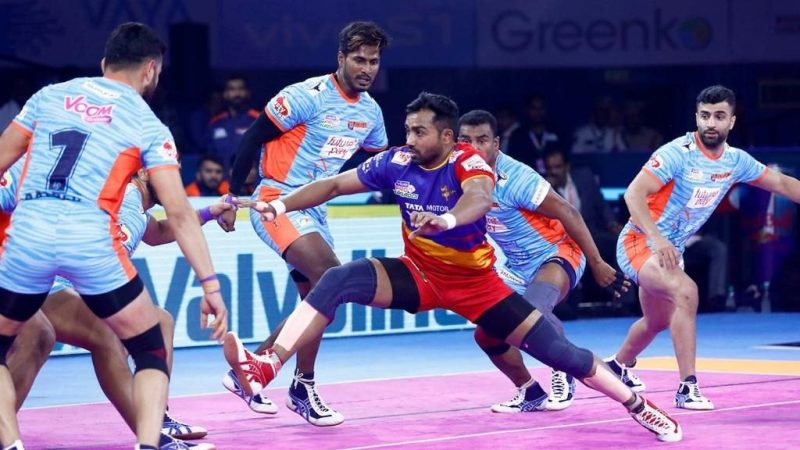
The roots of kabaddi go back some 4,000 years in the Indian subcontinent, but for most of that time it stayed a village game, played on mud and known by a different name in almost every region.
The launch of Pro Kabaddi in 2014 turned that rural game into prime-time television, and India have kept winning at the top level: on 26 September 2026 the men’s and women’s teams both beat Iran to win gold at the Asian Games in Aichi-Nagoya.
Kabaddi is said to have started as a form of practicing combat moves for battles and wars in ancient times.
“It is believed that kabaddi was invented to develop defensive responses by an individual against group attacks and group’s responses to an individual attack,” according to the World Kabaddi Federation. In fact, the game of kabaddi starts with a single raider going into the opponent’s side, which comprises seven defenders.
“This is the only combative sport in which offence is an individual effort whereas defence is a group effort,” the WKF pointed out.
Kabaddi history in the Mahabharata
Deeply rooted in Indian culture, kabaddi is often linked to the Sanskrit epic Mahabharata. Popular tellings say the Pandava warrior Arjuna learned its skills from Lord Krishna and could slip through enemy lines and return unharmed.
T 1568 -It is said that the sport of #Kabaddi was created in remembrance of Abhimanyu the Warrior from Mahabharta ! #BachchanBol #Wednesday
Amitabh Bachchan (@SrBachchan), August 5, 2014
Another tale from the Mahabharata involves Arjuna’s son, Abhimanyu, who invaded the seven-tiered defence — an army formation — of the Kauravas. It draws sporting parallels to a single raider raiding in the opposition side of the mat, which often has seven defenders.
There are also literary accounts of Krishna and of Siddhartha Gautama, the Buddha, playing an early form of the game.
Kabaddi’s origin: India or Iran?
A popular belief is that kabaddi began in what is now Tamil Nadu, and the name itself may come from the Tamil words kai and pidi, “to hold hands”. The game went by many names across the subcontinent: sadugudu in Tamil Nadu, chedugudu in Andhra Pradesh, hu-tu-tu in western India, ha-du-du in Bengal and Bangladesh, and jabarjang in Punjab.
Some argue that the sport originated in Iran about 5,000 years ago. “My hometown, Sistan, was where it was first found,” claimed Meraj Sheykh, a notable kabaddi player from Iran.
“Several ancient books spoke about it too. We were the original founders of the game, not India,” Meraj told ESPN, though he added: “India has popularized the game and has increased its outreach.”
Modern kabaddi took shape in the 1920s. The first set of rules was drawn up in Maharashtra in 1921 and revised in 1923. Kabaddi is the national game of Bangladesh, and a state sport in several Indian states, but India has no official national sport.
The first national tournament was held in Baroda (now Vadodara) in 1923, and in 1938 kabaddi was part of the All-India Olympic Championships in Calcutta, the forerunner of the National Games.
Kabaddi in Olympics and Asian Games
Kabaddi got its first international exposure at the 1936 Olympics in Berlin. It was not an official Olympic event: a 35-member contingent from Hanuman Vyayam Prasarak Mandal (HVPM), a physical education institute in Amravati, was invited by the organisers to put on an exhibition of kabaddi, kho kho and mallakhamb alongside the Games.
The displays went down well, and the HVPM contingent was given an honorary medal.
The All India Kabaddi Federation (AIKF) was set up in 1950 and began holding annual national championships for men from 1952 and for women from 1955. In between, kabaddi was a demonstration sport at the first Asian Games, in New Delhi in 1951.
The Amateur Kabaddi Federation of India (AKFI) was formed in 1972, the same year Bangladesh made kabaddi its national game. The first Asian Kabaddi Championship followed in Calcutta in 1980, and India beat Bangladesh in the final to become the first champions. India have since won eight of the nine men’s editions.
Kabaddi was a demonstration sport again at the 1982 Asian Games in New Delhi and became a medal sport at the 1990 Games in Beijing. India won the first seven men’s gold medals. The run ended in 2018 in Jakarta, when Iran knocked India out in the semi-finals and beat South Korea 26-16 in the final. India took the gold back in Hangzhou in 2023 (the 2022 Games), beating Iran 33-29, and kept it at Aichi-Nagoya in 2026 with a 40-34 win over Iran: nine golds in ten editions.
The women’s event joined the Asian Games in 2010. India won in 2010 and 2014, lost the 2018 final 27-24 to Iran, then beat Chinese Taipei 26-25 in 2022 and Iran 37-34 in 2026: four golds in five editions.
Kabaddi World Cup offers glory
The International Kabaddi Federation (IKF) staged the first Kabaddi World Cup in Mumbai in 2004.
Twelve teams took part, and India beat Iran 56-28 in the final to become the first world champions.
#Throwback to when @IamAnupK & Co. led Team to victory in the 2016 Kabaddi World Cup #OnThisDay 3⃣ years ago.
Star Sports (@StarSportsIndia), October 22, 2019
The IKF has held three men’s World Cups (standard style), all in India: Mumbai in 2004, Panvel in 2007 and Ahmedabad in 2016. India beat Iran in all three finals. The first Women’s Kabaddi World Cup was held in Patna in 2012, where India beat Iran in the final, and India also won the second edition, in Dhaka in 2025, against Chinese Taipei.
Pro Kabaddi takes it to the masses
The real breakthrough came in 2014. Pro Kabaddi took a rural pastime to prime-time television across the country, and twelve seasons have now been played (2014 to 2025) with eight different champions. Patna Pirates won three in a row, Jaipur Pink Panthers and Dabang Delhi K.C. have two titles each, and U Mumba, Bengaluru Bulls, Bengal Warriorz, Puneri Paltan and Haryana Steelers one each. Dabang Delhi are the current champions after winning Season 12 in 2025. The full list is on our Pro Kabaddi team owners page.
The league made stars of raiders such as Anup Kumar, Pardeep Narwal (the league’s all-time leading raid-point scorer), Rahul Chaudhari, Pawan Sehrawat, Naveen Kumar and Maninder Singh, and of defenders such as Manjit Chhillar, Ravinder Pahal, Sandeep Narwal and Fazel Atrachali, who holds the record for most tackle points.
A post shared by Pardeep Narwal (@pardeepnarwal.09) on Instagram
From a game played on village mud to a professional league and back-to-back Asian Games golds, kabaddi has come a long way, and India remain the team everyone else is chasing.
Feature image courtesy: Twitter / @ProKabaddi