






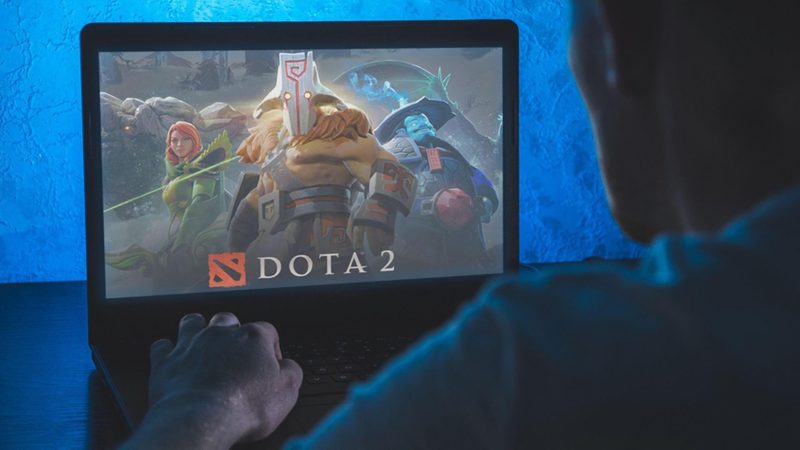
Developed by Valve Corporation, Dota 2 is a popular multiplayer online battle arena video game.
Playing this eSports game casually gives you a taste of what to expect, however, the best that Dota 2 has to offer is only experienced as you climb the ranks.
Your Dota 2 rank is tied to your Matchmaking Rank points (MMR), which is a numeric representation of your skill level that changes over time depending on your performances in the game.
In essence, MMR ensures that players with similar ranks compete against each other instead of having gamers with a large disparity in rankings or MMR squaring off, which makes for lopsided, unbalanced and unfair competition.
It’s worth noting that players are more self-aware of their surroundings once they climb up Dota 2’s ranking system.
But how exactly does this ranking system work? While Dota 2’s ranking system may look simple to experienced players who are familiar with games that have a modern rating system, it could prove to be more complex for newcomers.
With that in mind, here’s all you need to know to know about the Dota 2 ranking system.
Dota 2 Ranking System
Dota 2 no longer runs ranked seasons. The old six-monthly reset, where every medal was wiped and everybody recalibrated, is gone — Valve has not announced a ranked-season reset in any of its update posts between June 2022 and August 2026. Your MMR and your medal simply carry forward.
There is also no fixed amount of MMR won or lost per match any more. Valve changed that in the 7.33c patch of May 2023: the gain or loss now depends on how far apart the two teams are in rating, and in Valve’s own words the results for players with high rank confidence land “closer to +/-25 MMR”. Rank confidence is the game’s own measure of how sure it is that your rating is right — the surer it is, the smaller your swings per game.
There are a total of eight ranks in Dota 2, namely Herald, Guardian, Crusader, Archon, Legend, Ancient, Divine, and Immortal.
Each of the first seven medals has five stars; Immortal has none, and ranks players on a live leaderboard instead. Valve does not publish the MMR cut-off for any medal. The figures below are the community’s tracked estimates, working out at exactly 770 MMR per medal and about 154 per star from Herald through Ancient, with Divine a little wider and Immortal starting at roughly 5,620. They are the numbers every Dota 2 guide uses, but treat them as approximate rather than official:
- Herald ranks: – 0-769 MMR
- Guardian ranks: – 770-1539 MMR
- Crusader ranks: – 1540-2309 MMR
- Archon ranks: – 2310-3079 MMR
- Legend ranks: – 3080-3849 MMR
- Ancient ranks: – 3850-4619 MMR
- Divine ranks: – 4620-5619 MMR
- Immortal ranks: – 5620+ MMR
The one Immortal threshold Valve does state is for Immortal Draft, the mode where the two highest-rated players pick the teams. Valve raised the minimum to enter it from 5,620 to 6,500 MMR in May 2023, and again to 8,500 MMR in March 2025, which its patch notes describe as roughly the top 0.1 per cent of players.
In case, a player isn’t satisfied or happy with one’s Dota 2 MMR, he or she can reset it in just a few seconds.
If you feel you are in the wrong bracket, or you are returning after a long break, Dota 2’s recalibration option lets you have your rank worked out again from scratch. It is not unlimited: the button is only offered when you are eligible, and it disappears once used.
All you need to do to start your Dota 2 MMR calibration is go to the settings menu and click on the account tab.
Once you do the aforementioned step, a large blue Activate Recalibration button will be present under the MMR Recalibration section.
After pressing the button as mentioned above, the game will immediately start the recalibration process to find you a suitable match to face off against.
Two things worth knowing before you press it. Valve does not document how long the cool-down is or how many games the process takes, and the third-party guides that claim to know disagree with each other — so do not plan around a number you read somewhere. What the client does show you is your rank confidence, and that is the thing driving how fast your rating moves while you recalibrate.
Once the entire recalibration process has been completed, you will receive a new MMR value and medal. Your previous MMR still plays a large part in where you land, so recalibration is not a reset to zero and rarely moves anyone far.
Photo credit: Alamy