






Longest six in cricket history: what the lists claim, and what the tracking shows
Shahid Afridi’s 153-metre six tops almost every list, but cricket keeps no official distance record and the biggest numbers are projections rather than measurements. The evidence points somewhere else.
Apr 16, 2024 · Updated Aug 31, 2026
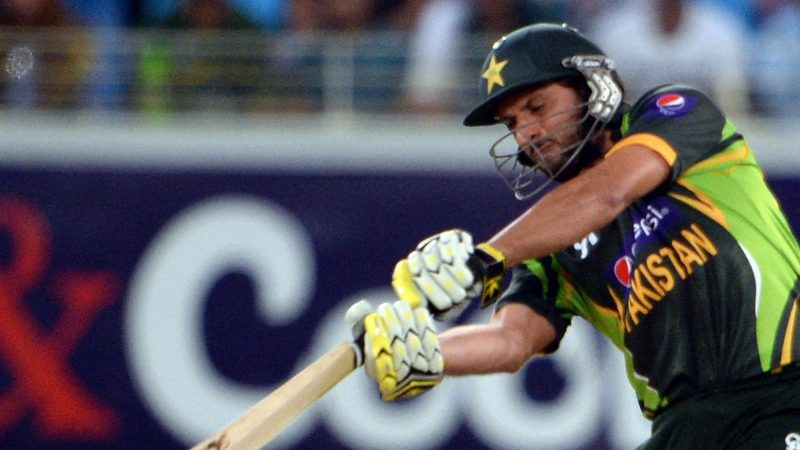
Ask who hit the longest six in cricket history and almost every list returns the same answer: Shahid Afridi, 153 metres, against South Africa in 2013. Some versions say 158. A few say 160. Those same lists then put Brett Lee second on anything between 130 and 143 metres.
That spread is the story. Cricket keeps no official record for the longest six, no governing body ratifies one, and hardly any of the famous distances was measured the way a long jump is measured. Here is the list as it is usually published, and then what the evidence actually supports.
Longest six in cricket history: the list everyone quotes
These are the international hits that appear on almost every version of this list, with the distance most commonly attached to each. Read the next section before treating any of them as a measurement.
| Player | Team | Opponent | Claimed distance | Venue | Year |
|---|---|---|---|---|---|
| Shahid Afridi | Pakistan | South Africa | 153m, also given as 158m and 160m | Johannesburg | 2013 |
| Brett Lee | Australia | West Indies | 130 to 135m, also given as 143m | Brisbane | 2005 |
| Martin Guptill | New Zealand | South Africa | 127m | Wellington | 2012 |
| Liam Livingstone | England | Pakistan | 122m | Leeds | 2021 |
| Corey Anderson | New Zealand | India | 122m | Napier | 2014 |
| Mark Waugh | Australia | New Zealand | 120m | Perth | 1997 |
Two things about that table are worth flagging straight away. The Mark Waugh six is dated 1999 almost everywhere, including on this page until now. It was the second Test at the WACA in November 1997, when he hit Daniel Vettori onto the top of the Lillee-Marsh stand. And Simon O’Donnell’s 122-metre hit at the MCG, which several lists file among the internationals, was nothing of the sort. It came in a Sheffield Shield match.
Why none of those numbers is a landing point
Here is the part the lists leave out, and it explains every discrepancy above.
When a broadcaster puts a distance on screen, ball-tracking systems are not reporting where the ball came to rest. They report the distance the ball would have travelled had nothing got in its way. A ball that slams into the roof of a stand 105 metres from the bat is still climbing and still moving forward, so the system models the rest of the arc and prints the projected total.
That mechanism is why the biggest sixes carry the biggest numbers. The hits that leave a ground are exactly the hits stopped early by a roof, a stand or a wall, which makes them the hits with the most projection and the least observation in them. A six that drops harmlessly into the seats gets reported far more honestly than one that disappears over the top.
Two further problems sit on top of that. Ball tracking only reached cricket around 2007, so everything earlier carries no tracked figure at all and was estimated from the commentary box. And when a ball genuinely clears the stadium, nobody outside is watching the right patch of pavement, which leaves the landing point to be reconstructed later from whatever anyone remembers.
What the physics allows
The Cricket Monthly, ESPNcricinfo’s long-form title, worked several of the famous hits back from stadium geometry using satellite imagery. Its conclusion is blunt. Clearing 120 metres is possible for an exceptional strike. Anything past 130 is, in its words, out of the question.
The supporting argument is a frequency one, borrowed from baseball, where hitting distances have been studied for decades. Verified hits thin out sharply as distance climbs, roughly by 80 per cent for every extra five metres. If genuine 140-metre sixes existed, 130-metre sixes would show up several times a season as a matter of arithmetic. They do not show up at all.
Shahid Afridi’s six, and the two hits that get mixed up
Afridi hit two enormous sixes in South Africa in 2013 and the lists have been merging them ever since. One came at Johannesburg, where the claimed figure runs as high as 160 metres. The other came at Bloemfontein, and that is the one usually labelled 158.
Neither survives contact with a map. Measured from the pitch to the point where the ball cleared the structure, the Johannesburg hit put the ball no more than about 100 horizontal metres from the bat, with an unimpeded maximum somewhere near 120. The Bloemfontein hit works out the same way. Both were colossal. Neither was 153 metres, and no version of the arithmetic gets either of them there.
The innings deserves remembering on its own merits. In the third ODI at the Wanderers on 17 March 2013, Hashim Amla made 122 and AB de Villiers 128 in a third-wicket stand of 238 as South Africa posted 343 for five. Afridi answered with 88 from 48 balls, seven of them sixes. Pakistan were bowled out for 309 and lost by 34.
Brett Lee at the Gabba, and the bat nobody mentions
Lee’s six off Daren Powell in the first Test at Brisbane in November 2005 cleared the grandstand and finished in the practice nets outside the ground. Wisden recorded that it came down near the feet of Carl Rackemann, the former Australia fast bowler, who had just walked through the turnstiles with his wife and daughter. It remains the longest hit by a specialist fast bowler that anyone has bothered to record.
It is also the entry on this list carrying the largest asterisk. Lee was using a Kookaburra Kahuna, the bat with a six-millimetre strip of carbon graphite running down the spine of the blade underneath the manufacturer’s sticker. Ricky Ponting, Mike Hussey and Sanath Jayasuriya used it too. In February 2006 the MCC ruled the graphite reinforcement illegal under the laws governing what a bat may be made of, and by October that year the ICC had it withdrawn from first-class cricket.
So the second-longest six in cricket history, as the lists have it, was struck inside a narrow window with equipment that was subsequently banned. That does not make the hit less astonishing. It does make it a poor benchmark.
Martin Guptill’s 127 metres is the best-evidenced of the lot
If you want the long six with the most credible number attached, it is Guptill’s off Lonwabo Tsotsobe at the Westpac Stadium in Wellington in 2012. It is the only hit near the top of this list that came from trajectory-tracking technology rather than an estimate, and the working is unusually transparent: the ball struck the roof of the stand about 105 metres from the bat, still travelling, and the system projected roughly another 20 on top.
Note what that means. Even the best-documented giant six on record is 105 metres of observation and 22 metres of extrapolation. That is as good as the evidence gets. It is worth holding in mind next to a bare figure of 153. Worth noting too that several lists relocate this six to the Eden Park car park in Auckland, which is the wrong end of the country.
What a fully tracked season actually produces
The cleanest test available is to ignore the folklore and look at what happens when thousands of sixes are hit in front of calibrated cameras.
Across the whole of IPL 2026, the longest six of the season was around 106 metres. Tim David hit his for Royal Challengers Bengaluru against Chennai Super Kings at the M Chinnaswamy Stadium on 5 April, off Jamie Overton, during an unbeaten 70 from 25 balls that carried RCB to 250. David Miller matched it. Cooper Connolly’s 103 at Mohali was next.
An entire season of the most aggressive T20 batting on earth, played by specialists picked for precisely this skill, topped out at about 106 metres. A claimed 153 does not sit at the far end of that distribution. It sits outside it altogether.
And even here the reporting wobbles. Some season lists give the longest as Tilak Varma’s 107 metres rather than the 106 credited to David and Miller. If a fully tracked competition cannot settle its own season record to within a metre, a figure quoted to the metre for an untracked hit from 1993 is not a measurement. It is a story.
The IPL’s own all-time mark, Albie Morkel’s 125 metres for Chennai off Pragyan Ojha at Chepauk in 2008, belongs to the untracked era and has stood unbeaten for 18 seasons. A record nobody approaches across nearly two decades of steadily harder hitting is usually telling you something about how it was arrived at.
The long hits from outside international cricket
The domestic game keeps its own folklore, and one entry in it may be better evidenced than anything above.
Aiden Blizzard, playing for Victoria against Western Australia at the WACA in January 2008, cleared the square-leg boundary and landed the ball in the practice-wicket area about 130 metres from the bat, after which it rolled a good deal further. That one was measured to a landing point rather than projected, though it was also wind-assisted, which is the sort of caveat the headline lists never carry.
Simon O’Donnell’s 122-metre hit for Victoria against New South Wales at the MCG in March 1993, off Greg Matthews, reached the third tier of the Great Southern Stand and is generally reckoned the biggest six struck at that ground.
Adam Gilchrist cleared 122 metres off Charl Langeveldt at Dharamshala on 17 May 2011, the third six of an over on his way to 106 as Punjab beat Bangalore by 111 runs. The HPCA Stadium sits high enough in the Himalayan foothills that thin air does some of the work.
Furthest back, Victor Trumper is said to have hit a ball roughly 120 to 125 metres at Redfern Oval in a Sydney club match in 1903, hard enough to break a second-floor window across the road. There was no tracking and no broadcast, just a distance that has been repeated for more than a century.
So what is the longest six in cricket history?
The honest answer comes in three parts.
The most frequently cited is Afridi’s at Johannesburg in 2013, and the number attached to it, whether 153 or 158 or 160, is not supported by the geometry of the ground. The best-evidenced is Guptill’s 127 metres at Wellington in 2012, and even that is a projection built on 105 observed metres. And the realistic ceiling for a cricket shot, on both the physics and the frequency data, is around 120 metres, which is roughly where the two biggest claims land once anyone measures them properly.
Which leaves a tidier conclusion than the lists allow. A handful of batters have hit a cricket ball about as far as a cricket ball can be hit, all within a few metres of one another, and the ranking between them is mostly an artefact of which roof each one happened to strike.
For the counting records rather than the distance ones, our lists of the most sixes in international cricket, the most sixes in T20 cricket, the most sixes in ODI cricket and the most sixes in IPL history are all counted rather than estimated. So is the list of the most runs in T20 cricket, where the men who hit these sixes keep reappearing.
Feature image courtesy: AFP / Asif Hassan