






Top 10 football players of all time: the greatest in football history, ranked
Picking the greatest footballer who ever lived is an argument without an end, but it is not an argument without evidence. Here are the ten greatest players in football history, how we ranked them, and where the 2026 World Cup leaves the debate.
Nov 27, 2023 · Updated Oct 2, 2026
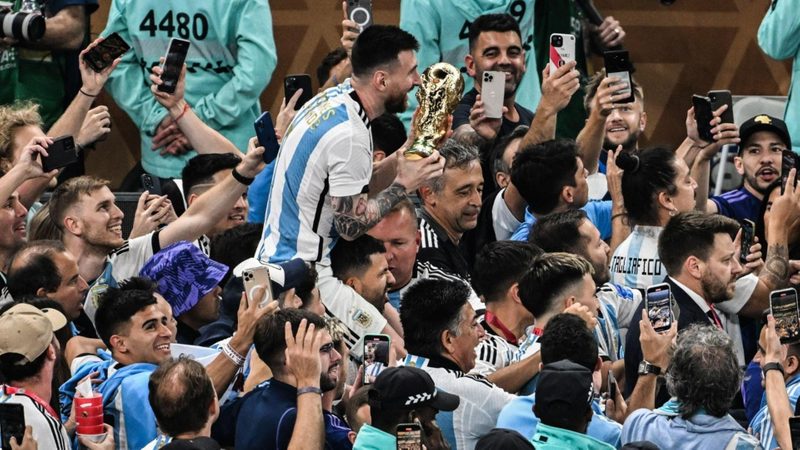
Lionel Messi still tops our list. But the 2026 World Cup in North America has given the argument its first real shake in years: Spain beat his Argentina in the final, and Kylian Mbappe took the World Cup goalscoring record off him three weeks after he had claimed it.
How this list is ranked
Three things decide the order, weighted against the era a player worked in: how completely they dominated at their peak, whether they changed the way football was played, and what they actually won.
Goals alone do not decide it, and that is the single biggest reason a list like this looks wrong at first glance. Cristiano Ronaldo has scored nearly three times as many career goals as Diego Maradona and sits below him here, because Maradona won a World Cup close to single-handedly and bent an entire league around himself for seven years. Zinedine Zidane is in the top six on 156 career goals. If you want a list ordered by goals, the table below has that column and you can re-sort it in your head.
Comparing eras is also not a solved problem, and anyone claiming otherwise is selling something. Pele scored his goals against different defences, under different laws, with different medicine and different pitches. The honest position is that the top three or four are interchangeable depending on what you weigh, and that the ten names below are not.
Top 10 football players of all time
| # | Player | Country | Career goals | World Cups | Ballon d’Or |
|---|---|---|---|---|---|
| 1 | Lionel Messi | Argentina | 900+ | 1 (2022) | 8 |
| 2 | Pele | Brazil | 767 | 3 (1958, 1962, 1970) | — |
| 3 | Diego Maradona | Argentina | 345 | 1 (1986) | — |
| 4 | Cristiano Ronaldo | Portugal | 970+ | — | 5 |
| 5 | Johan Cruyff | Netherlands | 433 | — | 3 |
| 6 | Zinedine Zidane | France | 156 | 1 (1998) | 1 |
| 7 | Gerd Muller | West Germany | 724 | 1 (1974) | 1 |
| 8 | Ronaldo Nazario | Brazil | 414 | 2 (1994, 2002) | 2 |
| 9 | Alfredo Di Stefano | Argentina / Spain | 509 | — | 2 |
| 10 | Michel Platini | France | 354 | — | 3 |
Three things to read carefully in that table:
- Goals are club plus senior international in official competitive matches. Totals from before the database era vary by source, which is why Pele is often quoted at 1,281 — that figure includes friendlies and tour matches, and 767 is the competitive count.
- Messi and Ronaldo are still playing, so their totals move. Ronaldo, at 41 and still with Al Nassr, is inside 30 goals of becoming the first footballer to reach 1,000.
- The Ballon d’Or column does not read across eras. Until 1995 the award was open only to European players, which is the entire reason Pele and Maradona show a dash; it was then opened to players of any nationality at European clubs, and to everyone in 2007. Both were later given honorary awards. Read that column as a measure of peak recognition, not of quality.
The ten, one by one
1. Lionel Messi (Argentina)
Out of Barcelona’s La Masia academy and into a first Ballon d’Or at 22, then seven more — a record eight in all, the most recent in 2023. Two Champions League trebles with Barcelona, the Copa America in 2021, and then Qatar in 2022, where the World Cup and a second Golden Ball finally closed the one argument that had been held against him. He is the only player to have won two World Cup Golden Balls, in 2014 and 2022.
The 2026 tournament was a strange coda. At 39 he scored eight goals, created both in the semi-final win over England, and took Argentina to a final they lost 1-0 to Spain after extra time and a red card. Along the way he passed Miroslav Klose’s 16 World Cup goals to become the tournament’s all-time leading scorer — and held that record for under four weeks before Mbappe’s brace in the third-place play-off moved past him. He now sits second on 21. At club level he is past 900 career goals with Inter Miami, where he delivered the franchise its first trophy, the Leagues Cup.
2. Pele (Brazil)
The only man to win three World Cups, and the first global superstar the sport produced. He announced himself with six goals at the 1958 tournament as a 17-year-old, then won again in 1962 and 1970 with a Brazil side still used as the benchmark for how football should look. Almost all of his club career was spent at Santos, and his 767 competitive goals were scored in an era when a forward could expect to be kicked for ninety minutes without protection.
3. Diego Maradona (Argentina)
The most complete case ever made for one player carrying a team. At the 1986 World Cup he scored twice in the quarter-final and twice in the semi-final and won it; at Napoli he delivered the first two league titles in the club’s history, in 1987 and 1990, and they would not win Serie A again for 33 years. Ball control and close dribbling that a generation of players tried and failed to copy.
4. Cristiano Ronaldo (Portugal)
The leading goalscorer in football history, past 970 for club and country, and the record holder for goals in men’s international football. League titles in three countries — England, Spain and Italy — five Champions Leagues, four of them at Real Madrid, and five Ballon d’Or awards. He also drove Portugal to the first major trophy in their history at Euro 2016. Still playing at 41, still scoring, and the only realistic candidate to reach 1,000 career goals.
5. Johan Cruyff (Netherlands)
The most influential figure in modern football, as a player and then twice over as a coach. He was the on-field expression of Total Football at Ajax, winning three consecutive European Cups from 1971 to 1973 and three Ballon d’Or awards, and he took the Netherlands to the 1974 World Cup final, losing to hosts West Germany but leaving as the player of the tournament. What he built afterwards at Barcelona is why Messi’s Barcelona played the way it did.
6. Zinedine Zidane (France)
Control and technique in place of volume. Spotted at Cannes and signed by Bordeaux, he won multiple titles at Juventus before a move to Real Madrid, where he won the Champions League in his first season with a volley that still gets shown weekly. He scored twice, both headers, as France won the 1998 World Cup at home, and took them back to the final in 2006. Named the world’s best player in 1998, 2000 and 2003.
7. Gerd Muller (West Germany)
A finisher with almost no equal: 398 league goals in 453 league games for Bayern Munich, 565 in all competitions, and 724 for club and country in his career. He won the European Championship with West Germany in 1972 and then the World Cup two years later, scoring the winning goal in the 1974 final against the Netherlands. He finished his career in the United States with the Fort Lauderdale Strikers.
8. Ronaldo Nazario (Brazil)
The most destructive centre-forward of the modern era before injuries took the top off his career, and still rated by many who played against him as the best striker they faced. He was in Brazil’s 1994 World Cup-winning squad at 17 in a bit-part role, scored 30 in his first season at PSV, then moved to Barcelona, Inter and Real Madrid. He lost the 1998 final to France, then won it in 2002 with eight goals, including both in the final. Two Ballon d’Or awards, 414 career goals.
9. Alfredo Di Stefano (Argentina / Spain)
Arguably the most complete footballer who ever played — a forward who defended, created and organised in an age when players did one job. Born in Buenos Aires, he came through River Plate, spent time at Millonarios in Colombia, and then made Real Madrid the biggest club in the world: five consecutive European Cups from 1956 to 1960 and eight La Liga titles. Two Ballon d’Or awards. He represented both Argentina and Spain, and, through a mix of boycotts, failed qualification and injury, never played a single World Cup match.
10. Michel Platini (France)
Three consecutive Ballon d’Or awards, in 1983, 1984 and 1985, the first player to win three in a row; only Messi, with four straight from 2009 to 2012, has gone further. Born in north-eastern France to Italian parents, he turned professional at Nancy, won Ligue 1 with Saint-Etienne and then became the best player in Europe at Juventus. His peak was Euro 1984 on home soil: nine goals in five matches, still the record for a single European Championship, and a trophy for France.
Knocking on the door
Kylian Mbappe has the strongest live claim. He is now the all-time leading scorer at World Cups on 22 goals, he won the tournament in 2018, was runner-up in 2022, and has taken the Golden Boot at two consecutive World Cups — ten goals in 2026, the first player to do that back to back. What holds him out of the ten for now is the shape of the rest: one World Cup won, a 2026 campaign that ended in a semi-final defeat and a lost third-place play-off, and no Ballon d’Or yet.
Behind him, the 2026 final was the clearest changing of the guard the sport has staged in years. Rodri took the Golden Ball as the tournament’s best player, from the base of a Spain midfield that conceded once in seven matches on the way to the final, and Lamine Yamal was 19 and already a European champion when he ran at Argentina in New Jersey. We wrote about the two Barcelona generations meeting in that final in Messi and Yamal. Neither belongs on an all-time list yet. Ask again in 2030.
Quick answers
Who is the greatest footballer of all time?
On the balance of peak dominance, influence and trophies, Lionel Messi. Pele and Maradona are the serious counter-arguments, and which one you prefer usually comes down to how much weight you give three World Cups against a single-handed one.
Who has scored the most goals in football history?
Cristiano Ronaldo, with more than 970 for club and country. He also holds the record for goals in men’s international football.
Who has scored the most World Cup goals?
Kylian Mbappe, on 22, since 18 July 2026. He passed Lionel Messi (21) with two goals in the third-place play-off against England.
Who has won the most World Cups as a player?
Pele, with three — 1958, 1962 and 1970. Nobody else has more than two.
Who has won the most Ballon d’Or awards?
Lionel Messi, with eight. Cristiano Ronaldo is next on five.
Why is Kylian Mbappe not in the top 10?
Because the record he holds is a tournament record, not a career one. One World Cup win and two Golden Boots is an elite return, but every player in the ten above either won more or reshaped how the game is played. He has time.
For the full story of the tournament that reopened this argument, read our report on Spain’s 1-0 win over Argentina in the final and the 2026 World Cup individual awards. More in our football section.
Photo credits: Alamy