






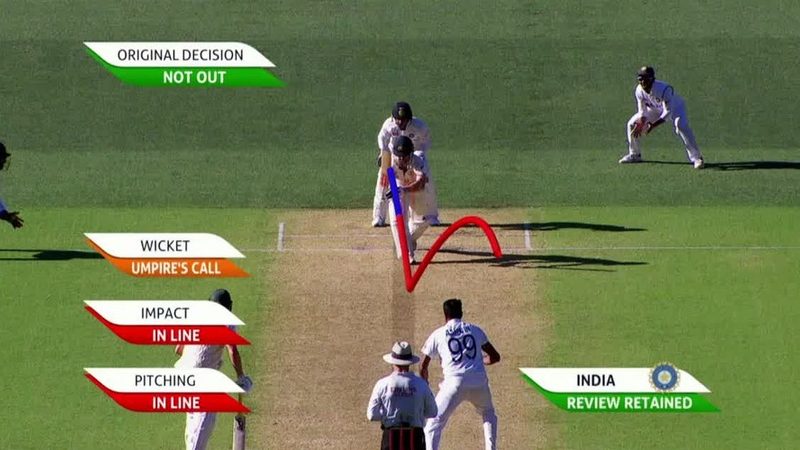
Umpire’s call is the part of the Decision Review System (DRS) that keeps the on-field umpire’s decision when ball-tracking shows an lbw to be too close to call. It is why a batter can survive a review even when the graphic shows the ball clipping the stumps, and why a batter given out can stay out when the ball is only grazing them.
It has been criticised by players and former umpires for years. The ICC Cricket Committee, then chaired by Anil Kumble, nevertheless decided to keep it in April 2021, and it is still part of the ICC playing conditions in 2026.
What is umpire’s call in cricket?
When an lbw decision is reviewed, the third umpire first checks that the delivery was legal and that the ball did not touch the bat first. Ball-tracking then reports three things:
- Pitching: where the ball pitched.
- Impact: where the ball first hit the batter.
- Wicket: whether the ball would have gone on to hit the stumps.
The ICC’s DRS protocol (Appendix D of the playing conditions) defines umpire’s call as the result reported when the technology shows a marginal decision on either the impact or the wicket. When that happens, the on-field umpire’s original decision stands, whether it was out or not out. There is no umpire’s call for pitching.
How umpire’s call works
Every verdict depends on the centre of the ball.
Pitching. If the centre of the ball pitched outside the line of leg stump, the batter is not out. Pitching in line or outside off stump keeps the lbw alive.
Impact. The impact is “in line” if the centre of the ball hit the batter between the outside edges of the stumps. If only part of the ball was in that zone, the verdict is umpire’s call. If the batter made no genuine attempt to play the ball, an impact outside off stump can still be out.
Wicket. Ball-tracking reports one of three outcomes:
- Hitting: the ball was hitting the stumps, with the centre of the ball inside the wicket zone.
- Umpire’s call: the ball was hitting, but the centre of the ball was outside the zone.
- Missing: the ball was missing the stumps.
In practice, at least half the ball has to be hitting the wicket zone to overturn a not-out decision. To overturn an out decision, the ball has to be missing altogether.
| On-field decision | Ball-tracking shows | Final decision |
|---|---|---|
| Not out | Impact in line and Hitting | Out (overturned) |
| Not out | Umpire’s call on impact or wicket | Not out (stands) |
| Out | Umpire’s call on impact or wicket | Out (stands) |
| Out | Missing, or impact outside the line while playing a shot | Not out (overturned) |
The wicket zone has changed
The wicket zone has been redrawn twice:
- 2017: the protocol defined it as the outside of the outer stumps, the base of the stumps and the bottom of the bails.
- 2021: the ICC lifted the top of the zone to the top of the stumps, so that the umpire’s call margin was the same for height as for width. The same change let a batter ask the umpire whether they had been judged to be making a genuine attempt to play the ball before deciding whether to review.
- 2025: the playing conditions announced on 27 June 2025 made the wicket zone “the actual outline of the stumps and bails”.
Do you lose a review on umpire’s call?
No. Since the ICC’s 2017 playing conditions, a player review that fails only because of umpire’s call is classed as “Unchanged – Umpire’s Call”, and it does not count against the team’s review allowance.
The 2025 playing conditions added one more case. If a batter given out caught reviews and replays show no bat involved, the third umpire checks for lbw. The original decision on that lbw check is treated as out, so an umpire’s call verdict now leaves the batter out. Before the change, it would have left them not out.
Why is umpire’s call controversial?
The objection is simple: if the ball is shown hitting the stumps, the bails would fall, so why is it not out?
In January 2021, after a series of close lbw reviews in the Boxing Day Test between Australia and India in Melbourne, former ICC elite panel umpire Daryl Harper told the Sydney Morning Herald: “I’ve had enough of umpire’s call. Let’s just ban umpire’s call. Get rid of the controversy and just go with it. Any contact with ball on stump will dislodge a bail. No 48 per cent, 49 per cent.”
Virat Kohli, then India captain, put it this way at a media briefing in Pune in March 2021, before the ODI series against England:
“According to me, umpire’s call right now is creating a lot of confusion. When you get bowled, as a batsman you don’t expect the ball to hit more than 50% of the stumps to consider yourself bowled. So when the ball is shown as clipping the stumps, the bails are going to fall.”
Less than a fortnight after Kohli’s comments, the ICC Cricket Committee decided to keep it. Kumble said: “The principle underpinning DRS was to correct clear errors in the game whilst ensuring the role of the umpire as the decision maker on the field of play was preserved… Umpire’s Call allows that to happen, which is why it is important it remains.”
The debate returned in February 2024. Zak Crawley was given out lbw to Jasprit Bumrah during England’s 434-run defeat in Rajkot, and the decision stood on review. England captain Ben Stokes said afterwards: “I think you should take away umpire’s call if I’m being perfectly honest, but I don’t want to get too much into it because then it sounds like we’re moaning about that as why we lost.”
The case for umpire’s call
Ball-tracking never shows the ball hitting the stumps. It shows a prediction of where the ball would have gone after it hit the pad, and that prediction has a margin of error. Nasser Hussain made the point on Sky Sports in 2021, in reply to Kohli: “that ball has never hit the stumps. That is a prediction.” He argued that umpire’s call is “not there to back up the umpire, it’s to give the margin of error for technology”. If every predicted clip of the stumps were out, he said, fielding sides would appeal and review far more often.
Umpire’s call is also often confused with the soft signal. That was a separate rule for referred catches, and the ICC scrapped it from 1 June 2023. Umpire’s call survived that change and the later ones, so for now the on-field umpire still gets the benefit of the doubt on the closest lbws.
Sources: ICC Playing Conditions, Appendix D (DRS); ICC playing conditions releases of 15 May 2023 and 27 June 2025; ICC Cricket Committee decisions, April 2021.
Feature image courtesy: Twitter / Cricket Australia