






Sooryavanshi has eight first-class games and an average of 17.25, and Dravid is asking everyone to be patient
The IPL’s youngest Orange Cap winner starts a red-ball season in Bengaluru on Sunday. Rahul Dravid used a T20 launch in Dublin to argue why that matters.
Aug 22, 2026
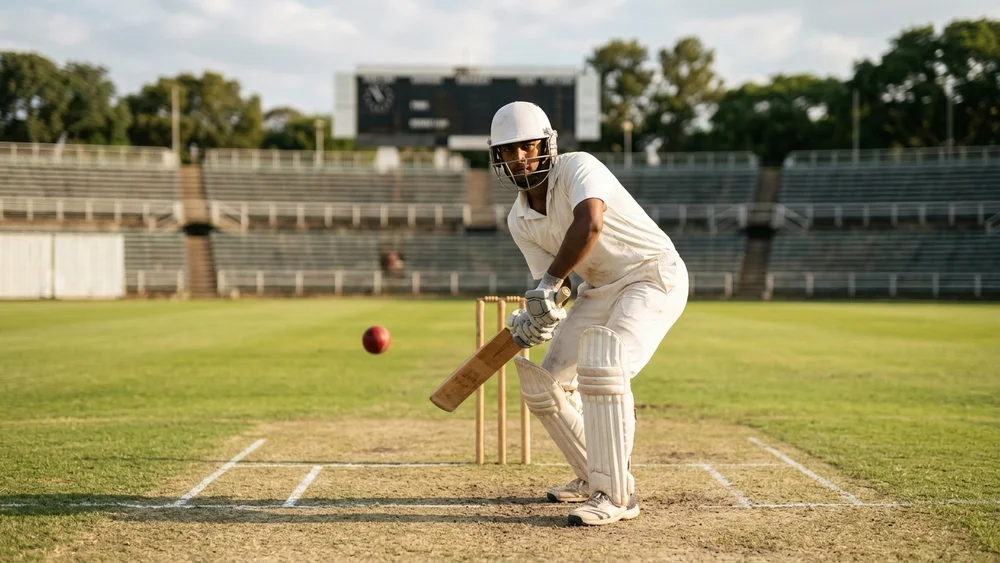
Rahul Dravid was in Dublin this week to help launch a new T20 league, and ended up making the case for Test cricket. Asked about Vaibhav Sooryavanshi, he made an argument that reaches a good deal further than one teenager.
“All of us also want to see Test cricket survive, all of us want to see Test cricket grow,” Dravid told Cricinfo, “and we need players like him to be able to hopefully play all formats of the game.”
The timing helps. Sooryavanshi starts a red-ball season on Sunday 23 August.
Eight first-class games, average 17.25
That is the whole of Sooryavanshi’s red-ball career so far. Eight matches, an average of 17.25, and all of them squeezed into a calendar at a point when he was pushing for a place in India’s Under-19 set-up. He has never had a run of first-class cricket. He has had fragments of it, between other commitments.
Set that against what he has done with a white ball. He scored 776 runs in 16 matches for Rajasthan Royals in IPL 2026 at a strike rate of 237.30, won the Orange Cap and the MVP award, and hit 72 sixes, breaking a season record Chris Gayle had held since 2012. He was 15 years and 65 days old when he became the youngest Orange Cap winner. He made his India debut at 15 too, the youngest player ever to represent the country, and in July he hit an 18-ball fifty against Zimbabwe and then an 81 to close out a 3-0 sweep.
Those two records belong to the same 15-year-old. One of them is a phenomenon. The other is eight games and an average of 17.25, which is what a talented teenager’s first-class record usually looks like, because that is what it is.
Dravid is asking for patience, twice
“He’s only 15 and I think you’ve got to just give him some time and you’ve got to be patient with him,” Dravid said. “He’s obviously been such a success straightaway, right, but he’s going to go through his ups and downs and I think people are going to have to be patient with him.”
He said it twice in one answer, which tells you what he expects to happen. Dravid coached Sooryavanshi at Rajasthan Royals in IPL 2025 and has watched the reaction to him up close. He also knows what an Indian audience does to a teenager who fails in a format they have decided he should conquer.
The warning underneath it is specific: “I think he’s going to have some success but he also might have periods where it probably doesn’t work out well for him.”
The Duleep Trophy is the actual test
India’s zonal red-ball competition starts on 23 August on the two grounds at the BCCI’s Centre of Excellence in Bengaluru and runs to 10 September, with the final at the M. A. Chidambaram Stadium in Chennai. Matches are four days long, five for the final. It is a straight knockout between six zones, and Central and South both have byes into the semi-finals as last season’s finalists.
Sooryavanshi will play for East Zone as vice-captain, with Ishan Kishan captaining a squad that also has Mohammed Shami, Mukesh Kumar and Abhimanyu Easwaran in it. That is a serious dressing room for a 15-year-old to learn the format in.
More importantly, it is continuity. Two matches at minimum, three if East Zone reach the final, and then potentially two more when India A host Australia A in a pair of unofficial Tests in September. That would be four or five red-ball games between late August and the end of September, which is more than half of what he has played in his life.
What Dravid is really arguing
There is a version of Sooryavanshi’s next five years where he plays franchise T20 cricket across the world, makes an enormous amount of money, and never has a first-class average worth discussing. Nothing about that path would be irrational. Plenty of players have taken it.
Dravid’s point is that he is not on it. “Vaibhav Sooryavanshi, by not playing in T20 competitions all over the world, is actually playing in the red-ball Indian domestic competition,” he said. “He’s growing, he’s getting better at red-ball skills.”
Whether that holds is the interesting question, and it is not really Sooryavanshi’s to answer on his own. It depends on whether the Duleep Trophy and India A fixtures keep getting scheduled around him, and on whether an average of 17.25 is allowed to climb slowly in public without somebody deciding after two failures that he is a white-ball player.
Dravid, who co-owns the Dublin Guardians in the league he was in Dublin to promote, has an obvious commercial interest in T20 cricket working. He spent the interview arguing for the four-day game anyway.