






Narendra Modi Stadium, Ahmedabad: pitch report, records and stats
The world’s largest cricket ground has staged four IPL finals and two World Cup finals in five seasons. Here is what its pitch actually does, format by format, and every record it holds.
Jul 25, 2026 · Updated Oct 4, 2026
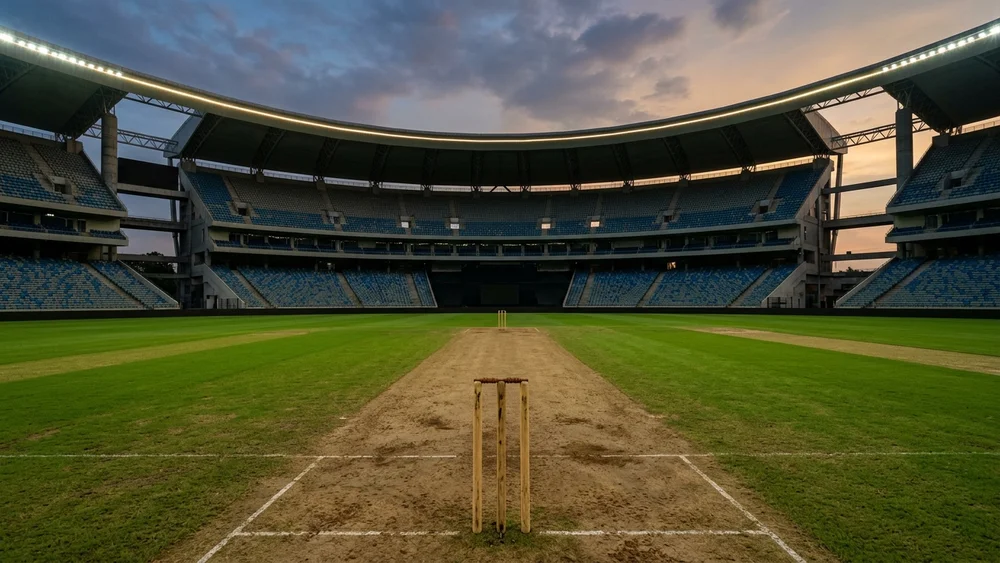
The Narendra Modi Stadium in Ahmedabad holds 132,000 people, which makes it the largest cricket ground in the world and the largest stadium of any kind by seating capacity. It is the home of Gujarat Titans, it has staged four IPL finals in five seasons, and in the space of three years it hosted both the 2023 ODI World Cup final and the 2026 T20 World Cup final. What follows is a pitch report built from the ground’s own scorecards, then the Test, ODI, T20I and IPL records, and the older Motera history that most record pages leave out.
Narendra Modi Stadium at a glance
| Detail | |
|---|---|
| Location | Motera, north Ahmedabad, Gujarat |
| Capacity | 132,000 |
| Owner | Gujarat Cricket Association |
| Ends | Adani Pavilion End, Jio End |
| First opened | 1983, as the Sardar Patel Stadium |
| Demolished and rebuilt | 2015 to 2020, at a cost of about 800 crore rupees |
| Lighting | LED strip built into the rim of the roof, no conventional floodlight towers |
| First Test | 12 November 1983, India v West Indies |
| First ODI | 5 October 1984, India v Australia |
| First T20I | 28 December 2012, India v Pakistan |
| Home teams | Gujarat Titans (IPL), Gujarat (domestic) |
One point of confusion is worth clearing up before the numbers. The ground was knocked down in 2015 and rebuilt on the same site, so some sources start its record book in 2021 and others run it continuously from 1983. Cricket’s record keepers take the second view, which is why a Kapil Dev spell from 1983 and a Jasprit Bumrah spell from 2026 sit in the same table.
Narendra Modi Stadium pitch report
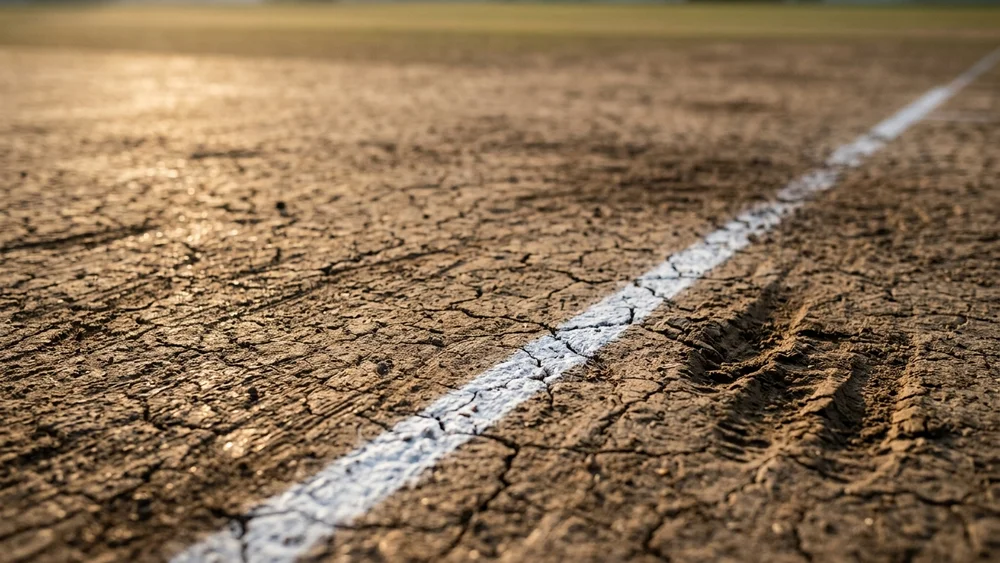
The short version: this is the most even big venue in Indian cricket, and the reputation it has for being a batting paradise comes almost entirely from a handful of enormous IPL scores rather than from what the surface does on average.
Across all 53 IPL matches played here up to and including the 2026 final, the side batting first has won 26 and the side chasing has won 26. The one match that got away from that symmetry was tied, Rajasthan Royals and Kings XI Punjab both finishing on 191 for 6 in April 2015 before a Super Over settled it. That is as close to a coin flip as a venue record gets, and it is unusual. Every other major Indian ground we have measured leans one way: the chase wins clearly at Eden Gardens and at Sawai Mansingh, batting first has the better record all-time at Chepauk. Ahmedabad refuses to pick a side.
The first-innings average tells the same story. Over those 53 IPL games it is 180.7, and across the matches played since 2016 it is 185.8. That is a good batting surface rather than a freak one, and it is a long way below the 220-plus par that Jaipur has produced in the last two seasons.
Where the ground does something genuinely odd is in the gap between the IPL and international T20 cricket played on the same square. Across the 14 men’s T20Is here the first innings averages 193.5, which is roughly 13 runs above the IPL figure, and the side batting first has won nine to five. So the format that usually produces the bigger scores produces the smaller ones here. The sample is small enough that it should be read as a tendency rather than a law, but it does mean the standard advice to chase at Ahmedabad has no support in the T20I record at all.
Red-ball cricket has changed more than either. Across the nine Tests since 2005 the first innings averages 318.6, but across the four played since the rebuilt stadium opened in 2021 that falls to 239.8, and the side bowling first has won all three that produced a result. A Test here is now a bowler’s proposition in a way the old Motera never was.
Practically, that means a first-innings score around 180 is competitive in the IPL rather than commanding, the square boundaries are long enough to make spinners hard to hit straight down the ground, and captains who bowl first because of dew are working off a habit rather than off this venue’s evidence. Ahmedabad in April and May gets less dew than several other Indian grounds.
One naming point that trips up pitch reports: the ends are the Adani End and the Jio End. Older previews still refer to a GMDC End, which was the name of the north pavilion at the demolished stadium. It no longer exists.
Test records at the Narendra Modi Stadium
The ground has staged 16 Tests, from India against West Indies in November 1983 to India against West Indies again in October 2025.
| Record | Detail |
|---|---|
| Highest team total | Sri Lanka 760 for 7 declared, November 2009 |
| Lowest team total | India 76, April 2008 v South Africa |
| Highest individual score | Mahela Jayawardene 275, November 2009 |
| Best bowling in an innings | Kapil Dev 9 for 83, November 1983 v West Indies |
| Most runs (since 2005) | Virender Sehwag 426 |
| Most wickets (since 2005) | Ravichandran Ashwin 26 |
Sri Lanka’s 760 for 7 declared in November 2009 is the biggest score the ground has seen in any format, and it is Sri Lanka’s highest Test total in India. It is not their highest anywhere, which is the 952 for 6 declared they made at Colombo in 1997. Jayawardene batted for most of two days for his 275, Prasanna Jayawardene made 154 not out, and India still saved the match by batting out the fourth innings at 412 for 4.
India’s 76 all out against South Africa in April 2008 is the lowest total here; South Africa replied with 494 for 7 declared, AB de Villiers making 217.
The single most extraordinary Test at the ground is also the shortest. The day-night match against England in February 2021 lasted 140.2 overs, the briefest completed Test anywhere since 1935. England were dismissed for 112 and 81, the fewest runs any side has scored against India while losing all 20 wickets, Axar Patel took 11 wickets across the two innings, and India won by ten wickets inside two days.
ODI records at the Narendra Modi Stadium
Ahmedabad has staged ODIs since October 1984. The figures below are computed across the 21 men’s ODIs played here since April 2005, which is the period for which ball-by-ball data exists; the headline records are all-time.
| Record | Detail |
|---|---|
| Highest team total | South Africa 365 for 2, February 2010 |
| Lowest team total | Zimbabwe 85, October 2006 |
| Highest individual score | Devon Conway 152 not out, October 2023 |
| Best bowling | Prasidh Krishna 4 for 12, February 2022 |
| Highest successful chase | Pakistan 319 for 7 chasing 316, April 2005 |
| Most runs (since 2005) | Rohit Sharma 355 |
Conway’s 152 not out came in the opening match of the 2023 World Cup, when New Zealand chased England’s 282 for 9 with 82 balls to spare. It is worth flagging because several venue pages credit that innings to Kane Williamson, who was injured and did not play. Rachin Ravindra made 123 not out at the other end.
The bat-first and chase split across those 21 matches is 9 to 12, and the first-innings average is 252.4, rising only slightly to 254.1 in the games since 2016. Pakistan’s chase of 316 in April 2005 remains the biggest successful pursuit here.
T20I records at the Narendra Modi Stadium
Fourteen men’s T20Is have been played here, starting with India against Pakistan in December 2012 and ending, so far, with the 2026 World Cup final.
| Record | Detail |
|---|---|
| Highest team total | India 255 for 5, 8 March 2026 |
| Lowest team total | New Zealand 66, February 2023 |
| Highest individual score | Shubman Gill 126 not out off 63, February 2023 |
| Best bowling | Jasprit Bumrah 4 for 15, 8 March 2026 |
| Most runs | Virat Kohli 258 |
Both the batting and the bowling record were set in the same match, and it was the biggest match the ground has staged. India made 255 for 5 in the 2026 T20 World Cup final and bowled New Zealand out for 159 to win by 96 runs, a result that made them the first side to win three T20 World Cups, the first to defend the title, and the first host nation to win it. Our reports on the final and on what the pitch was expected to do cover it in detail.
The other end of the range is just as stark. New Zealand were bowled out for 66 chasing India’s 234 for 4 in February 2023, a defeat by 168 runs, in the match where Gill made his 126 not out.
IPL records at the Narendra Modi Stadium
Gujarat Titans have played here since the franchise was created for the 2022 season, and the ground has hosted 53 IPL matches in all.
| Record | Detail |
|---|---|
| Highest team total | Punjab Kings 243 for 5, 25 March 2025 |
| Lowest team total | Sunrisers Hyderabad 86, 12 May 2026 |
| Highest individual score | Shubman Gill 129 off 60, 26 May 2023 |
| Best bowling | Mohit Sharma 5 for 10, 26 May 2023 |
| Highest successful chase | Kolkata Knight Riders 207 for 7 chasing 205, 9 April 2023 |
| Most runs | Shubman Gill 1,384 |
| Most wickets | Rashid Khan 34 |
Punjab’s 243 for 5 was built on Shreyas Iyer’s 97 not out from 42 balls, and Gujarat’s reply of 232 for 5 made it a match of 475 runs. Gill’s 129 and Mohit Sharma’s 5 for 10 came in the same game, Qualifier 2 of the 2023 season against Mumbai Indians, a few hours apart.
The chase record is the one people remember. Kolkata needed 29 off the final over against Gujarat in April 2023, Umesh Yadav took a single from the first ball, and Rinku Singh hit the next five for six. Kolkata won by three wickets with Rinku 48 not out from 21.
The ground India books for finals
No venue in the country has been handed more showpiece cricket in the last five years. Ahmedabad has staged the IPL final in 2022, 2023, 2025 and 2026, with only the 2024 decider going elsewhere. Gujarat Titans won the first of those on debut; Chennai Super Kings took the 2023 final on a revised target after rain; Royal Challengers Bengaluru ended an 18-season wait for a title here in 2025, beating Punjab Kings by six runs, then defended it on the same ground in 2026 after the BCCI moved the match here from Bengaluru. Virat Kohli made 75 not out from 42 balls in that second one.
It has also staged India’s last two World Cup finals, and they could hardly have gone more differently. In November 2023 India were bowled out for 240 and Australia chased it down with seven overs to spare, Travis Head making 137 to win them a sixth title. In March 2026, on the same square, India made 255 for 5 and won the T20 World Cup by 96 runs. The ground was also where India beat Australia in the 2011 World Cup quarter-final, and where India beat Pakistan by seven wickets in the 2023 group stage.
Motera before the rebuild
Most records pages for this ground start in 2021, which throws away the better half of its history. The old Sardar Patel Stadium held about 49,000 and it collected an unusual number of landmark moments.
Kapil Dev took 9 for 83 against West Indies in the ground’s very first Test in November 1983, still the best innings analysis it has seen. Only Jasu Patel’s 9 for 69 against Australia at Kanpur in 1959 had been better by an Indian bowler, and Anil Kumble’s ten for 74 in 1999 later went past both. In March 1987 Sunil Gavaskar became the first batter to reach 10,000 Test runs, against Pakistan, in his 124th Test. On 8 February 1994 Kapil Dev had Hashan Tillakaratne caught at short leg for his 432nd Test wicket, passing Richard Hadlee’s record, and the ground let off 432 balloons. Sachin Tendulkar made the first double hundred of his international career here, 217 against New Zealand in October 1999. And on 24 March 2011, in the World Cup quarter-final against Australia, he became the first cricketer to 18,000 ODI runs, in a match India won to set up the semi-final they took on the way to the title.
Quick answers
Is the Narendra Modi Stadium a batting pitch? It is a good batting surface without being extreme. The IPL first-innings average is 180.7, and results are split 26 to 26 between sides batting first and sides chasing.
Should you bat or bowl first at Ahmedabad? The IPL record gives no edge either way. In T20 internationals batting first has the better record, nine wins to five, which is the opposite of the usual advice given for this ground.
What is the highest score at the Narendra Modi Stadium? Sri Lanka’s 760 for 7 declared in a 2009 Test. In white-ball cricket it is South Africa’s 365 for 2 in a 2010 ODI, and India’s 255 for 5 in the 2026 T20 World Cup final.
How many people does the Narendra Modi Stadium hold? 132,000, which makes it the largest cricket stadium in the world.
Why is it called the Narendra Modi Stadium? The rebuilt ground was renamed at its inauguration on 24 February 2021, the opening day of the day-night Test against England. The wider sports complex it sits in is still named after Sardar Vallabhbhai Patel.
Which teams play at the Narendra Modi Stadium? Gujarat Titans in the IPL, Gujarat in domestic cricket, and India across all three international formats.