








Highest powerplay score in IPL: SRH 125, and the 13 for 6 at the other end
Every IPL powerplay record, the highest and the lowest, has been set at one ground in Delhi. Here is the full list derived from all 1,243 matches, and why rival lists disagree about the lowest.
May 8, 2024 · Updated Aug 20, 2026
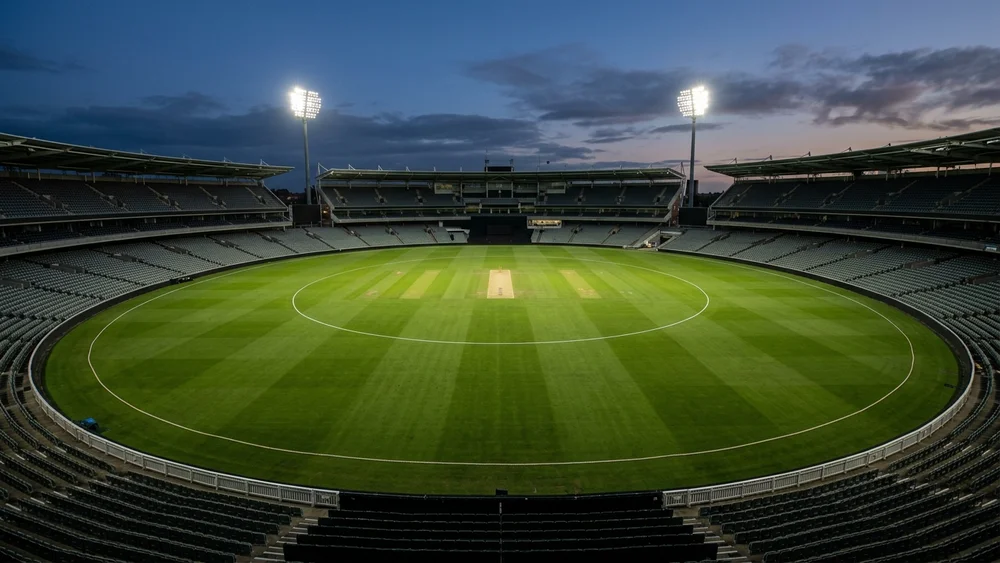
The highest powerplay score in IPL history is 125 without loss, made by Sunrisers Hyderabad against Delhi Capitals at the Arun Jaitley Stadium on 20 April 2024. Travis Head and Abhishek Sharma took the first six overs apart and never gave the innings back. At the other end of the same list sits 13 for 6, made by Delhi Capitals on the same ground on 27 April 2026, and the two records are closer together than they look.
Both were set at the Arun Jaitley Stadium, and Delhi Capitals were involved in both. That is the strange part of the powerplay record book, and it is the part every other list leaves out.
Highest powerplay score in IPL history
These are the biggest first-six-over totals across all 1,243 IPL matches played between 2008 and the end of the 2026 season, counting every run credited to the batting side including extras.
| # | Score | Team | Opponent | Ground | Date |
|---|---|---|---|---|---|
| 1 | 125/0 | Sunrisers Hyderabad | Delhi Capitals | Arun Jaitley Stadium | 20 Apr 2024 |
| 2 | 116/0 | Punjab Kings | Delhi Capitals | Arun Jaitley Stadium | 25 Apr 2026 |
| 3 | 107/0 | Sunrisers Hyderabad | Lucknow Super Giants | Rajiv Gandhi Intl Stadium | 8 May 2024 |
| 4 | 105/0 | Kolkata Knight Riders | Royal Challengers Bengaluru | M Chinnaswamy Stadium | 7 May 2017 |
| 5 | 105/0 | Sunrisers Hyderabad | Punjab Kings | Maharaja Yadavindra Singh Stadium | 11 Apr 2026 |
| 6 | 100/2 | Chennai Super Kings | Punjab Kings | Wankhede Stadium | 30 May 2014 |
| 7 | 97/1 | Rajasthan Royals | Royal Challengers Bengaluru | Barsapara Stadium, Guwahati | 10 Apr 2026 |
| 8 | 97/1 | Chennai Super Kings | Lucknow Super Giants | MA Chidambaram Stadium | 10 May 2026 |
| 9 | 94/1 | Sunrisers Hyderabad | Rajasthan Royals | Rajiv Gandhi Intl Stadium | 23 Mar 2025 |
| 10 | 93/1 | Punjab Kings | Kolkata Knight Riders | Eden Gardens | 26 Apr 2024 |
Only six powerplays in IPL history have reached three figures, and the way they are spread is the story. One came in 2014, one in 2017, then nothing for six years, then two in 2024 and two in 2026. Four of the six have been made in the last three seasons.
The quickest check on any of these numbers is a division. Six overs, so 125 is 20.83 an over for a third of an innings, with two fielders out and nobody at slip.
The 125 that still leads, and the 116 that nearly caught it
Hyderabad’s 125 came out of a stand that had no interest in a platform. Travis Head made 89 off 32 balls and Abhishek Sharma 46 off 12, and between them they faced five different bowlers inside six overs, none of whom went for fewer than 19. Hyderabad finished on 266 for 7 and won by 67 runs. It is not only the IPL record: no side in any T20 competition anywhere has scored more in the first six overs.
The 116 is the one worth knowing about, because of what it belonged to. Punjab Kings made it while chasing 265 against Delhi at the same ground on 25 April 2026, and they got there by six wickets with seven balls to spare. That is the highest successful run chase in IPL history, and the powerplay is where it was won. Delhi’s own opening six that evening produced 68 for 1 on the way to 264 for 2, built on KL Rahul’s 152 off 67 balls, which in most seasons would be a fast start and on that night was not close.
No Delhi bowler took a wicket in those six overs, and two of the four who bowled in them conceded more than 40 apiece.
Lowest powerplay score in IPL history
The other end of the table has a definition problem, which the next section deals with. On a full six-over powerplay, in an innings that carried on past it, this is the list.
| # | Score | Team | Opponent | Ground | Date |
|---|---|---|---|---|---|
| 1 | 13/6 | Delhi Capitals | Royal Challengers Bengaluru | Arun Jaitley Stadium | 27 Apr 2026 |
| 2 | 14/3 | Sunrisers Hyderabad | Rajasthan Royals | MCA Stadium, Pune | 29 Mar 2022 |
| 3 | 14/2 | Rajasthan Royals | Royal Challengers Bengaluru | Newlands, Cape Town | 18 Apr 2009 |
| 4 | 15/2 | Chennai Super Kings | Kolkata Knight Riders | Eden Gardens | 7 May 2011 |
| 5 | 16/1 | Chennai Super Kings | Royal Challengers Bengaluru | MA Chidambaram Stadium | 23 Mar 2019 |
| 6 | 16/1 | Chennai Super Kings | Delhi Capitals | Raipur | 12 May 2015 |
| 7 | 17/4 | Kolkata Knight Riders | Royal Challengers Bengaluru | Sheikh Zayed Stadium | 21 Oct 2020 |
| 8 | 17/4 | Rajasthan Royals | Kolkata Knight Riders | Sharjah | 7 Oct 2021 |
| 9 | 17/1 | Royal Challengers Bengaluru | Chennai Super Kings | JSCA Stadium, Ranchi | 18 May 2014 |
| 10 | 17/3 | Mumbai Indians | Punjab Kings | Wankhede Stadium | 12 Apr 2015 |
Twelve powerplays in 2,437 completed six-over innings have produced fewer than 20 runs, so this is a once-every-other-season event rather than a regular one.
Delhi’s 13 for 6 is the lowest of them and it is also the joint-most wickets any side has lost in an IPL powerplay, level with Kochi Tuskers Kerala’s 6 for 29 against Deccan Chargers in 2011. Losing six inside the first six overs is rare on its own. Doing it while scoring 13 has happened once.
Bhuvneshwar Kumar and Josh Hazlewood took all six between them, Bhuvneshwar for 5 runs and Hazlewood for 8. Delhi were 2 for 3, then 8 for 6, and were bowled out for 75 in 16.3 overs. Bengaluru’s reply reached 65 for 1 inside their own powerplay, and they finished the chase three balls after it ended, winning by nine wickets with 81 balls unused. Bhuvneshwar’s three that evening extended a lead he already held as the IPL’s leading powerplay wicket-taker, a list he now tops on 94.
Why some lists say the lowest is 2, and why this one does not
Search for the lowest IPL powerplay score and you will find 2 for 0, or 7 for 0, or 11 for 2. None of those is wrong exactly, and none of them is a six-over powerplay.
When rain shortens an IPL match, the powerplay shortens with it. A 10-over game gets a three-over powerplay, a five-over game gets a one-over powerplay, and the total that comes out the other end is not comparable to anything. Forty-three IPL innings have been played with a reduced powerplay: thirteen of four overs, eleven of five, ten of two, eight of three and one of a single over.
| Score | Powerplay length | Team | Date |
|---|---|---|---|
| 2/0 | 2 overs | Royal Challengers Bengaluru | 17 May 2015 |
| 7/0 | 1 over | Kolkata Knight Riders | 26 Apr 2025 |
| 11/2 | 2 overs | Chennai Super Kings | 18 May 2013 |
| 13/6 | 6 overs | Delhi Capitals | 27 Apr 2026 |
Read the powerplay-length column and the list sorts itself out. Royal Challengers Bengaluru’s 2 for 0 was two overs of cricket in a match cut to pieces, and a side that scores 2 in two overs is going at 1 an over, which is bad but not historic. Delhi scored 13 in six, which is 2.17 an over in a competition whose average powerplay now runs at more than ten.
Delhi Capitals and one ground hold all three records
The highest IPL powerplay, the second-highest and the lowest have all been made at the Arun Jaitley Stadium, and Delhi Capitals were on the field for all three. They conceded 125 to Hyderabad in April 2024. They conceded 116 to Punjab on 25 April 2026. They made 13 for 6 themselves two days later, on 27 April, against Bengaluru.
That is not entirely coincidence. Delhi’s home ground is a short, quick one, and our Arun Jaitley Stadium records page has its IPL first-innings average climbing from 171.8 to 182.3 across the same period. Published boundary measurements for the ground vary enough between sources that they are not worth quoting, but the scoring record is ours and it is consistent. A ground that rewards a fast start punishes a slow one just as hard, because the field is up either way.
What a par powerplay score is now
The average IPL powerplay across all 2,437 completed six-over innings is 48.37, or 8.06 an over. That number is close to useless on its own, because it is an average of two different competitions played fifteen years apart.
| Season | Average powerplay | Run rate | Innings of 60+ |
|---|---|---|---|
| 2013 | 41.27 | 6.88 | 7 of 150 |
| 2018 | 50.10 | 8.35 | 19 of 117 |
| 2022 | 46.94 | 7.82 | 21 of 148 (14.2%) |
| 2023 | 52.16 | 8.69 | 40 of 146 (27.4%) |
| 2024 | 56.79 | 9.47 | 51 of 140 (36.4%) |
| 2025 | 57.93 | 9.66 | 60 of 143 (42.0%) |
| 2026 | 60.51 | 10.08 | 72 of 144 (50.0%) |
Two things fall out of that table. The first is that 2026 was the first season in which the average IPL powerplay went at ten an over. For eighteen seasons the number sat between 6.88 and 9.66, and it had never once started with a one.
The second is the 60-plus column, which is the more useful one for anyone watching a match. In 2022, a powerplay of 60 put a side comfortably ahead of the game and happened in roughly one innings in seven. In 2026 it happened in exactly half of them, 72 of 144. Sixty is now the middle of the distribution rather than the top of it, and the score that actually signals a fast start has moved up towards 80.
The break is at 2023, which is the season the Impact Player rule arrived and let sides bat with a substitute to come. The same abrupt step shows up in the first-innings totals on our par score by ground analysis. What the data can establish is that the change was sudden rather than gradual; it cannot prove the rule caused it, because bats, boundary lengths and squad depth all moved over the same seasons.
How the IPL powerplay works
The IPL powerplay is the first six overs of each innings. Two fielders are permitted outside the 30-yard circle, and everybody else, the bowler and wicketkeeper included, has to stand inside it. Put a third man out there and the umpire calls a no-ball, and the batting side gets a free hit.
The rule is the same across T20 cricket, which is why the biggest scores tend to come from the same handful of players. The most runs in powerplays in T20s and the highest powerplay score in T20 internationals are covered separately, and the fifty-over game splits its innings into three blocks instead of one, which our guide to powerplay rules in cricket sets out in full.