






Dharamshala Stadium: pitch report, capacity and records at the HPCA ground
The HPCA ground sits 1,457 metres up with the Dhauladhar range behind it, and its IPL first-innings average has climbed from 175.7 to 214.4 since the league came back in 2023. Here is what the pitch actually does.
May 2, 2024 · Updated Sep 22, 2026
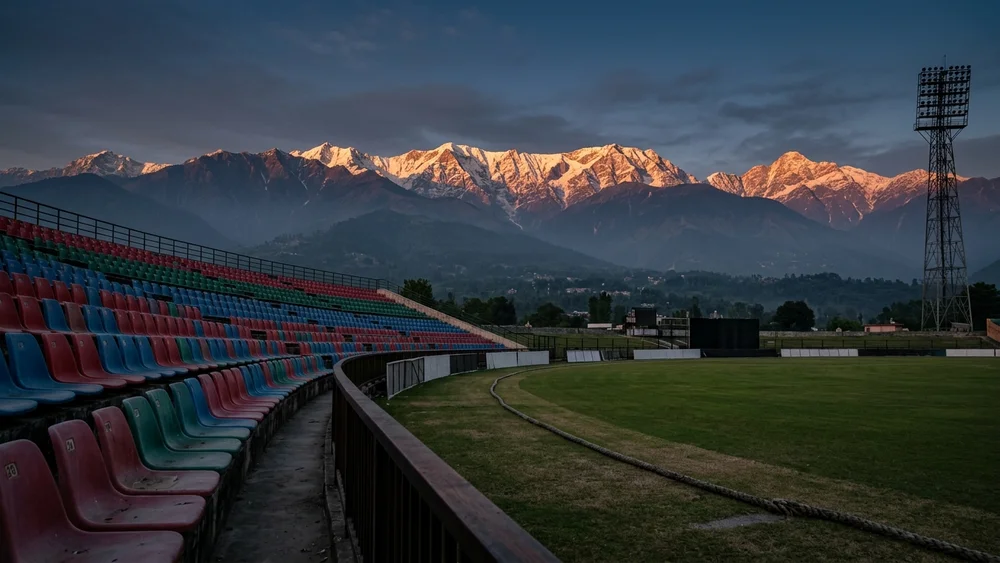
Dharamshala Stadium is the ground people photograph rather than the one they study, and the reputation that comes with the photograph is wrong. The Himachal Pradesh Cricket Association ground has a name for helping seamers, for cold mornings and for low scores. Its IPL numbers say the opposite, and they have been saying it louder every season.
Across the nine IPL first innings played here between 2010 and 2013, teams averaged 175.7. Across the nine played since the ground returned to the league in 2023, they have averaged 214.4. That is a rise of nearly 39 runs, at a venue that was already scoring heavily when the rest of the IPL was not.
Where is Dharamshala Stadium, and how many people does it hold?
The HPCA Stadium sits in Dharamshala, in the Kangra district of Himachal Pradesh, about 1,457 metres above sea level with the Dhauladhar range filling the view behind the northern stands. It was built in 2003 and is owned and run by the Himachal Pradesh Cricket Association. Himachal Pradesh play their home cricket here, and Punjab Kings have used it as a second home ground in the IPL alongside their main base at Mullanpur.
Capacity is 21,200 on the association’s own figure, though 23,000 and 25,000 both circulate widely enough that you should not trust any single number you read. The two bowling ends are the River End and the College End. It staged its first international on 27 January 2013, an ODI between India and England, and has since hosted two Tests, nine men’s ODIs, 10 men’s T20Is and two women’s T20Is, along with 19 IPL matches.
Dharamshala pitch report: is it a batting or a bowling pitch?
It is a batting pitch in the IPL and a fair one in international cricket, and the gap between those two statements is the whole story of the ground. The surface is hard and the bounce is true, and the ball carries in the thin mountain air, which is why big scores here arrive quickly once a batter is set. The low totals are not spread evenly across the ground’s history either. They cluster in its first IPL spell, where 116, 120 and 123 all came between 2011 and 2012, and in the March 2016 World T20, where rain shortened three of the six matches played here and produced four totals under 100.
These are the first-innings averages by format, counting only innings that ran the full distance or ended in ten wickets, so rain-shortened games do not drag the numbers down.
| Format | Full first innings | Average | Range |
|---|---|---|---|
| IPL | 18 | 195.1 | 120 to 254 |
| Men’s ODI | 8 | 254.9 | 112 to 388 |
| Men’s T20I | 8 | 159.2 | 117 to 199 |
The IPL average here has risen faster than the league’s
Dharamshala dropped off the IPL map after 2013 and did not stage another league match until 2023, which gives the venue an unusually clean before-and-after split: nine first innings on each side of a ten-year gap. Set those against the league as a whole, and against what par looks like at every other IPL venue, and the ground is not simply riding a general rise in scoring.
| IPL first innings | 2010 to 2013 | 2023 to 2026 | Change |
|---|---|---|---|
| Dharamshala | 175.7 | 214.4 | +38.8 |
| Whole league | 158.4 | 190.1 | +31.7 |
| Gap to league | +17.3 | +24.4 | +7.1 |
Nine innings is a small sample and worth treating as one, but the direction is not ambiguous. Every 2023 to 2026 first innings here except one beat the ground’s own 2010 to 2013 average, and the exception was Chennai Super Kings’ 167 in 2024, which still won the match by 28 runs.
Bat first or chase at Dharamshala?
Teams batting first have won 11 of the 18 completed IPL matches at the ground, and the split has got more lopsided lately: six of the nine completed since 2023 were won by the side that set the target. Internationals lean the other way, with chasing sides winning five of nine ODIs and five of nine completed T20Is, so the toss matters less here than the calendar does.
The two highest successful IPL chases at the venue both came in 2026, when Delhi Capitals tracked down 211 with three wickets in hand and six balls left, and Mumbai Indians passed Punjab’s 200 with a single ball to spare through Tilak Varma’s unbeaten 75 from 33. Before that season, nobody had chased more than 195 here in the league, which leaves Dharamshala well short of the biggest successful chases in IPL history.
Highest and lowest totals at Dharamshala Stadium
Royal Challengers Bengaluru rewrote the ground’s IPL record in Qualifier 1 of the 2026 season, making 254 for 5 against Gujarat Titans and winning by 92 runs. It is the highest total made in any IPL playoff match, beating Gujarat Titans’ 233 for 3 against Mumbai in the 2023 Qualifier 2, and Rajat Patidar’s unbeaten 93 came from 33 balls at a strike rate of 281.81. The ground record it replaced had stood since 2011, when Adam Gilchrist’s Kings XI Punjab made 232 for 2 against Bangalore and Gilchrist and Shaun Marsh put on 206 for the first wicket, at the time the biggest partnership in any T20 match. It is a long way off the highest totals in men’s T20 cricket, but at this ground it is the ceiling.
| Format | Highest | Lowest | Notable |
|---|---|---|---|
| Test | India 477 (2024) | Australia 137 (2017) | Only two Tests played |
| Men’s ODI | Australia 388 (2023) | India 112 (2017) | 771 runs in the Australia v New Zealand game |
| Men’s T20I | South Africa 200/3 (2015) | South Africa 117 (2025) | Ireland made 47 in a six-over match in 2016 |
| IPL | RCB 254/5 (2026) | Kings XI Punjab 116 (2011) | Previous best 232/2, also 2011 |
Australia’s 388 and New Zealand’s 383 in the 2023 World Cup added up to 771 runs in a single day, the highest aggregate any men’s World Cup match has produced, and Australia won it by five. At the other end of the scale, India were 29 for 7 against Sri Lanka in 2017 before MS Dhoni’s 65 dragged them to 112.
Highest individual scores and best bowling figures
Gilchrist’s 106 from 55 balls in 2011 is still the highest score made here in any T20, and Rohit Sharma matched the number four years later in a T20I against South Africa, off 66 balls. Rajat Patidar’s 93 from 33 in the 2026 qualifier is the fastest big score the venue has produced.
| Format | Highest score | Best bowling |
|---|---|---|
| Test | Steven Smith 111 (2017) | Kuldeep Yadav 5/72 (2024) |
| Men’s ODI | Dawid Malan 140 (2023) | Mohammed Shami 5/54 (2023) |
| Men’s T20I | Rohit Sharma 106 (2015) | Paul van Meekeren 4/11 (2016) |
| IPL | Adam Gilchrist 106 (2011) | Amit Mishra 4/9 (2011) |
Shaun Marsh holds the IPL run record at the ground with 334 in seven innings, ahead of Gilchrist on 295 and Prabhsimran Singh on 278. Piyush Chawla has the most IPL wickets here with 13, and Arshdeep Singh is next on 10. In Tests, Ravichandran Ashwin has 13 wickets from the ground’s two matches, nine of them in 2024, when he took 4 for 51 and 5 for 77.
The two Tests played at Dharamshala
The ground got the decider of the 2017 Border-Gavaskar Trophy, and India won it by eight wickets to take the series 2-1. Steven Smith made 111 in Australia’s first innings and Kuldeep Yadav, playing his first Test, took 4 for 68. Australia were bowled out for 137 second time round.
The second Test came in March 2024, the fifth against England, and India won by an innings and 64 runs inside three days. It was Ashwin’s 100th Test and Jonny Bairstow’s, and Ashwin marked his with 4 for 51 and 5 for 77, match figures of 9 for 128 that are the best any player has taken in a hundredth Test. Shubman Gill made 110 and Rohit Sharma 103 in a total of 477, Kuldeep Yadav took 5 for 72, and England’s two innings produced 218 and 195. It is the only Test at the venue to have finished without a fourth innings being needed.
The 2023 World Cup, and the outfield that nearly stopped it
Dharamshala staged five matches at the 2023 World Cup and spent most of that fortnight being talked about for the wrong reason. Players slipped repeatedly during Bangladesh’s win over Afghanistan on 7 October, on a sand-based outfield whose grass cover was patchy, and the match referee rated the outfield average. That rating carried no demerit points, so the ground kept its remaining fixtures, and Jos Buttler still called the surface poor in public before England played there three days later.
The cricket was worth staying for. Dawid Malan made 140 against Bangladesh, Daryl Mitchell made 130 and Virat Kohli 95 in India’s four-wicket win over New Zealand, and the Australia against New Zealand game on 28 October was decided by five runs after Travis Head’s 109 from 67 balls on his return from a broken hand.
Women’s cricket at the HPCA Stadium
The ground has hosted two women’s T20Is, both in the 2016 World T20, and both were low-scoring even by that tournament’s standards. India played England on 22 March and England played West Indies on 24 March. Stafanie Taylor’s 35 is the highest individual score made in either match, and Ekta Bisht’s 4 for 21 against England is the best bowling. No women’s ODI has been played here.
What to expect next time there is cricket here
Treat 200 as the working par in an IPL match and anything past 215 as a strong score rather than a routine one. In a T20I, the number drops a long way, closer to 160, because the internationals played here have come in December, February and March rather than in May. In an ODI, 260 to 270 puts a side in the game rather than ahead of it: India chased 274 here at the 2023 World Cup, and New Zealand finished five short of 389 in the same fortnight. The one constant is the carry: the ball reaches the keeper and the boundary in this air, and short bowling here has always cost more than it looks like it should. It is a very different proposition from Eden Gardens or the Narendra Modi Stadium, where the par score has moved for entirely different reasons.