






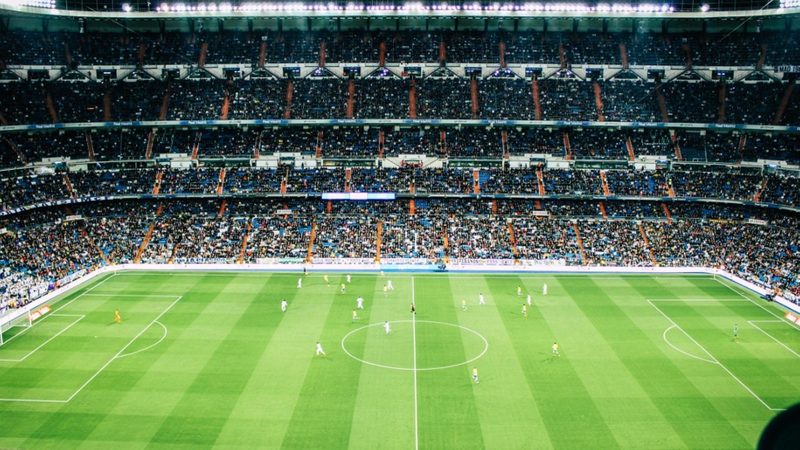
Football matches are fast and keep moving from end to end. The standard duration of a football match is 90 minutes which is equally divided into two halves of 45 minutes.
Some time gets added on in both halves due to stoppages and injuries to players depending on the interruptions during the game. This is called injury time or added time.
Teams that are inseparable at the end of 90 minutes, wherein both teams have either scored the same number of goals or remained goalless, in a league or a group stage match of a competition share a point each.
But when it comes to a knockout match where only one team can proceed further, extra time in football has to be used to determine a winner. Here, we look at what is extra time in football.
What is extra time in Football
When two teams remain inseparable after 90 minutes and injury time in a knockout match, referees use extra time to see whether the teams can score a goal and win the match.
Extra time is two equal periods of no more than 15 minutes each, so 30 minutes in all, and the teams change ends in between. There is usually a short break of about five minutes before extra time starts, but between the two periods the Laws allow only a short drinks break of no more than one minute.
In top-level competitions a team can make five substitutions, using no more than three stoppages plus half-time. Any unused substitutes and opportunities can be used in extra time, and where competition rules allow it, each team gets one additional substitute in extra time, with one additional opportunity to make it.
If the deadlock continues after 30 minutes of extra time, the match goes to a penalty shootout (officially, kicks from the penalty mark), with each team taking five kicks alternately and then sudden death if they are still level.
Variations of extra time in football
The Golden Goal and Silver Goal alternatives were tried out at the turn of the century. The golden goal was used at Euro 1996, the 1998 World Cup, Euro 2000 and the 2002 World Cup; the silver goal only at Euro 2004 and in UEFA club competitions from 2002-03.
Extra time would start after 90 minutes of regulation time. But the match was stopped with the first goal scored during extra time with the team scoring it being declared as the winners. Hence, the deciding goal was called the Golden Goal. Oliver Bierhoff won the Euro 1996 final for Germany with one, David Trezeguet won the Euro 2000 final for France, and Laurent Blanc’s golden goal against Paraguay in 1998 was the first at a World Cup.
In the Silver Goal variation, the game would not stop immediately if a team scores. The scores at half time of extra time are taken into account. If a team is leading the other at half time, the game ends there with the team leading declared as the winner.
But if the teams are level at half time, then the match continues similar to a normal game with extra time. The only major match decided by a silver goal was the Euro 2004 semi-final, when Traianos Dellas scored for Greece against the Czech Republic.
In February 2004 the IFAB, which writes the Laws of the Game, announced that both the Golden Goal and the Silver Goal would be removed after Euro 2004. Since then, once extra time starts, both periods are played in full.
However, extra time is not compulsory: competition rules can send a drawn match straight to penalties after 90 minutes.
Copa America 2024 did this: drawn quarter-finals, semi-finals and the third-place match went straight to a penalty shootout.
Only the final had extra time, and it was needed: Argentina beat Colombia 1-0 with a Lautaro Martinez goal in the second period of extra time.
Photo credit: Alamy