






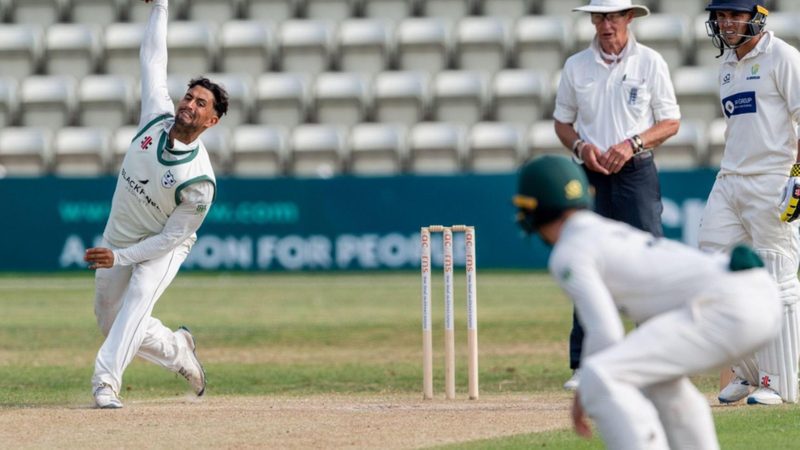
When one thinks about the game of cricket beyond the stars that play it, we tend to focus on its intricacies.
Everyone wants to know how many fours or sixes were hit in an innings, or who scored a hundred or a fifty.
On the bowling front, how many wickets a bowler takes, the mode of dismissals, maidens bowled and economy rates are often under the scanner.
However, one facet of the game from the bowling perspective that is often overlooked by fans is dot balls and their importance.
Dot balls can have a major say in deciding which team eventually goes on to win a game and they can be extremely valuable, especially in limited-overs cricket.
But precisely what is a dot ball in cricket? And how can they impact a match? Here’s a closer look at the significance of dots in cricket.
What is a dot ball in cricket?
A dot ball is a delivery off which no runs are scored at all — not off the bat, and not as extras. It takes its name from the scorebook, where such a delivery is marked with a single dot.
Dot balls are vital for fielding sides, in particular, and can have a major say in the outcome of a contest in limited-overs cricket.
That “no runs at all” is stricter than it first sounds, and it is where most confusion starts. A wide or a no-ball concedes a run before anything else happens, so neither can be a dot. A bye or a leg bye is still a run to the batting side even though it is not charged to the bowler’s figures, so those are not dots either — see our guide to extras in cricket for how each of those is recorded. The score registers the delivery in question as a single dot in the scorebook, hence the name.
Is a wicket ball a dot ball?
Yes, as long as no runs came off it. A wicket-taking delivery is marked with a W in the scorebook rather than a dot, but the definition only asks whether runs were scored, and none were. Statisticians count it in a bowler’s dot-ball tally.
The simplest way to see it: a maiden over is six dot balls in a row. A wicket maiden — an over with no runs off it and a wicket as well — is still six dot balls, not five. If the wicket delivery were excluded, no wicket maiden could ever contain six.
What is a good dot-ball percentage?
Dot-ball percentage is simply dots divided by legal deliveries bowled. A bowler who sends down four overs in a T20 has bowled 24 legal balls; 14 dots among them is 14 ÷ 24, or a shade over 58 per cent. In the same spell, six dots is 25 per cent, and the difference between those two spells is eight scoring balls the batting side did not get.
That is the arithmetic behind the cliché that dots build pressure. In a T20 innings of 120 balls, every extra ten dots is ten fewer chances to score, and the runs a side would have taken off them have to be made up somewhere else — usually by a bigger risk against a better ball.
As already mentioned, dot balls are vital in limited-overs cricket as they can bring added pressure to a batting side that is looking to accelerate and boost its run-rate.
Bowlers sometimes get lucky as batters miss bad deliveries entirely, thereby gifting them dots. More often they are earned: a yorker at the base of the stumps, or a full ball angled wide of off stump but still inside the tramlines, are the two staples at the death, when batters are swinging at everything.
Slower balls and bouncers are the other two standbys, both of them ways of taking the pace off or moving the ball away from the arc a batter wants to hit through.
It is why a run of dots is often talked about in the same breath as a wicket, particularly in a chase. A side that needs nine an over and gets three dots in a row is not just three balls behind — the rate it now needs has gone up for every ball still to come.
Photo credit: Alamy