






DLS method in cricket: how the target is set, and what the record says about who it favours
The Duckworth-Lewis-Stern method resets a target by comparing how much of two resources, overs and wickets, each side actually had. Here is how the number is produced, and what 221 rain-decided ODIs say about the belief that it helps the chasing team.
Jun 21, 2024 · Updated Aug 19, 2026
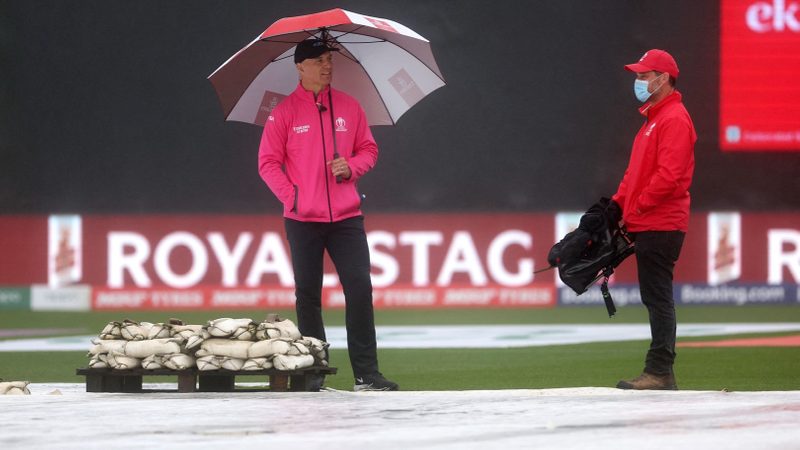
The DLS method is the calculation cricket uses to reset a target when rain, bad light or anything else shortens a limited-overs match. It stands for Duckworth-Lewis-Stern, after the three statisticians who built and then rebuilt it, and it works on a single idea: each side starts an innings with 100 per cent of two resources, overs and wickets, and a target should be adjusted in proportion to how much of those resources each side actually got.
That is the whole principle. What follows is how it turns into a number, what the published figures actually show about who it favours, and why the most famous image in the method’s history has the wrong total on it.
How the DLS method works
A side batting through a full 50-over innings without losing a wicket has used 100 per cent of its resources. Every over bowled uses some up, and so does every wicket, which is why the calculation cannot just be runs divided by overs. A team 10 for 0 after 10 overs has far more left in hand than a team 60 for 6 after the same 10 overs, and any method that ignores wickets would treat them identically.
DLS assigns a resource percentage to every combination of overs remaining and wickets lost. If the side batting second has fewer resources available than the side batting first had, the target comes down in proportion. If it somehow has more, which happens when the first innings is the one cut short, the target goes up.
| Situation | What DLS does |
|---|---|
| Second innings shortened | Target reduced in proportion to lost resources |
| First innings shortened | Target raised, because the chasing side knows its full allocation from the start |
| Both innings shortened | Resources compared directly, either way |
| Interruption with no overs lost | No change |
A worked example
Take a side that makes 250 from its full 50 overs, so it used 100 per cent of its resources. Rain then cuts the reply to 40 overs before a ball of it is bowled. Under the published Standard Edition table, a side starting an innings with 40 overs and all 10 wickets has about 89.3 per cent of the resources available.
So the second side is chasing 250 multiplied by 0.893, which is 223.25. The par score is 223 and the target to win is 224. Note what has not happened: the required rate has gone up, from 5.00 an over to 5.60, because ten overs were removed but no wickets were. Losing overs alone makes a chase harder per ball, not easier.
One caveat that most explainers skip. The table above is the Standard Edition, which is published precisely so that it can be used with a pen and paper at club level. International and major franchise cricket uses the Professional Edition, which runs as software and whose underlying figures are not public. You cannot reproduce an international DLS target by hand, and any calculator claiming to give you the official number is working from the standard table.
Does DLS favour the side chasing?
This is the complaint you hear whenever a target moves, and the published record gives it much less support than its popularity suggests.
Across the 2,569 men’s ODIs with published ball-by-ball data between June 2002 and August 2026, 221 were decided by DLS. In those matches the side batting second won 55.1 per cent of the time. Across every match in the same set, decided by any means, the side batting second won 52.3 per cent of the time.
So the chasing side does win slightly more often in a DLS match, by under three percentage points. That is a long way from the thumb on the scale the argument usually describes, and some of it is not the method at all: a rain-hit match is more likely to be one where a side chose to bowl first because the forecast was bad.
The T20 record points the other way, which is worth knowing before anyone treats the ODI number as a rule. Across 230 matches at men’s T20 World Cups, 11 were settled by DLS, and nine of those 11 were won by the side that batted first. That is a small sample and should be read as one, but nothing in it supports the idea that a shortened T20 chase is a gift.
How often does DLS actually decide a match?
Roughly one men’s ODI in twelve, on the same set of 2,569 matches: 221 of them, or 8.6 per cent. At T20 World Cups the rate is about half that, 11 in 230, which is 4.8 per cent.
Two things to hold on to about those figures. They exclude Afghanistan entirely, because the public ball-by-ball archive does not carry Afghanistan’s ODIs, and they start in 2002, so the method’s first five years are not in them. Both are stated here rather than buried, because a number like “one in twelve” invites being quoted without its scope.
The match that made it necessary
Before DLS, rain-affected targets used the Most Productive Overs method, and the 1992 World Cup semi-final at the SCG is why it no longer exists.
South Africa needed 22 runs from 13 balls against England when rain stopped play. The delay cost two overs. Most Productive Overs cut the target by subtracting the runs England had scored in their least productive overs, which took one run off the requirement while removing twelve balls to get it. South Africa came back needing 21 from one delivery.
Here is the part almost every retelling gets wrong, including the photographs. The giant SCG scoreboard read “SOUTH AFRICA TO WIN 22 RUNS OFF 1 BALL”, and that image is the one that circulates. The scoreboard was mistaken. The actual requirement was 21. If you have seen the 22 quoted as fact, you have seen a photograph of an error, which is a useful reminder that a picture of a number is not a source for it.
Frank Duckworth and Tony Lewis, both English statisticians, published their alternative in the mid-1990s. It was first used in a Zimbabwe against England match in 1997 and the ICC adopted it in 1999. Australian statistician Steven Stern took over as custodian after both men retired, recalibrated it for how much faster sides had started scoring, and the method was renamed Duckworth-Lewis-Stern in November 2014.
When a match can be decided at all
DLS cannot produce a result out of nothing. The side batting second has to face a minimum amount of cricket first: 20 overs in an ODI and five overs in a T20. Below that the match is a no result, however lopsided it looked. This is why you occasionally see a side apparently cruising and still getting nothing from the game.
It is also why the toss and the forecast interact the way they do. A captain who bowls first under heavy cloud is not only chasing a target, but keeping open the possibility that the target becomes a revised one.
Common questions about the DLS method
What does DLS stand for? Duckworth-Lewis-Stern, after Frank Duckworth, Tony Lewis and Steven Stern. It was the Duckworth-Lewis method until November 2014.
How is the DLS target calculated? By comparing the resources each side had. The chasing side’s target is the first innings score scaled by the ratio of the two resource percentages, then rounded up by one run to give a winning target rather than a tie.
Why does the target sometimes go up? Because the side batting second knows its reduced allocation from the first ball and can attack accordingly, while the side batting first planned for a full innings. Fewer overs with that knowledge is worth more per over.
How many overs are needed for a DLS result? Twenty per side in an ODI, five per side in a T20.
Can I calculate an international DLS target myself? Not exactly. International cricket uses the Professional Edition, whose tables are not published. The Standard Edition table gets you close and is the one every public calculator uses.
Related reading
- What is par score in cricket
- How to calculate run rate in cricket
- What a par score really is at each IPL ground
- Highest score in T20 World Cup
Read more of our cricket explainers
Featured photo: Marty MELVILLE / AFP