






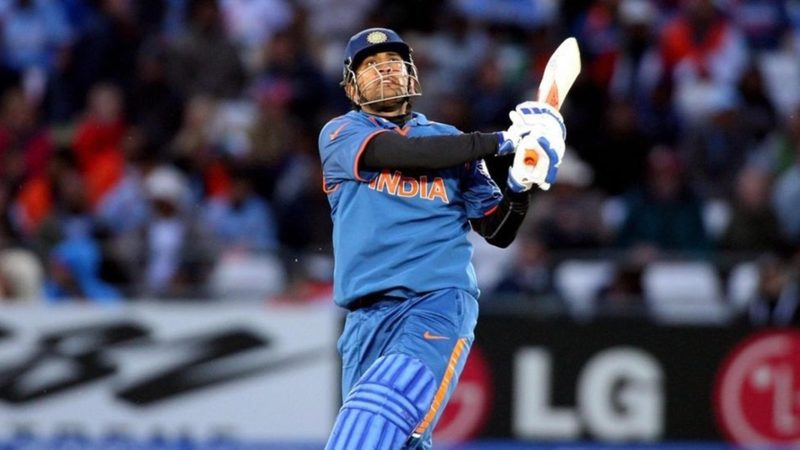
The slowest T20 international innings by an India batter is MS Dhoni’s 9 off 27 balls against Australia at the Melbourne Cricket Ground on 1 February 2008 — a strike rate of 33.33, with no boundaries.
T20 asks a batter to make the most of 120 deliveries, so an innings is judged by strike rate rather than runs. The list below ranks India’s men’s T20I innings by strike rate with a minimum of 20 balls faced. That floor matters: without it, any two-ball duck would top the table and tell you nothing.
Dhoni appears twice in the top three and Yuvraj Singh twice in the top six. Five of the ten innings contain no boundary at all.
Slowest T20I innings by India batters (minimum 20 balls)
|
# |
Player |
Runs |
Balls |
SR |
Against |
Ground |
Date |
|
1 |
MS Dhoni |
9 |
27 |
33.33 |
Australia |
Melbourne |
1 Feb 2008 |
|
2 |
Yuvraj Singh |
14* |
32 |
43.75 |
Pakistan |
Mirpur |
27 Feb 2016 |
|
3 |
MS Dhoni |
11 |
23 |
47.82 |
West Indies |
Lord’s |
12 Jun 2009 |
|
4 |
Bhuvneshwar Kumar |
16 |
32 |
50.00 |
Sri Lanka |
Colombo (RPS) |
29 Jul 2021 |
|
5 |
Ravichandran Ashwin |
10 |
20 |
50.00 |
New Zealand |
Nagpur |
15 Mar 2016 |
|
6 |
Yuvraj Singh |
11 |
21 |
52.38 |
Sri Lanka |
Mirpur |
6 Apr 2014 |
|
7 |
Shikhar Dhawan |
14 |
24 |
58.33 |
Australia |
Bengaluru |
27 Feb 2019 |
|
8 |
Ishan Kishan |
19 |
32 |
59.37 |
New Zealand |
Lucknow |
29 Jan 2023 |
|
9 |
Gautam Gambhir |
17 |
27 |
62.96 |
England |
Wankhede |
22 Dec 2012 |
|
10 |
Virat Kohli |
19 |
29 |
65.51 |
West Indies |
Lauderhill |
3 Aug 2019 |
Statistics correct up to 23 August 2026. Men’s T20 internationals only.
MS Dhoni | 9 off 27 vs Australia | SR 33.33 | 2008
Dhoni’s 27-ball 9 came in the only T20I of India’s 2007-08 tour of Australia. Batting first at the MCG, India were 20/4 inside four overs when the captain walked out. He never got going, was dismissed by David Hussey without hitting a boundary, and India were bowled out for 74 in 17.3 overs. Australia knocked the runs off in 11.2 overs to win by nine wickets.
Yuvraj Singh | 14* off 32 vs Pakistan | SR 43.75 | 2016
The second-slowest innings on the list is also the one India won from, which is why strike rate on its own is a blunt instrument. Chasing 84 in the 2016 Asia Cup T20 at Mirpur, India lost Rohit Sharma, Ajinkya Rahane and Suresh Raina to Mohammad Amir inside three overs. Virat Kohli (49) and Yuvraj added 68 to see it through, Yuvraj unbeaten on 14 from 32. India won by five wickets with 27 balls to spare, and Kohli took the player-of-the-match award for the same kind of innings.
MS Dhoni | 11 off 23 vs West Indies | SR 47.82 | 2009
India lost their first three wickets for 29 in 4.2 overs against West Indies at Lord’s in the 2009 World Twenty20. Dhoni joined Yuvraj Singh and made 11 from 23 before falling to Dwayne Bravo. Yuvraj’s 67 from 43 balls carried India to 153/7, but West Indies chased it in 18.4 overs to win by seven wickets.
Bhuvneshwar Kumar | 16 off 32 vs Sri Lanka | SR 50.00 | 2021
Bhuvneshwar Kumar’s 32-ball 16 against Sri Lanka in Colombo in July 2021 is the longest boundary-less innings in the table. Five of these ten innings contain no four and no six at all — Dhoni’s 9 and 11, Bhuvneshwar’s 16, Ashwin’s 10 and Yuvraj’s 11 in the 2014 final. Between them the ten innings produced seven fours and not a single six.
Ravichandran Ashwin | 10 off 20 vs New Zealand | SR 50.00 | 2016
Ashwin’s 20-ball 10 in Nagpur at the 2016 World T20 shares a strike rate of exactly 50.00 with Bhuvneshwar’s innings; Bhuvneshwar ranks above him here because he used 12 more deliveries to get there.
Yuvraj Singh | 11 off 21 vs Sri Lanka | SR 52.38 | 2014
The most consequential innings on the list. In the 2014 World T20 final at Mirpur, India lost Ajinkya Rahane and Rohit Sharma with the score on 64/2 in 10.3 overs and Yuvraj walked in to join Virat Kohli. He struggled against pace and spin alike, making 11 from 21 as India closed on a below-par 130/4. Sri Lanka chased it down in 17.5 overs to win the title by six wickets.
Why the 20-ball qualification matters
Strike rate over a handful of deliveries is noise. A batter who faces four balls for one run has a strike rate of 25, lower than every innings in the table above, without having done anything unusual. Twenty balls is a third of a batter’s likely allocation in a T20 innings and is long enough for a strike rate to mean something — it is also the floor most published lists of slow T20 innings use, which is why the same names recur across them.
What is the slowest T20I innings by an Indian?
MS Dhoni’s 9 from 27 balls against Australia at the MCG on 1 February 2008, at a strike rate of 33.33.
Who has the most slow innings on this list?
MS Dhoni and Yuvraj Singh, with two each in the top ten.
Has any Indian batted 40 balls or more at under a run a ball in a T20I?
No. Among India innings of 40 balls or more, the lowest strike rate is Ishan Kishan’s 35 from 42 against West Indies at Eden Gardens in February 2022, a rate of 83.33.
Follow us on Telegram for the latest updates from the world of sports!
Interested in cricket betting? Click here to check out the list of top sites.
Photo credit: Alamy