








SG cricket ball: who makes it, what the Laws require, and why India’s Tests use it
The SG is the red ball used for Test cricket in India, made by hand in Meerut. What the Laws require of any cricket ball, and how the SG differs from the Dukes and the Kookaburra.
Feb 1, 2022 · Updated Sep 19, 2026
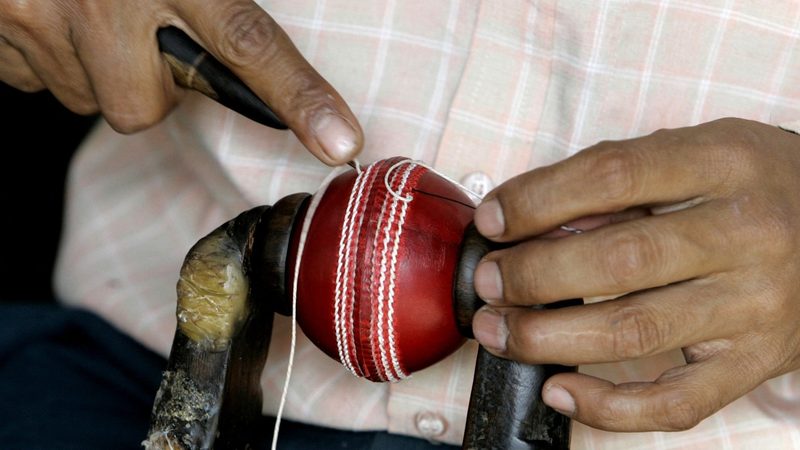
The SG cricket ball is the red ball used for Test cricket in India. It is made by hand in Meerut by Sanspareils Greenlands, the company the initials belong to, and it is one of only three brands used in international cricket alongside the Dukes and the Kookaburra.
It is not used for every match India play at home. The SG is the red-ball choice for Tests and for India’s first-class cricket; white-ball internationals in India are played with a white ball, and the SG Test line itself comes in red, white and pink. What follows is what the Laws actually require of a cricket ball, what SG makes, and how their ball differs from the other two.
What the Laws require of any cricket ball
The Laws of Cricket do not name a single manufacturer. Law 4 sets the weight and the size, and Law 4.6 says only this: “The Governing Body responsible for the match shall determine the size of ball to be used.” Everything else — the leather, the seam, the core, the brand stamped on it — is left open. An SG, a Dukes and a Kookaburra are all legal because they all sit inside the same small box.
| Ball | Weight | Circumference | Used by |
|---|---|---|---|
| Size 1 | 156 g to 163 g | 22.4 cm to 22.9 cm | Men’s cricket |
| Size 2 | 142 g to 149 g | 21.5 cm to 22 cm | Women’s cricket |
| Size 3 | 133 g to 140 g | 20.5 cm to 21 cm | Junior cricket |
Two other clauses matter for a Test. Law 4.4 lets the fielding captain take a new ball once 80 overs have been bowled with the old one in any match of more than one day, which is the number every argument about the SG’s durability is really about. And Law 4.5 says that if a ball becomes unfit for play, the umpires replace it with one of comparable wear — not a new one.
Who makes the SG ball, and where
Sanspareils Greenlands was established in 1931, founded by the brothers Kedarnath and Dwarakanath Anand, and the family still runs it: Paras Anand is the chief executive and Puneet Anand a director. The balls are made at the company’s works on Gangol Road in Partapur, Meerut, in Uttar Pradesh — the town that supplies a large share of the world’s cricket equipment.
SG’s own specification for the Test ball is a four-piece construction in Grade 1+ alum-tanned leather around a cork core, water-proofed, with the seam stitched by hand. The same Test ball is produced in red for daylight cricket, white for white-ball matches and pink for day-night Tests.
The BCCI first put an SG ball into Ranji Trophy cricket in 1992 and sanctioned it for Test matches in India two years later, in 1994. It has been India’s home Test ball ever since.
SG vs Dukes vs Kookaburra
The three balls are legal in the same way and different in almost every other way. The difference that does the work is the seam: how it is stitched, how proud it stands, and how long it stays that way.
| SG | Dukes | Kookaburra | |
|---|---|---|---|
| Made in | Meerut, India | London, England | Melbourne, Australia |
| Maker | Sanspareils Greenlands | British Cricket Balls Ltd | Kookaburra Sport |
| Stitching | All six rows by hand | All six rows by hand | Two central rows by hand, the rest by machine |
| Seam | Thickest thread, most prominent | Pronounced, holds its shape longest | Flatter, goes soft soonest |
| Used for Tests in | India | England, West Indies, Ireland | Everywhere else |
The practical consequence is a different shape of innings in each country. A Dukes keeps seam movement available to a bowler for a long stretch. A Kookaburra goes soft soonest and asks the bowling side to find another way earliest. The SG sits in between and then behaves differently again, because the surface it is being bowled on is usually dry and abrasive rather than green.
Which bowlers does the SG ball suit?
Spinners, mostly, and for a reason that is about the ball rather than the pitch alone. The SG’s thick hand-stitched seam stands proud enough for a finger spinner to grip and for the ball to bite when it lands, and Indian surfaces — dry, with little grass and less moisture — scuff the leather quickly. That combination gives the older SG something the other two lose: a hard, raised seam on a rough ball, which is exactly what reverse swing and turn both need.
Seamers get the opposite deal. The lacquer goes early on abrasive square-cut outfields, there is rarely enough in the surface for the new ball to do much, and by the time the ball is old enough to reverse, the spinners are usually already bowling.
The criticism of the SG ball
The complaint has always been durability, and it came to a head in February 2021, during the India vs England Test in Chennai, when Virat Kohli, then India’s Test captain, and Ravichandran Ashwin both said the seam had gone by 60 overs — twenty short of the point at which Law 4.4 lets a captain ask for a new one.
Sanspareils Greenlands spent about eighteen months on a redesign and produced a version with a raised uthi hui seam, a darker shade of red and a harder core, which Paras Anand said would hold together for 50 to 60 overs. That is worth reading carefully: the fix was pitched at the same window the criticism was about.
Boards do change the ball
It is easy to assume the map is fixed. It is not. Pakistan moved their first-class cricket from the Dukes back to the Kookaburra for 2026-27, the second such switch in seven years, on the argument that a ball which does too much for the bowlers stops batters and seamers developing. India has used the same home-made ball for its Tests since 1994 without a change of brand, which is a large part of why the SG debate never quite goes away.
Is SG owned by Sunil Gavaskar?
No. Sunil Gavaskar has never owned Sanspareils Greenlands; he is its most famous endorser, and the association is old enough that the assumption is understandable. He signed a lifetime contract with SG in 1983, turned down offers from foreign brands to do it, and was still using an SG bat when he retired, having made most of his runs with the Triple Crown and Sunny Tonny. SG’s current front line is KL Rahul, Hardik Pandya and Rishabh Pant.
SG ball FAQs
Where is the SG ball made? In Meerut, Uttar Pradesh, by Sanspareils Greenlands Pvt. Ltd.
When did India start using the SG ball in Tests? In 1994, two years after it was introduced to the Ranji Trophy.
How much does a Test cricket ball weigh? Between 156 g and 163 g when new, under Law 4.1. That applies to every brand.
Is there a pink SG ball? Yes. The SG Test is made in red, white and pink, the last of those for day-night Tests.
Why do bowlers complain about the SG ball? Because its seam has historically flattened before the 80 overs at which a captain may take the new ball.
Author: William Paul
Follow us on Telegram for the latest updates from the world of sports!
Interested in cricket betting? Click here to check out the list of top sites.
Featured photo: AFP / PRAKASH SINGH