






Racism in cricket is one of the darkest truths that continue to draw blood from the sport. It showcases how players are condemned to racial slurs or monikers that carry ill intent.
In January 2021, during India’s third Test against Australia in Sydney, India told officials that a group of their players, including Jasprit Bumrah and Mohammed Siraj, had been racially abused by the crowd. A group of spectators was removed from the SCG on the fourth day after Siraj alerted the umpires, and Cricket Australia apologised to India.
A fortnight earlier, South Africa’s players had raised their fists in support of the Black Lives Matter movement before their Boxing Day Test against Sri Lanka in Centurion.
The gesture followed criticism of the team for not taking a knee, or making any other gesture, when they returned to international cricket against England in November 2020.
The history of racist incidents in cricket largely ranges from remarks on skin colour and nationality. And despite the Anti-Discrimination Policy, these cases are still prevalent.
In June 2021, England’s Ollie Robinson was suspended from international cricket after racist and sexist tweets he had posted in 2012 and 2013 resurfaced on the day of his Test debut against New Zealand. Later in 2021, Azeem Rafiq’s allegations about his time at Yorkshire led to a parliamentary hearing and a national inquiry.
Here are some instances of racism in cricket that rocked the sport:
Monkeygate
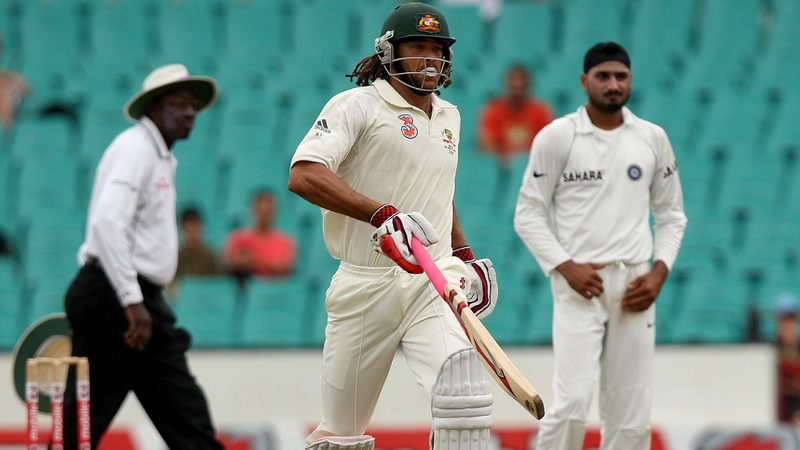
The Monkeygate saga is by far the ugliest controversy to have unfolded in Australia-India rivalry and one which still resonates today.
The incident, a verbal altercation between Andrew Symonds and Harbhajan Singh in an already-tense second Australia-India Test at Sydney in 2008, saw the Indian off-spinner allegedly call the Aussie a ‘Monkey’.
Neither umpire heard the remark. Ricky Ponting reported it to the umpires, who reported Harbhajan to match referee Mike Procter. At the hearing after the Test, Sachin Tendulkar, who was batting with Harbhajan at the time, said words had been spoken in both English and Hindi.
Procter found Harbhajan guilty of racial abuse and banned him for three Tests.
On appeal, Justice John Hansen found the racism charge not proved, and on 29 January 2008 it was replaced by the lesser charge of using abusive language. Symonds could not say for certain whether Harbhajan had said “monkey” or the Hindi phrase “teri maa ki”. The ban was lifted, and Harbhajan was fined 50 per cent of his match fee.
The two later became team-mates at Mumbai in the Indian T20 League. Symonds died in a car crash in Queensland in 2022.
Daren Sammy called ‘kalu’
In June 2020, West Indies’ Daren Sammy said that he and Sri Lanka’s Thisara Perera had been called ‘kalu’, a Hindi word for ‘black’, when they played for Hyderabad in the Indian T20 League in 2013 and 2014.
The former West Indies captain said on Instagram that he only understood what the word meant after watching comedian Hasan Minhaj.
recently I discovered a word that I was being called was not what it actually meant I need some answers. So before I start calling out names I need these individuals to reach out and please tell me there’s another meaning to that word. I saw u as brothers
Daren Sammy (@darensammy88), June 9, 2020
Sammy later said he had had a good conversation with a former Hyderabad team-mate, who told him the word had been used ‘from a place of love’.
I’m please to say that I’ve had a really interesting conversation with one of the guys and we are looking at ways to educate rather than focusing on the negatives. My brother reassured me that he operated from a place of love and I believe him.
Daren Sammy (@darensammy88), June 11, 2020
Dean Jones’ ‘terrorist’ comment on live TV
The late Dean Jones was a fine one-day batter and a popular commentator, but his ‘terrorist’ remark about South Africa’s Hashim Amla during a Test in Colombo in August 2006 ended his commentary contract.
When Amla, a Muslim with a full beard, took a catch, Jones was heard saying “the terrorist gets another wicket”. The remark was made during a commercial break but went out on air.
His contract with Ten Sports was terminated, and Jones apologised.
Moeen Ali labelled Osama
In his autobiography, published in 2018, Moeen Ali wrote that an Australian player had called him ‘Osama’ during the Cardiff Test of the 2015 Ashes.
He wrote: “An Australian player had turned to me on the field and said, ‘Take that, Osama.’ I could not believe what I had heard. I remember going really red. I have never been so angry on a cricket field.”
England coach Trevor Bayliss raised it with his Australia counterpart Darren Lehmann at the time. The player denied it and said he had called Moeen a ‘part-timer’, and Moeen chose not to take it further. Cricket Australia looked at it again in 2018, found no new evidence and closed the matter.
Jofra Archer tweets about racism
England’s Jofra Archer was racially abused by a spectator during the first Test against New Zealand at Mount Maunganui in November 2019, and said so on Twitter.
A bit disturbing hearing racial insults today whilst battling to help save my team , the crowd was been amazing this week except for that one guy , @TheBarmyArmy was good as usual also
Jofra Archer (@JofraArcher), November 25, 2019
New Zealand Cricket identified the man, a 28-year-old from Auckland, and banned him from cricket venues in New Zealand for two years.
Azeem Rafiq and Yorkshire
Former Yorkshire spinner Azeem Rafiq said he had suffered racist abuse and bullying during his two spells at the club, from 2008 to 2014 and from 2016 to 2018. An independent report commissioned by Yorkshire upheld some of his complaints in 2021.
In November 2021, the England and Wales Cricket Board suspended Yorkshire from hosting international matches, the club’s chairman Roger Hutton resigned, and Rafiq gave evidence to a parliamentary committee.
In 2021 the ECB had also commissioned the Independent Commission for Equity in Cricket in response to the Yorkshire case. Its 317-page report, published in June 2023 after evidence from more than 4,000 people, found widespread racism, sexism and elitism in the game in England and Wales.
These six cases are among the most prominent, but there have been others. Darren Lehmann was banned for five ODIs for a racist remark about Sri Lanka in 2003. Herschelle Gibbs was banned for two Tests in 2007 after telling Pakistan supporters to “go back to the zoo”. Pakistan captain Sarfaraz Ahmed was suspended for four matches in 2019 for a racist slur at South Africa’s Andile Phehlukwayo.
For the cricket itself, compare the cricket betting sites.
Feature image courtesy: AFP / Greg Wood