








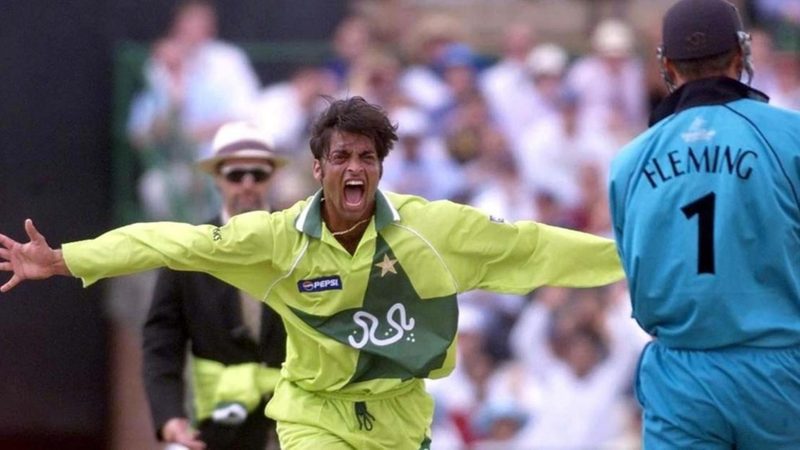
The fastest ball in cricket history is Shoaib Akhtar’s 161.3 km/h — 100.2 mph — to Nick Knight of England at Cape Town during the 2003 World Cup. Twenty-three years on, nothing has been measured faster, and only one other bowler has been credited with a delivery past 100 mph.
⚠️ Before the lists, the thing that governs all of them: cricket keeps no official record for bowling speed. The ICC ratifies runs and wickets; it does not ratify these. Every figure below is a broadcaster’s speed-gun reading, taken on equipment that has changed repeatedly over fifty years, calibrated differently, and measured at different points in the ball’s flight. These are the numbers the game has settled on — they are not measurements made to one standard.
The clearest illustration is a reading that was withdrawn. Brett Lee was clocked at 161.8 km/h in a Test at Brisbane in the 2000-01 season, which would have put him ahead of Akhtar. Channel Nine, Australia’s broadcaster at the time, later accepted the reading was wrong. It appears on no list, this one included.
Fastest ball in cricket history: the ten quickest recorded
| Bowler | Fastest delivery | Against | Year |
|---|---|---|---|
| Shoaib Akhtar (Pakistan) | 161.3 km/h (100.2 mph) | England | 2003 |
| Shaun Tait (Australia) | 161.1 km/h (100.1 mph) | England | 2010 |
| Brett Lee (Australia) | 160.8 km/h (99.9 mph) | New Zealand | 2005 |
| Jeff Thomson (Australia) | 160.6 km/h (99.8 mph) | West Indies | 1975 |
| Mitchell Starc (Australia) | 160.4 km/h (99.7 mph) | New Zealand | 2015 |
| Andy Roberts (West Indies) | 159.5 km/h (99.1 mph) | Australia | 1975 |
| Fidel Edwards (West Indies) | 157.7 km/h (97.9 mph) | South Africa | 2003 |
| Mitchell Johnson (Australia) | 156.8 km/h (97.4 mph) | England | 2013 |
| Mohammad Sami (Pakistan) | 156.4 km/h (97.1 mph) | Zimbabwe | 2003 |
| Shane Bond (New Zealand) | 156.4 km/h (97.1 mph) | India | 2003 |
Shaun Tait’s 161.1 km/h came to Craig Kieswetter in his first over of an ODI against England at Lord’s in 2010; Australia won that match by 42 runs. Jeff Thomson’s 160.6 km/h at Perth in 1975 stood as the benchmark for three decades before the modern guns arrived.
Fastest ball in Tests, ODIs and T20s
📌 There is no per-format speed record either, which is the honest answer to “what is the fastest ball in Test cricket?” Nobody maintains separate ratified lists by format, which is why the same handful of deliveries turns up wherever the question is asked.
What can be said with confidence: Akhtar’s 161.3 km/h and Tait’s 161.1 km/h were both bowled in one-day internationals, and Mitchell Starc’s 160.4 km/h against New Zealand at Perth in 2015 is the quickest delivery widely credited in a Test match. Beyond those, the format attached to a given reading is often reported inconsistently, and this page does not guess at it.
Fastest ball in the Indian T20 League
| Bowler | Team | Speed | Year |
|---|---|---|---|
| Shaun Tait (Australia) | Rajasthan | 157.71 kph | 2011 |
| Lockie Ferguson (New Zealand) | Gujarat | 157.3 kph | 2022 |
| Umran Malik (India) | Hyderabad | 157 kph | 2022 |
| Mayank Yadav (India) | Lucknow | 156.7 kph | 2024 |
| Anrich Nortje (South Africa) | Delhi | 156.2 kph | 2020 |
| Umran Malik (India) | Hyderabad | 156 kph | 2022 |
Tait’s 157.71 kph for Rajasthan in 2011 is still the quickest recorded in the competition, fifteen seasons later. Mayank Yadav’s 156.7 kph against Bengaluru was the fastest ball of the 2024 season.
Fastest ball by an Indian bowler
| Bowler | Fastest ball | Against | Year |
|---|---|---|---|
| Umran Malik | 157 kph | Delhi | 2022 |
| Mayank Yadav | 156.7 kph | Bengaluru | 2024 |
| Irfan Pathan | 153.7 kph | Pakistan | 2007 |
| Mohammed Shami | 153.3 kph | Australia | 2014 |
| Jasprit Bumrah | 153.26 kph | Australia | 2018 |
⚠️ The top two rows are franchise cricket, and that distinction gets lost constantly. Umran Malik’s 157 kph and Mayank Yadav’s 156.7 kph were both bowled in the Indian T20 League. The fastest ball by an India bowler in international cricket is Malik’s 156 kph against Sri Lanka in 2023 — not Irfan Pathan’s 153.7 kph, which is the quickest of the earlier generation but has been beaten.
Javagal Srinath is reported to have passed 157 kph in South Africa in 1996, on equipment nobody now treats as reliable, so it sits outside every list.
Fastest ball in cricket history: quick answers
What is the fastest ball ever bowled? 161.3 km/h (100.2 mph) by Shoaib Akhtar against England at Cape Town in 2003.
Has anyone else bowled 100 mph? One bowler: Shaun Tait, 161.1 km/h (100.1 mph) against England in 2010.
What is the fastest ball by an Indian? Umran Malik’s 157 kph in the 2022 Indian T20 League; his 156 kph against Sri Lanka in 2023 is the fastest by an India bowler in an international.
What is the fastest ball in the Indian T20 League? Shaun Tait’s 157.71 kph for Rajasthan in 2011.
Is there an official fastest-ball record? No. The ICC does not ratify bowling speeds; every figure comes from a broadcaster’s speed gun.
More on the same subject: the fastest bowler in the world, the fastest Indian bowler and Umran Malik’s fastest ball.
Follow us on Telegram for the latest updates from the world of sports!
Interested in cricket betting? Click here to check out the list of top sites.
Photo credit: Alamy