






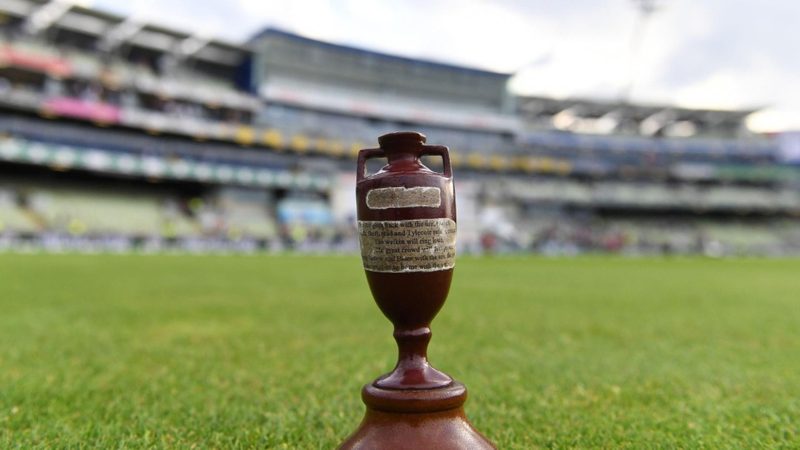
The Ashes urn is 10.5 cm tall and weighs 124.8 grams — and MCC, which owns it and has it on display at Lord’s, is blunt about what it is not: “It is not and never has been a trophy.” The thing the winning captain actually lifts is a Waterford Crystal replica, first handed over in 1999. The urn itself has never left Lord’s for an Ashes series and never travels with the result.
That distinction is the answer to most questions about the “Ashes trophy”, so it is worth having both objects straight before the history.
The Ashes urn: size, weight and what is actually inside it
| Detail | The urn |
|---|---|
| Height | 10.5 cm |
| Weight | 124.8 g |
| Material | Terracotta, possibly an antique perfume bottle or cosmetic jar |
| Contents | Unknown — probably the ashes of a burnt bail |
| Home | The MCC Museum at Lord’s, permanently |
| Status | A personal memento, not a trophy |
Two of those rows usually get stated with more confidence than the evidence supports, so be careful with them. Nobody can say for certain what is inside the urn; MCC’s own account is that the object’s origin and contents are both uncertain, with a burnt bail the likeliest answer and a version involving the ashes of a lady’s veil in circulation as well. And the urn was probably not made to be a cricket prize at all — the shape is that of a small antique perfume bottle or cosmetic jar.
The weight is worth noting because it is so often given as unknown. It is not: 124.8 grams, about the weight of a cricket ball short of a third.
What is written on the Ashes urn
Two things are attached to it, and they are different in kind. The first is a hand-written label reading simply “The Ashes”. The second is not a label at all but a poem cut out of the Melbourne newspaper Punch, dated 1 February 1883, and pasted below it. The verse reads:
When Ivo goes back with the urn, the urn;
Studds, Steel, Read and Tylecote return, return;
The welkin will ring loud,
The great crowd will feel proud,
Seeing Barlow and Bates with the urn, the urn;
And the rest coming home with the urn.
Every name in it is one of Ivo Bligh’s players on the 1882-83 tour — Allan Steel, Walter Read, the wicket-keeper Edward Tylecote, Dick Barlow and Billy Bates — which is why the verse reads like a team sheet. “Studds” is plural for a reason: the squad contained two brothers, Charles and George Studd. A red velvet bag to hold the urn came with it.
⚠️ The verse is often described as “engraved” or “etched” on the urn. It is not. It is newsprint, glued on, which is part of why the object is as fragile as MCC says it is.
The urn is not the trophy, and the Waterford Crystal one is
By the 1990s both boards wanted something the winning side could actually be handed and take home. MCC commissioned an urn-shaped Waterford Crystal trophy, and it was first presented to Australia captain Mark Taylor after the 1998-99 series. It has gone to the winning captain at the end of every Ashes series since.
The original stays put regardless. Whoever wins, the urn remains in the MCC Museum at Lord’s — which is the reason the commentary line about Australia “retaining the urn” is figurative and always has been.
Australia hold the Ashes, having won the 2025-26 series 4-1 — Perth, Brisbane, Adelaide and Sydney, with England’s only win at Melbourne. The full roll of honour is in our Ashes winners list.
How a seven-run defeat produced an urn
Australia beat England by seven runs at The Oval in August 1882 — their first Test win on English soil. The Sporting Times ran a mock obituary for English cricket, ending with the line that gave the series its name: the body would be cremated and “the ashes taken to Australia”.
Ivo Bligh took an England side to Australia that winter promising to bring back “the ashes”, and won the three-match series 2-1 after losing the first Test. A fourth match was played on the same tour and lost, but it was not part of the Ashes series — a distinction argued over ever since. The urn was presented to him on that tour.
📌 Exactly when and by whom is genuinely disputed, and a page that picks one version is guessing. One account has it handed to Bligh at Rupertswood after a social match on Christmas Eve 1882, before the Tests began; another has a group of Melbourne women presenting it once the series was won, among them Florence Morphy, whom Bligh later married. The poem pasted to the urn is dated 1 February 1883, which at least fixes the decoration as later than Christmas. MCC treats the origin as uncertain, and so should anyone else.
What is not disputed is how it reached Lord’s. Bligh — by then Lord Darnley — died in 1927, and Florence presented the urn to MCC; Lord’s dates the presentation to 1928. He had always regarded it as a personal gift rather than a sporting prize, which is precisely why it became a museum piece instead of a trophy.
The three times the urn has been to Australia
For an object at the centre of a contest played half the time in Australia, it travels remarkably little:
- 1988 — the Bicentennial celebrations, for less than a week.
- 2006-07 — toured six cities over three months during the Ashes series.
- December 2019 to February 2020 — the Velvet, Iron, Ashes exhibition at State Library Victoria in Melbourne.
Three visits in roughly 140 years, and none of them because a series result sent it there.
Ashes trophy: quick answers
How big is the Ashes trophy? The urn is 10.5 cm tall and weighs 124.8 g. The Waterford Crystal trophy the captains lift is a larger urn-shaped replica.
What is the Ashes urn made of? Terracotta — probably a repurposed antique perfume bottle or cosmetic jar.
What is inside the Ashes urn? Nobody knows for certain. A burnt bail is the likeliest answer; a lady’s veil is the other version told.
What is written on the Ashes urn? A hand-written “The Ashes” label, and beneath it a six-line poem cut from Melbourne Punch of 1 February 1883.
Does the winning team take the urn home? No. It stays in the MCC Museum at Lord’s whatever the result.
Who holds the Ashes now? Australia, after winning the 2025-26 series 4-1.
More on the rivalry and the format: England v Australia Test records, Test cricket rules explained and what stumps means — including the bail that may be inside the urn.
Follow us on Telegram for the latest updates from the world of sports!
Interested in cricket betting? Click here to check out the list of top sites.
Photo credit: Alamy