






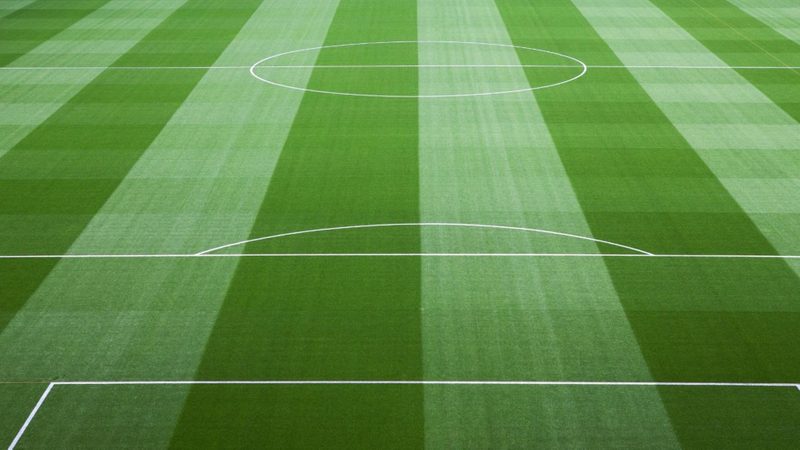
Football is one of the most popular team sports globally. Known as soccer as well, it has a massive fan following which helps garner great interest within the business world, making it a huge financial success.
A football pitch is the playing surface for football. The football ground size is set out in Law 1 of the Laws of the Game. Those Laws are written and maintained by the International Football Association Board (IFAB) rather than by FIFA — FIFA is one of IFAB’s five members, alongside the four British associations, and applies the Laws rather than writing them.
While the pitches are made of natural turf, artificial surfaces are also allowed, provided they are green. Artificial turfs are used, especially in areas where weather conditions affect natural grass maintenance.
What is the official football ground size?
The playing area of a soccer field has multiple lines marked on it, including the boundary lines. The longer lines are called touchlines and the shorter ones are termed goal lines. All the lines on the pitch are equal and are not more than 12 centimetres wide.
There is a goal in the centre of each end of the goal lines. A football pitch is divided into two halves, separated by a halfway line, at the centre of which is a circle with a radius of 9.15 metres. Each half has a designated penalty and goal area.
According to the norms set by FIFA, the length of the touchline ranges between 90-120 metres. On the other hand, the goal line has to be a minimum of 45 metres and a maximum of 90 metres.
International matches are tighter: touchlines of 100-110 metres and goal lines of 64-75 metres. A competition may also fix a single size within those ranges, which is what UEFA does.
One point of vocabulary: the whole of the shorter line is the goal line, including the part between the posts. “Byline” is commentary shorthand for the stretch of it either side of the goal, not a term in the Laws.
Football pitch dimensions at a glance
| Measurement | Metric | Imperial |
| Length (touchline) | 90–120 m | 100–130 yds |
| Length, international matches | 100–110 m | 110–120 yds |
| Width (goal line) | 45–90 m | 50–100 yds |
| Width, international matches | 64–75 m | 70–80 yds |
| Between the inside of the goalposts | 7.32 m | 8 yds |
| Crossbar height | 2.44 m | 8 ft |
| Penalty area, from each post | 16.5 m | 18 yds |
| Goal area, from each post | 5.5 m | 6 yds |
| Penalty mark from the goal | 11 m | 12 yds |
| Centre circle and penalty arc radius | 9.15 m | 10 yds |
| Corner arc radius | 1 m | 1 yd |
| Line width, maximum | 12 cm | 5 ins |
Grounds such as FC Barcelona’s Camp Nou and Manchester United’s Old Trafford play on 105 x 68 metres — the size UEFA requires for its own competitions, and the reason it has become the default for new stadiums.
Goal size and dimensions
The goals consist of two upright posts, placed equidistant from the centre of the goal line, joined by a horizontal crossbar. The posts and crossbars should be white and made of metal or other approved materials.
Law 1 puts 7.32 metres (8 yards) between the inside of the posts. The crossbar should be 2.44 metres from the ground. A goal is awarded when the entire ball crosses the line between the two goalposts.
Penalty area size and dimensions
The penalty area is the box on the football pitch where the goalkeeper is legally allowed to use his hands to manipulate the ball. It is drawn from the goal line: 16.5 metres from the inside of each goalpost, extending 16.5 metres into the field. That makes it 40.32 x 16.5 metres, or 44 x 18 yards.
A foul by the defending team on the offensive team in the box earns the latter a penalty kick. The penalty spot is 11 metres in front of the centre of the goal.
The penalty arc is drawn outside the box, and it is an arc rather than a semi-circle: it is the part of a 9.15-metre circle around the penalty mark that falls outside the penalty area. Its job is to keep every other player 9.15 metres from the ball at a penalty kick.
Goal area size and dimensions
The goal area, commonly called the six-yard box, is also a rectangle formed from the goal line, starting 5.5 metres or six yards from each goal post. Goal kicks are taken from anywhere inside it, as is any free kick awarded to the defending side in their own penalty area. Since 2019 the ball is in play at both as soon as it is kicked and clearly moves — it no longer has to leave the penalty area first, which is why goalkeepers can now roll it to a defender standing inside the box.
The one restriction runs the other way. An indirect free kick to the attacking side for an offence inside the goal area is not taken where the offence happened: it is moved to the nearest point on the goal-area line that runs parallel to the goal line.
Photo credits: Alamy