






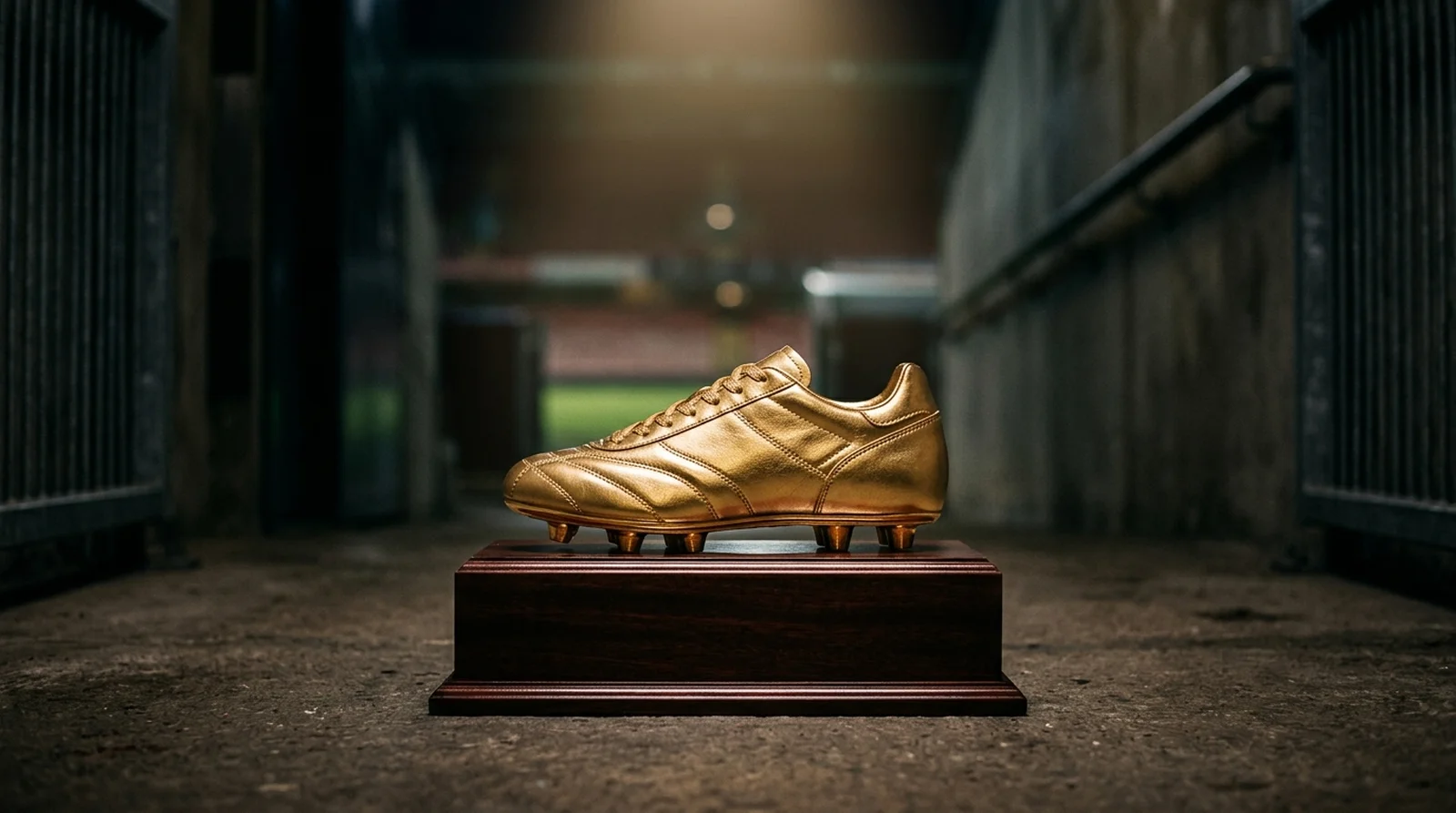
The FIFA World Cup Golden Boot goes to the tournament’s leading goal-scorer, and after 23 editions it finally has a repeat winner. Kylian Mbappe is the only player to have won it twice — eight goals for France at Qatar 2022, then 10 more at the 2026 World Cup in Canada, Mexico and the United States. He is also the first to win it in back-to-back tournaments.
The Golden Ball is awarded to the best player and the Golden Glove to the best goalkeeper. The Golden Boot is the scoring prize, with the Silver Boot and Bronze Boot going to the second and third-highest scorers.
Branded originally as the Golden Shoe, the award officially started in 1982, with the top scorers of earlier editions recognised retrospectively. It took its current name, the Golden Boot, at the 2010 FIFA World Cup in South Africa.
FIFA World Cup Golden Boot winners: the full list
|
Year |
Player |
Country |
Goals |
|
1930 |
Guillermo Stabile |
Argentina |
8 |
|
1934 |
Oldrich Nejedly |
Czechoslovakia |
5 |
|
1938 |
Leonidas |
Brazil |
7 |
|
1950 |
Ademir |
Brazil |
8 |
|
1954 |
Sandor Kocsis |
Hungary |
11 |
|
1958 |
Just Fontaine |
France |
13 |
|
1962 |
Florian Albert |
Hungary |
4 |
|
1966 |
Eusebio |
Portugal |
9 |
|
1970 |
Gerd Muller |
West Germany |
10 |
|
1974 |
Grzegorz Lato |
Poland |
7 |
|
1978 |
Mario Kempes |
Argentina |
6 |
|
1982 |
Paolo Rossi |
Italy |
6 |
|
1986 |
Gary Lineker |
England |
6 |
|
1990 |
Salvatore Schillaci |
Italy |
6 |
|
1994 |
Oleg Salenko |
Russia |
6 |
|
1998 |
Davor Suker |
Croatia |
6 |
|
2002 |
Ronaldo Nazario |
Brazil |
8 |
|
2006 |
Miroslav Klose |
Germany |
5 |
|
2010 |
Thomas Muller |
Germany |
5 |
|
2014 |
James Rodriguez |
Colombia |
6 |
|
2018 |
Harry Kane |
England |
6 |
|
2022 |
Kylian Mbappe |
France |
8 |
|
2026 |
Kylian Mbappe |
France |
10 |
Kylian Mbappe, the first two-time Golden Boot winner
Mbappe’s first Golden Boot came in Qatar in 2022, when his eight goals included a hat-trick in the final that France still lost to Argentina on penalties. Lionel Messi finished that tournament on seven.
The 2026 race between the same two men ran to the last weekend. Mbappe and Messi were level on eight goals with two matches left, and the third-place play-off settled it: Mbappe scored twice as France lost a wild game 6-4 to England, taking him to 10. Messi needed a hat-trick in the final to catch him, and Argentina lost 1-0 to Spain without him scoring.
Ten goals is the joint-third biggest haul in a single World Cup, and the tournament also made Mbappe the competition’s all-time leading scorer: 22 goals in 22 appearances across 2018, 2022 and 2026, past Messi on 21 and well past Miroslav Klose, whose 16 had stood as the record since 2014. The rest of the 2026 prizes went elsewhere — Rodri took the Golden Ball and Unai Simon the Golden Glove as Spain swept the 2026 World Cup awards.
Just Fontaine’s 13 goals, still the single-tournament record
Just Fontaine scored 13 times in six matches in 1958, and no one has beaten it since. The French striker hit two hat-tricks in that edition, including a four-goal performance against West Germany in the third-place play-off.
Four players in all have reached double figures in one World Cup: Fontaine with 13, Hungary’s Sandor Kocsis with 11 in 1954, Gerd Muller with 10 in 1970 and Mbappe with 10 in 2026. Kocsis held the record until Fontaine broke it four years later, and despite his 11 goals Hungary lost the 1954 final to West Germany in the Miracle of Bern. Muller’s 10 made him the first German to win the award, and he was central to West Germany winning the title in 1974.
At the other end of the scale, the lowest winning total is four, shared six ways in 1962. Five goals has been enough three times — in 1934, 2006 and 2010.
When the Golden Boot has been shared
Before 1994 a tie simply meant a shared award, which is how six players ended up as joint winners in 1962. FIFA then introduced a tie-breaker: level on goals, the player with more assists takes it, and since 2006 fewer minutes played is the next test.
The rule did not help in the year it arrived. Oleg Salenko and Hristo Stoichkov both finished 1994 on six goals and one assist, so the Golden Boot was shared anyway — the last time it has been. It has mattered since: in 2010 Thomas Muller was one of four players on five goals, and his three assists were what separated him from David Villa, Wesley Sneijder and Diego Forlan.
Which countries have produced the most Golden Boot winners
Brazil have supplied more Golden Boot winners than any other country — five players across four tournaments, in Leonidas (1938), Ademir (1950), Garrincha and Vava (both in the six-way tie of 1962) and Ronaldo Nazario (2002). Ronaldo’s eight goals in 2002 came as Brazil won the title, the last time a Golden Boot winner also lifted the trophy.
Germany are next with three winners, Gerd Muller in 1970 for West Germany and Miroslav Klose and Thomas Muller in 2006 and 2010. France also have three awards, but from two players: Fontaine in 1958 and Mbappe twice. Argentina, Italy, England and Hungary have two each.
Golden Boot, Golden Ball and Golden Glove: what is the difference
The three headline individual prizes at a World Cup measure different things. The Golden Boot is purely about goals. The Golden Ball is voted on and goes to the tournament’s outstanding player, which is why it has gone to players who scored little — Rodri did not score at all in 2026. The Golden Glove is the goalkeeping award, and you can see every Golden Glove winner here. Full squads, fixtures and results from the last edition sit on our FIFA World Cup 2026 page.