





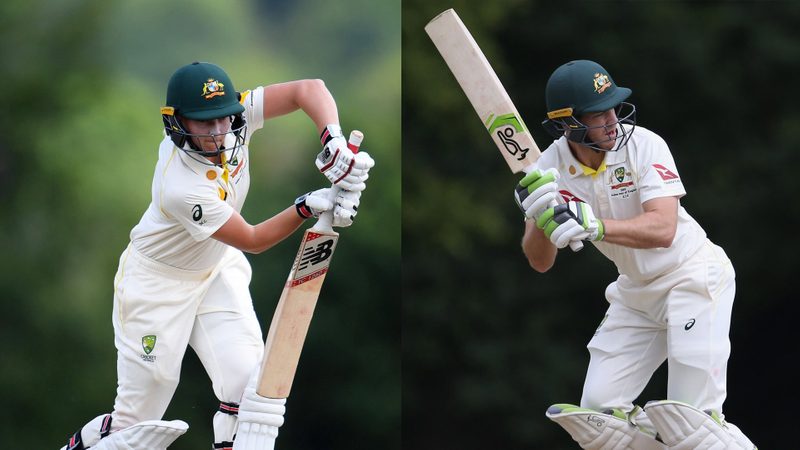
Updated 27 October 2026: The gold-orange emblem on the collar of Australia’s Test shirt is “Walkabout Wickets”, an artwork by Aboriginal artist Aunty Fiona Clarke. It was created for the 2016 Boxing Day Test, and for the 2025-26 kits Clarke updated it into a new artwork, “Land & Sea”, which keeps the Walkabout Wickets motif.
What is the orange symbol on Australia’s cricket shirt?
When people noticed the “big golden flower” on Australia’s collars during the 2019 Ashes, Cricket Australia explained it as a symbol of the team’s commitment to reconciliation with Aboriginal and Torres Strait Islander peoples.
The artist, Aunty Fiona Clarke, is a Kirrae Whurrong woman and the great great grand-daughter of James ‘Mosquito’ Couzens, who played in the Aboriginal XI in a landmark match at the MCG in 1866 and also toured England in 1868. Clarke created the artwork ahead of the 2016 Boxing Day Test to mark the 150th anniversary of that 1866 match, and it has been on the collar of the Test shirt ever since. By 2022 cricket.com.au described it as a mainstay on the collar of both the men’s and women’s Test shirts.
What does Walkabout Wickets mean?
The artwork depicts past, present and future Aboriginal cricketers. Each part of it has a meaning:
- the large circle is Lord’s, one of the famous grounds the 1868 team visited;
- the smaller circles are the team’s other meeting places;
- the flying stumps stand for Aboriginal cricketers getting the better of the English at their own game;
- the wickets with no bails say that the game is continuously evolving;
- the dots above are stars, which stand for ancestors.
Clarke has described the wider design as being about connection: “The overall design is to do with the process of connecting with yourself as an individual, as a team, in the community and whatever is surrounded by you.”
Who were the 1868 Aboriginal XI?
The 1868 Aboriginal team was the first sporting team from Australia to play abroad. They made a perilous journey by ship to England and played 47 matches, at venues including Lord’s and The Oval. For the 150th anniversary in 2018, an Aboriginal XI toured England again, and two of its fast bowlers, Scott Boland and Brendan Doggett, have since played Test cricket for Australia.
What changed in the 2025-26 kits?
For the kits Australia wear across the 2025-26 and 2026-27 summers, Clarke’s new artwork “Land & Sea” incorporates the Walkabout Wickets motif and extends the tribute to the 1868 Aboriginal XI. On the white-ball kits, the Indigenous artwork has moved from the side panels onto the shoulders. On the Test whites the change is small: yellow piping around the collar replaces green. “The stars symbolise every cricketer, Aboriginal and non-Aboriginal, who continues this shared legacy through the game,” Clarke said.
Walkabout Wickets has also appeared on Australia’s Indigenous playing shirts. When Australia’s men wore one for the T20I series against India in December 2020, the artwork was the circular centrepiece on the front.
Indigenous cricketers who have played Tests for Australia
- Faith Thomas: the first Indigenous Test cricketer, who debuted against England on 21 February 1958. She died in April 2023, aged 90.
- Jason Gillespie: the first acknowledged Aboriginal man to play Test cricket.
- Ashleigh Gardner: Test debut against England on 18 July 2019.
- Scott Boland: Test debut against England on 26 December 2021. On 14 July 2025 at Sabina Park he became the first Indigenous Australian to take a Test hat-trick.
- Brendan Doggett: Test debut against England at Perth on 21 November 2025, in the 2025-26 Ashes opener. With Boland also playing, it was the first time an Australian men’s Test team had two Indigenous players in it.
Before Doggett’s debut, only two Indigenous men, Gillespie and Boland, had played Test cricket for Australia in almost 150 years.
Following India’s next series? See our guide to cricket betting sites.
Featured Image Courtesy: Twitter / @CricketAus