





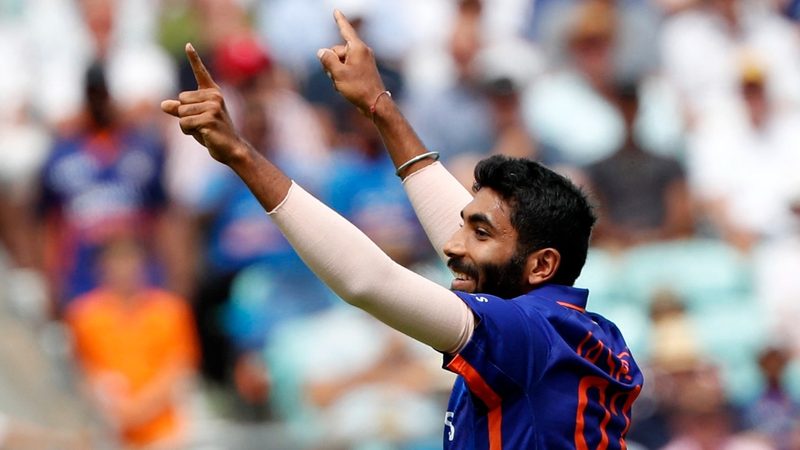
A hat-trick in cricket is a scenario where one bowler dismisses three batters in successive deliveries.
However, there are certain conditions for a bowler to claim a hat-trick in cricket. Firstly, the deliveries must be bowled by an individual bowler in the same match. The bowler can claim a hat-trick in cricket even if his three wickets in successive deliveries are spread across different overs.
E.g.1: If Jasprit Bumrah claims a wicket on the last delivery of his first over and then two scalps in the first two deliveries of his second over, it means Bumrah has claimed a hat-trick in a cricket match.
E.g.2: If Tim Southee claims two wickets on the last two deliveries of his first over and a wicket on the first ball he bowls in his second over, it means Southee has claimed a hat-trick in a cricket match.
In Test or First Class cricket, the hat-trick in cricket rule can spread across innings.
E.g.: If James Anderson claims two consecutive wickets in the first innings and the third off the first ball in the second innings, it means Anderson has claimed a hat-trick in a cricket match.
It has happened three times in Tests: Courtney Walsh and Merv Hughes both did it across two innings in the 1988-89 series between Australia and West Indies, and Jermaine Lawson did it against Australia at Bridgetown in 2003.
All three wickets must be credited to the bowler. Under the Laws of Cricket that means bowled, caught (by any fielder, the wicketkeeper or the bowler), leg before wicket (LBW), stumped or hit wicket. A run-out is not credited to the bowler, so it does not count towards a hat-trick.
What are the types of hat-tricks in cricket?
There are two notable types of hat-tricks in cricket, a double hat-trick and a team hat-trick.
Double hat-trick: When a bowler claims four wickets in four successive deliveries, they are said to have claimed a double hat-trick in cricket.
Team hat-trick: When a bowler takes two wickets in successive deliveries and the wicket on the third ball bowled is a run-out effected by the bowler or a fielder, it is termed a team hat-trick.
Another way of getting a team hat-trick is if a bowler gets one wicket, followed by a run-out and then the bowler gets another scalp off the third successive ball.
Who claimed the first hat-trick in cricket?
Australia’s Fred Spofforth is the first bowler to take a hat-trick in international cricket.
During England’s first innings of the Test against Australia, Spofforth claimed the wickets of England’s Vernon Royle, Francis Mackinnon and Tom Emmett in consecutive deliveries, at Melbourne in January 1879.
How many hat-tricks have there been in Test cricket?
There have been 50 hat-tricks in Test cricket. Hugh Trumble, Jimmy Matthews, Wasim Akram and Stuart Broad have two each, and Matthews took both of his in the same match, one in each innings against South Africa at Manchester in 1912.
The most recent came from Bangladesh’s Hasan Mahmud against Afghanistan in Abu Dhabi in October 2026. Figures are from ESPNcricinfo, to 12 October 2026.
For four wickets in four balls, see our guide to the double hat-trick in cricket.
Author: William Paul
Featured photo: AFP / IAN KINGTON