





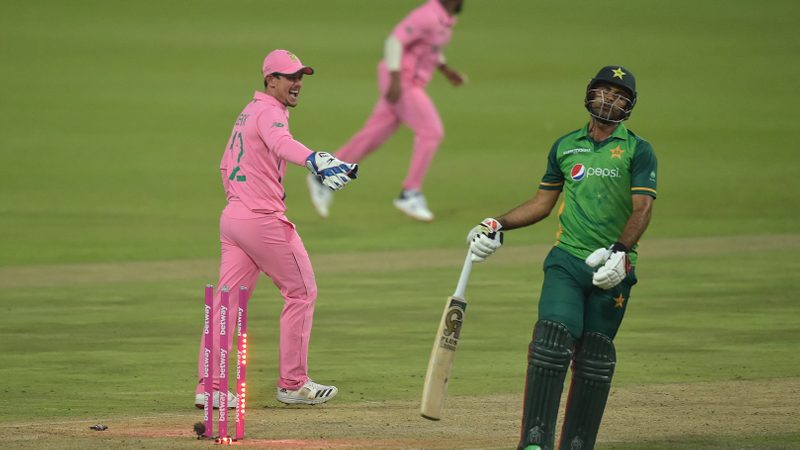
Updated 27 October 2026: Fake fielding is an offence under Law 41.5 of the Laws of Cricket. If an umpire decides that a fielder wilfully tried to distract, deceive or obstruct a batter, the ball is dead, neither batter can be out, and the batting side gets five penalty runs. The rule is in the MCC’s current Laws (the 2017 Code, 4th Edition 2026) and in the ICC’s men’s international playing conditions effective from October 2026. It became a talking point in April 2021, when Fakhar Zaman was run out on 193 after a gesture by Quinton de Kock and no penalty was given.
What is fake fielding?
Law 41.5.1 says: “it is unfair for any fielder wilfully to attempt, by word or action, to distract, deceive or obstruct either batter after the striker has received the ball.” Law 41.5.2 adds: “It is for either one of the umpires to decide whether any distraction, deception or obstruction is wilful or not.”
In practice, fake fielding means pretending to have the ball: miming a throw that never comes, or pretending to gather a return at the stumps, so that a batter slows down, turns back or dives when there is no need. The key word is “attempt”. After the Fakhar Zaman run-out, the MCC put it this way on Twitter: “The Law is clear, with the offence being an ATTEMPT to deceive, rather than the batsman actually being deceived.”
What is the penalty for fake fielding?
When either umpire considers that a fielder has caused or attempted such a distraction, deception or obstruction, Law 41.5 says:
- the umpire immediately calls and signals Dead ball (41.5.3);
- neither batter can be dismissed from that delivery (41.5.4);
- the bowler’s end umpire awards 5 penalty runs to the batting side and tells the fielding captain why, then the batting captain as soon as practicable (41.5.6);
- the ball does not count as one of the over (41.5.7);
- runs completed before the offence are scored, and so is the run in progress, whether or not the batters had crossed (41.5.8);
- the batters choose which of them faces the next delivery (41.5.9).
If the obstruction involves physical contact, the umpires first decide whether it is an offence under Law 42 (Players’ conduct) (41.5.5). After the match the umpires report the incident. Under the MCC Laws the report goes to the Executive of the offending side and to any Governing Body responsible for the match (41.5.10). In men’s internationals, the ICC playing conditions send it to the ICC Match Referee instead, “who shall take such action as is considered appropriate against the fielder concerned”.

When was the fake fielding law introduced?
The offence came in with the MCC’s 2017 Code of Laws, which took effect on 1 October 2017. The ICC’s updated playing conditions, written in response to the new Code, brought it into international cricket three days earlier, on 28 September 2017.
Queensland’s Marnus Labuschagne was the first player penalised under it, a day after the ICC change, in a JLT One-Day Cup match against a Cricket Australia XI at Allan Border Field in Brisbane. In the 27th over he dived for a ball in the covers, failed to stop it, then leapt to his feet and shaped to throw. Batter Param Uppal stuttered and started back for his crease before he realised the ball was going to Matthew Renshaw at long-off. The umpires conferred, and it cost Queensland five penalty runs.
The Fakhar Zaman run-out: why was there no penalty?
On 4 April 2021, in the second ODI at the Wanderers in Johannesburg, Pakistan were chasing 342 against South Africa. Fakhar Zaman almost took them there on his own: he made 193 off 155 balls with 18 fours and 10 sixes, and Pakistan’s next-highest scorer was Babar Azam with 31.
Pakistan needed 31 runs from the last six balls. Off the first ball of the final over, Fakhar hit the ball to the fielder at long-off and turned for a second run. Behind the stumps, de Kock pointed towards the bowler’s end, as if the throw was going there. Fakhar slowed down and looked back at his partner, Haris Rauf, but Aiden Markram’s throw came to the keeper’s end and hit the stumps directly, with Fakhar short of his ground.
The umpires, Marais Erasmus and Allahudien Paleker, did not rule it deliberate deception. South Africa won by 17 runs to level the three-match series 1-1, and Pakistan won the third ODI in Centurion by 28 runs to take the series 2-1.
The MCC spelled out what a fake fielding ruling would have meant: “If so, then it’s Not out, 5 Penalty runs + the 2 they ran, and batsmen choose who faces next ball.” With the delivery not counting, Pakistan would have needed 24 from six balls instead of 31.
Fakhar blamed himself: “The fault was mine as I was too busy looking out for Haris Rauf at the other end as I felt he’d started off a little late from his crease, so I thought he was in trouble. The rest is up to the match referee, but I don’t think it’s Quinton’s fault.” South Africa captain Temba Bavuma called it clever: “I don’t think he broke the rules in any kind of way. It was a clever piece of cricket.”
Fakhar’s 193 was the highest ODI score by a batter batting second at the time, beating Shane Watson’s 185 not out. It has since been passed twice: by Glenn Maxwell’s 201 not out against Afghanistan at the Wankhede on 7 November 2023, and by Shubman Gill’s 223 not out against West Indies in Guwahati on 30 September 2026.
Other famous fake fielding moments
Kumar Sangakkara and Ahmed Shehzad, 2013
Before the law existed, in the second ODI of a 2013 series, Pakistan opener Ahmed Shehzad was on 80 in the 35th over and coming back for an easy second run. Sri Lanka’s Kumar Sangakkara mimed taking the throw and knocking the bails off before the ball had even been thrown, and Shehzad dived for his crease. Wisden called it Sangakkara “clearly attempting to make Shehzad dive for comedy effect”. Shehzad went on to make a hundred.
Jonny Bairstow and Steve Smith, 2019 Ashes
In the 2019 Ashes, England keeper Jonny Bairstow, without the ball in hand, pretended to collect a throw and go for the stumps as Steve Smith ran to the striker’s end. Smith put in a full-length dive, but the ball had been thrown to the non-striker’s end, where Jofra Archer collected it. It was judged to be a humorously intended action, and Smith took it in his stride: “He got me there, didn’t he? Dirtied my clothes.”
Virat Kohli and Bangladesh, 2022 T20 World Cup
After India beat Bangladesh in Adelaide at the 2022 T20 World Cup, Bangladesh vice-captain Nurul Hasan said the umpires had missed a fake throw by Virat Kohli. In the seventh over of the chase, Liton Das played Axar Patel towards the deep off-side field; as Arshdeep Singh threw the ball back, Kohli, standing at point, feigned a throw as the ball went past him. Umpires Marais Erasmus and Chris Brown took no action. “It could have been a five-run penalty,” Nurul said. India won by five runs, after rain had set Bangladesh a revised target of 151 from 16 overs.
Following India’s next series? See our guide to cricket betting sites.
Featured photo: Christiaan Kotze / AFP