






Cricket balls come in three colours: red, white and pink. Red is the traditional ball for Test and first-class cricket, white is used in ODIs and T20s, and pink is used in day/night Tests. All three are the same size and weight. Under the ICC playing conditions, a new ball must weigh between 156 and 163 grams (5.5 to 5.75 ounces) and measure between 22.4 and 22.9 centimetres around.
Which ball is used in which format?
| Format | Ball | New balls (ICC playing conditions, October 2026) |
|---|---|---|
| Test | Red (pink in day/night Tests) | One new ball per innings; the fielding captain may take another after 80 overs |
| ODI | White | Two new balls, one from each end, for overs 1 to 34; the fielding team then picks one of them for overs 35 to 50 |
| T20I | White | One new ball per innings |
The home board supplies the balls in every format and tells the visiting board which brand it will use at least 30 days before the match.
Red ball
The red ball is the oldest cricket ball and is still used for Test and first-class cricket. There are three main manufacturers of international balls, and which one is used depends on where the match is played.
Dukes balls are used in England, Ireland and the West Indies. They are hand-stitched, with all three rows of stitching on each half holding the ball together. Made for English conditions, the Dukes is a darker red and is known for swinging and for keeping its seam upright for longer.
Kookaburra, the Australian manufacturer, supplies the red ball for Tests in most other countries. On a Kookaburra only the inner two rows of stitching hold the halves together; the outer four are machine-stitched and are there only for grip. It tends to swing early and then gets easier for batters as it softens.
SG, short for Sanspareils Greenlands, makes the red ball for Test and first-class cricket in India. The company was founded in Sialkot in 1931 and has been based in Meerut since 1950. It began supplying Ranji Trophy balls in 1992 after BCCI approval, and that later extended to Tests. Like the Dukes, the SG is hand-stitched, and its prominent seam gives spinners extra grip on Indian pitches.
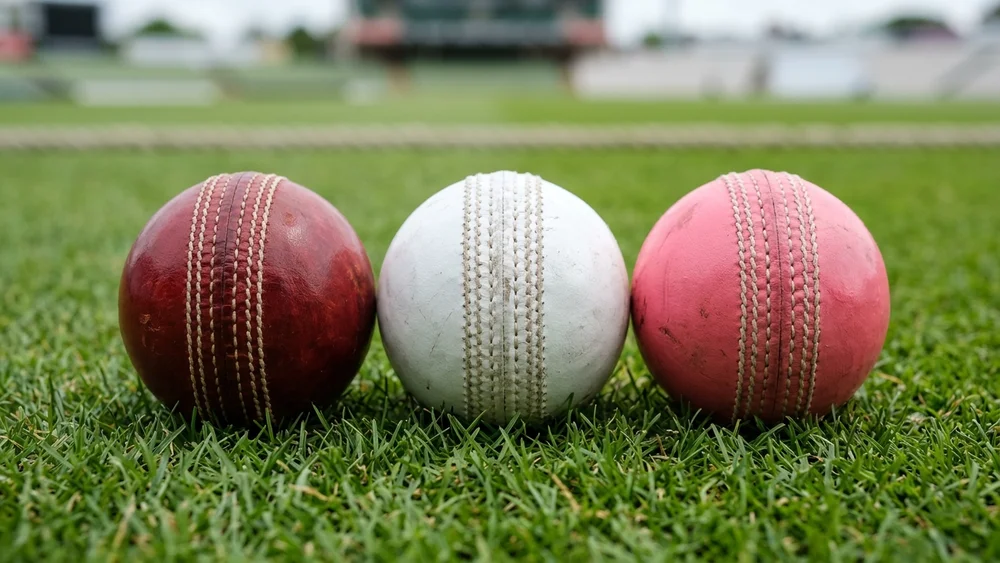
White ball
White balls came in with floodlit one-day cricket, because a red ball is hard to pick up at night and does not stand out against coloured clothing. The idea took off with Kerry Packer’s World Series Cricket in the late 1970s: about 2,000 people watched a WSC Supertest at VFL Park in November 1977, but a year later 44,377 turned up at the Sydney Cricket Ground for a floodlit one-day match between the same two sides. The first floodlit ODI, Australia against West Indies at the SCG on 27 November 1979, followed. Today all professional one-day cricket is played with white balls, at night or not. Limited-overs internationals use white Kookaburra balls; white Dukes balls were used at the 1999 World Cup but have not been used since.
White balls tend to swing more early on and deteriorate faster than red ones, which is why ODIs use two new balls. From October 2012 one new ball was used from each end for the whole innings. Under the current ICC playing conditions, one ball is used from each end for the first 34 overs, and at the end of the 34th over the fielding team chooses one of the two to finish the innings. The other goes into the supply of replacement balls. In a match cut to 25 overs a side or fewer before it starts, each team gets only one new ball.
Pink ball
The pink ball was the answer to a problem neither of the others could solve: a ball that stays visible under lights in Test cricket and contrasts with white clothing. A white ball would not last 80 overs and would disappear against the players’ whites. Pink balls were trialled from the late 2000s, including in a floodlit first-class match between Guyana and Trinidad and Tobago, and the English season’s curtain-raiser was played under lights in Abu Dhabi in 2010.
The ICC changed the Test playing conditions to allow day/night Tests in October 2012, and the first was played at the Adelaide Oval on 27 November 2015, Australia beating New Zealand by three wickets. Wikipedia’s list of day/night Tests has 25 men’s matches, the latest Australia’s eight-wicket win over England at the Gabba in December 2025. Australia have played 15 of them and won 14; their only defeat was by eight runs to West Indies at the Gabba in January 2024. Adelaide has hosted eight.
India have played five day/night Tests, winning their three at home and losing both in Adelaide. In their first, against Bangladesh at Eden Gardens in November 2019, they won by an innings and 46 runs. The pink ball does not always favour pace: when India beat England by 10 wickets in Ahmedabad in February 2021, spinners took 28 of the 30 wickets that fell, with Axar Patel taking 6/38 and 5/32 and Joe Root 5/8.
Photo credit: Unsplash