





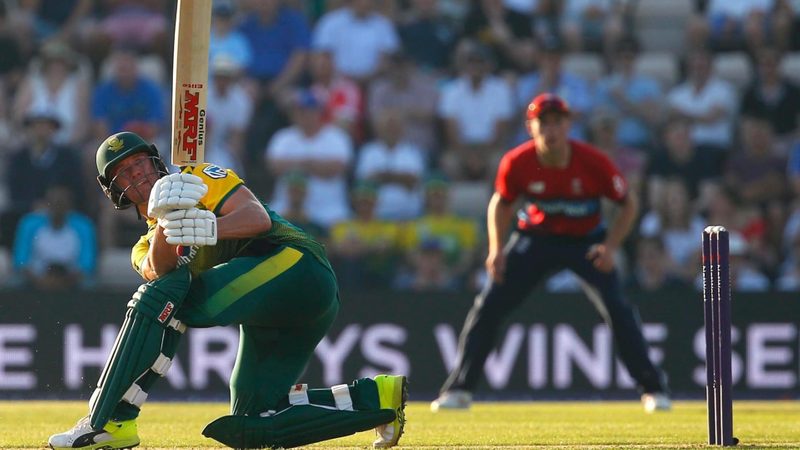
The team that scores the most runs wins a cricket match and generally, a huge chunk of a side’s scoring happens toward the end of their innings.
Runs that come at a very quick frequency generally happen toward the fag end of the innings where batters look to maximise the runs that they can score.
These are the overs that are known as slog or death overs and they are called slog overs because batters tend to go all out and slog or muscle the bowlers over the boundary ropes in their effort to score big before the end of their innings.
With that in mind, here’s a look at what are slog overs in cricket and some of the best players in this phase of a contest.
What are slog overs in cricket?
Slog overs are a series of overs in white-ball cricket where the batters attempt to score as many runs as possible in a short period of time, usually at the end of an innings. The team’s performance in slog overs can make the difference between a win and a loss.
There is no hard and fast rule about which overs are considered slog overs. A lot depends on the format and number of wickets available in hand for the batting side.
If a side has a long batting line-up with wickets in hand, the batters can start slogging early instead of waiting for the last few overs to begin. In One Day International (ODI) cricket, the last 10 of the 50 overs are usually considered slog overs, and they match the third and final Powerplay of the innings. In T20 cricket, the final four or five overs are generally considered slog overs.
Also called the death overs, slog overs are often the most exciting part of the contest. While the batters take risks to try and score more runs, the fielding team has to think quickly and strategically to try to stop the batting side from scoring too many runs.
Mahendra Singh Dhoni was considered one of the best finishers in the game due to his ability to have maximum impact in the slog overs. In the 2011 World Cup final against Sri Lanka at the Wankhede, he promoted himself up the order, made 91 not out off 79 balls and saw India home with ten balls to spare.
Yuvraj Singh was another batter who was considered one of the most dangerous batters in the slog overs. His fearless and clean hitting got India over the line on many occasions.
AB de Villiers, Kieron Pollard, Andre Russell, Shahid Afridi, Michael Bevan and Andrew Symonds were some of the other batters who had a good reputation in the slog overs.
On the other hand, the bowling side usually reserves their best bowlers for the end of the innings. Bowlers who can keep the runs down in this phase are known as death-over specialists.
Lasith Malinga, Trent Boult, Jasprit Bumrah and Umar Gul are some of the top bowlers who are renowned for their accuracy and ability to bowl yorkers and slower balls at the death, which often makes it difficult for the batters to score runs. They are also known for maintaining their composure and remaining focused when bowling under pressure.
Rules that shape the slog overs
The ICC playing conditions (October 2026 edition) set how many fielders can guard the boundary, and that changes as the innings goes on.
- ODIs: no more than two fielders may be outside the 30-yard circle in overs 1 to 10, four in overs 11 to 40, and five in overs 41 to 50. The slog overs are the only phase in which five fielders can patrol the boundary.
- T20Is: only two fielders may be outside the circle in the six Powerplay overs, and no more than five after that.
- Slow over rate: in both formats, a fielding side that is not in position to bowl the first ball of the final over by the scheduled cut-off time can have only four fielders outside the circle for the rest of the innings. Falling behind on time can therefore cost a boundary fielder in the final overs, just when the batting side is going hardest.
- One ball in the back half of an ODI: two new balls are used for overs 1 to 34, one from each end. After the 34th over, the fielding side picks one of them for the rest of the innings, so the slog overs are bowled with a single older ball, which gives the bowlers a better chance of reverse swing.
- Wides: the umpire judges a wide against where the batter was standing when the ball was delivered. A batter who backs away towards the leg side after the ball is bowled can no longer turn a bowler’s wide yorker into a wide.
Photo credit: Alamy