





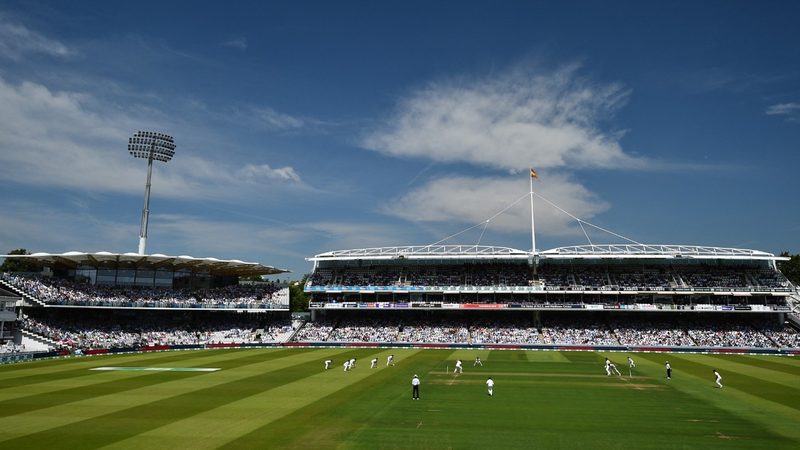
Updated 28 October 2026: Lord’s, the home of cricket in St John’s Wood, London, has a slope that drops about 2.5 metres (8 ft 2 in) from the Grand Stand side of the ground to the Tavern side. It runs across the pitch, so it changes how the ball behaves from each end, and every one of the 151 Tests played at Lord’s has been played on it, the latest England’s win over Pakistan on 27 Aug 2026.
Why is there a slope at Lord’s?
Lord’s opened on its present site in 1814, on land that included a duck pond and a pronounced slope, and the ground was built around it. Smaller ridges in the pitch have been taken out over the years, but the slope never has. In 2002 a £1.25m project laid a new outfield and new drainage, removing about 17,000 tonnes of the old surface, and the slope stayed. MCC has turned down calls to level it: that would mean rebuilding the ground, and a new square would need about five years to mature before Lord’s could host Test cricket again.
How steep is the Lord’s slope?
The drop is 2.5 metres, or 8 ft 2 in, from one side of the ground to the other. Wisden puts it this way: an average-sized person at one end of the slope would not be visible from the other end. Tim Murtagh, the former Ireland seamer who bowled at Lord’s for Middlesex from 2007, says it is easy to see when you look at the pitch front-on but not necessarily from side-on.
Which way does the slope run?
It runs from the Grand Stand on the north side of the ground down to the Tavern and Mound Stands on the south side, across the line of the pitch, which is played between the Pavilion End and the Nursery End. So from the Pavilion End the ball tends to come down the hill into right-handed batters and away from left-handers, and from the Nursery End it tends to run away from right-handers.

How does the slope affect bowlers?
Murtagh, who mostly bowled from the Nursery End, says the slope gives a seamer something to work with even on a flat pitch: “You have the slope that takes the ball away from the right-hander.” When swing and a grassy pitch are moving the ball the same way, he says, the bowler has three things in his favour. From the Pavilion End the plan is to attack the stumps, as Glenn McGrath did, with the ball running back down the hill into the right-handers. Angus Fraser told The New York Times that McGrath, Jimmy Anderson and Curtly Ambrose all preferred the Pavilion End.
It takes time to get used to. Murtagh says it took him his first season at Middlesex, and that landing on the slope made him feel he was falling away in his action. A line that is only slightly too straight can run down the leg side, and a bowler who corrects too far can end up giving the batter a wide one to hit.
How does the slope affect batters?
Batters have to adjust as well. Murtagh says batters often fall over at the Pavilion End the first couple of times they play there, and have to change their feet, their centre of gravity or their weight. Against bowling from the Pavilion End, the ball that comes back down the slope makes leaving risky. “You’re not leaving with confidence,” Fraser said, remembering McGrath bowling Alec Stewart as he left a ball in an Ashes Test. The slope can be mastered, though: Joe Root has 2,203 Test runs at Lord’s, more than anyone, with eight hundreds.
The bowlers who mastered the slope
James Anderson took 123 Test wickets at Lord’s in 29 matches, more than any other bowler, and Stuart Broad took 113 in 28. Anderson was the first pace bowler to take 100 Test wickets at a single ground, and he played his last Test there, against West Indies in July 2024, when England won by an innings and 114 runs.
| Bowler | Span | Matches | Wickets | Average | Best |
|---|---|---|---|---|---|
| James Anderson | 2003-2024 | 29 | 123 | 24.81 | 7/42 |
| Stuart Broad | 2008-2023 | 28 | 113 | 27.66 | 7/44 |
| Ian Botham | 1978-1992 | 15 | 69 | 24.53 | 8/34 |
| Fred Trueman | 1952-1965 | 12 | 63 | 22.12 | 6/31 |
| Bob Willis | 1973-1984 | 9 | 47 | 18.76 | 7/78 |
| Brian Statham | 1951-1961 | 9 | 45 | 17.46 | 7/39 |
| Hedley Verity | 1933-1939 | 7 | 42 | 14.59 | 8/43 |
| Graeme Swann | 2009-2013 | 10 | 40 | 24.07 | 5/44 |
The most successful visiting bowlers are Richard Hadlee and Glenn McGrath, with 26 wickets each. McGrath’s 8/38 against England in 1997 is the second-best innings return at Lord’s, behind Ian Botham’s 8/34 against Pakistan in 1978.
| Bowler | Team | Matches | Wickets | Average | Best |
|---|---|---|---|---|---|
| Richard Hadlee | New Zealand | 4 | 26 | 21.26 | 6/80 |
| Glenn McGrath | Australia | 3 | 26 | 11.50 | 8/38 |
| Tim Southee | New Zealand | 5 | 24 | 27.29 | 6/43 |
| Kagiso Rabada | South Africa | 3 | 22 | 16.45 | 5/51 |
| Malcolm Marshall | West Indies | 3 | 20 | 17.00 | 6/32 |
| Courtney Walsh | West Indies | 4 | 20 | 22.95 | 6/74 |
Only five bowlers have taken eight wickets in a Test innings at Lord’s, and Bob Massie did it twice in the same match, in 1972.
| Bowler | Figures | For | Against | Date |
|---|---|---|---|---|
| Ian Botham | 8/34 | England | Pakistan | 15 Jun 1978 |
| Glenn McGrath | 8/38 | Australia | England | 19 Jun 1997 |
| Hedley Verity | 8/43 | England | Australia | 22 Jun 1934 |
| Derek Underwood | 8/51 | England | Pakistan | 8 Aug 1974 |
| Bob Massie | 8/53 | Australia | England | 22 Jun 1972 |
| Bob Massie | 8/84 | Australia | England | 22 Jun 1972 |
| Ian Botham | 8/103 | England | West Indies | 28 Jun 1984 |
Test figures are from ESPNcricinfo’s Statsguru, up to England against Pakistan in August 2026.
Looking for odds on England’s next Test? See our guide to cricket betting sites.
Featured photo: Glyn Kirk/AFP