





England and Australia have played 74 Ashes series since 1882–83. Australia have won 35, England 32, and seven have been drawn. The most recent, in Australia in 2025–26, went to Australia 4–1.
For a contest this old, plenty of its history is half-remembered or wrong. Here are five facts about the Ashes.
1. Why the name ‘Ashes’?
The term goes back to Australia’s win at the Oval in 1882, their first Test victory on English soil. The defeat was not taken well by the English public or press.
And it was only a few days after the defeat that journalist Reginald Shirley Brooks made a mockery out of the England cricket team in the Sporting Times, which read, “In Affectionate Remembrance of English Cricket which died at the Oval on 29th August 1882, deeply lamented by a large circle of sorrowing friends and acquaintances. R.I.P. N.B.—The body will be cremated, and the ashes taken to Australia.”
Before the 1882–83 tour of Australia, England captain Ivo Bligh vowed to “regain those ashes”. The name only really stuck 20 years later, when England captain Pelham Warner took a team to Australia in 1903 promising to regain “the Ashes”.
Having done so, Warner published a book called How We Recovered the Ashes, which revived public interest in the legend.
2. What’s written on the urn?
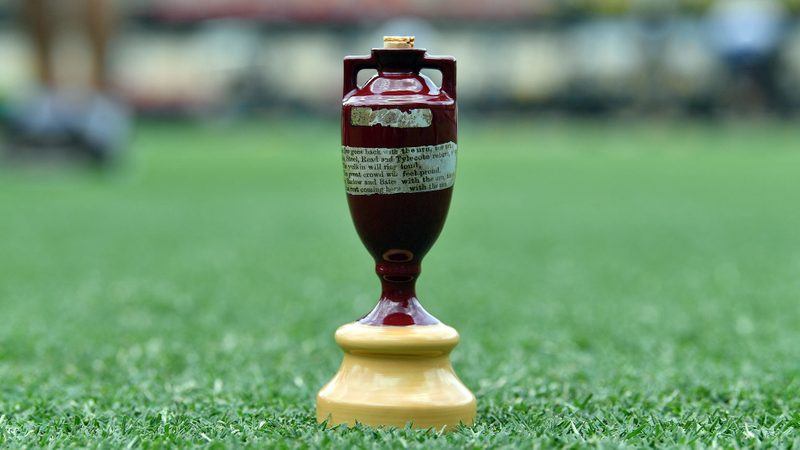
The urn was made during England’s 1882–83 tour, on which Bligh’s side won two of the three Tests. It was presented to Bligh as a personal gift, after a friendly match at Rupertswood near Melbourne, by a group of Victorian women. It has long been believed to contain the ashes of a cricket bail, though some stories say a lady’s veil.
Two labels are pasted on the urn. The upper one says “The Ashes”, and the lower one reads:
“When Ivo goes back with the urn, the urn;
Studds, Steel, Read and Tylecote return, return;
The welkin will ring loud,
The great crowd will feel proud,
Seeing Barlow and Bates with the urn, the urn;
And the rest coming home with the urn.”
(The names in italics are players from England’s 1882–83 touring team. The verse was cut from Melbourne Punch of 1 February 1883.)
The urn has never been the official trophy. It was a personal gift to Bligh, and Florence Morphy, whom he later married, was among the women who presented it. Since the 1998–99 series the winners have received the Ashes Trophy, a Waterford Crystal replica of the urn.
3. The original urn rests in England
The original urn is too fragile to travel and stays in the MCC Museum at Lord’s, whichever side holds the Ashes. Bligh’s widow gave it to MCC after his death in 1927. Since 1929 it has been to Australia only three times: for the Bicentenary Test in Sydney in 1988, for a touring exhibition during the 2006–07 series, and for an exhibition at the State Library Victoria in 2019.
4. England have not whitewashed Australia since 1890
England’s only Ashes series in which they won every Test came in the 19th century: 1886 (3–0), 1886–87 (2–0), 1887–88 (a single Test) and 1890, when they won both Tests played and the third was abandoned. Australia have won all five Tests of a series three times, in 1920–21, 2006–07 and 2013–14.
The closest England have come since was in 1978–79, when they beat Australia 5–1.
5. What if it’s a draw?
If a series is drawn, the side that already holds the Ashes keeps them. That first happened in 1938, when Australia retained them. There have been seven drawn series in all (1938, 1962–63, 1965–66, 1968, 1972, 2019 and 2023), and England were the holders only once, in 1972; Australia retained the Ashes in the other six.
Feature image courtesy: AFP / Saeed Khan