








Bumrah has not bowled a T20I since the World Cup final, and in Delhi he was marking out a longer run-up
Cleared to play on Thursday, Jasprit Bumrah spent Friday evening in the Delhi nets measuring out a run-up a third longer than his usual one. His first T20I since the World Cup final has been six months in coming.
Sep 13, 2026
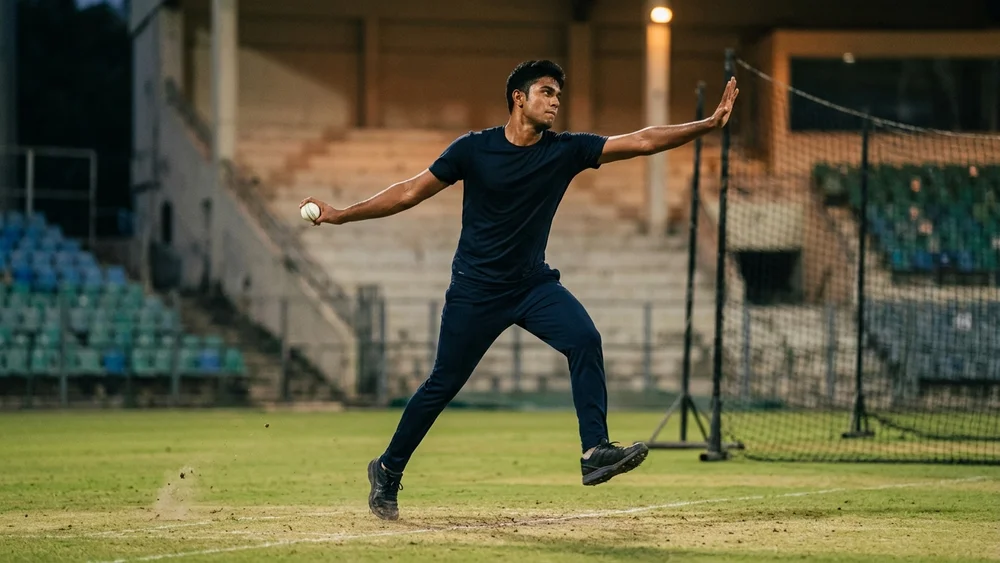
The last time Jasprit Bumrah bowled in a T20 international he took four wickets for 15 runs, India beat New Zealand by 96 runs in Ahmedabad, and he walked off with the player-of-the-match award from a World Cup final. That was 8 March. Six months later he was back in an India shirt at the Arun Jaitley Stadium, and the first thing he pulled out of his kit bag was a measuring tape.
Six months, one knee, and a rehab block in Bengaluru
Bumrah has not played a T20I since that final, the one that made India the first side to defend the title and gave them a record third. The gap was not planned. His left knee flared up again over the summer, and it cost him the third ODI in England in July and the two Tests in Sri Lanka that followed. The middle of his year was spent in rehab at the BCCI’s Centre of Excellence in Bengaluru instead.
He was cleared on Thursday, 10 September, in the same selection update that sent Harshit Rana home. Rana picked up a rectus femoris strain bowling in a match simulation on 7 September, at the same Bengaluru facility, and lost his place in both the Afghanistan and Asian Games squads to Yash Thakur. Thakur is 27, bowls for Vidarbha, and won his first India cap in Zimbabwe on 25 July.
A day after the clearance, Bumrah was in the Delhi nets. Training began 40 minutes late, at 6.40pm, with a drizzle taking the edge off the heat. He started in a fielding drill, two to win off one ball, and rather than snatching at the throw he set his feet, straightened his front arm and knocked all three stumps over. He was in no hurry about anything that evening.
Ten walking strides, then sixteen quick ones
Then came the tape, and the markers. A black bottle went down at the far end, where he would start. An India cap sat in the middle, the point at which the walk became a run. A red bottle went closest to the stumps to mark the leap. What he ran in off for most of the session was not the run-up anyone recognises: ten long walking strides, then sixteen quick-burst steps, then the jump. At its fullest it was roughly a third longer than his usual approach. At one point he was setting off from behind the mark Arshdeep Singh was using.
That matters because Bumrah’s action is the most examined piece of machinery in Indian cricket. The shuffle, the short jog, the braced front knee, the hyperextended right wrist snapping the ball out. Nobody has touched it in ten years because it works. Watching him lengthen it, shorten it and lengthen it again inside one net session was not something Indian fans have had much practice at.
The results were mixed, which is the honest thing to say about any first evening back. Off the long run he pushed a full ball across Vaibhav Sooryavanshi, drew the drive and found the thick outside edge, then celebrated it like a Test wicket. He worked Sanju Samson over around the stumps. He yorked Shivam Dube and enjoyed that one too. But the rhythm came and went. He slowed down mid-approach once. He aborted the run-up more than once. When Ishan Kishan, striking the ball beautifully all evening, needed tying down, Bumrah went back to the shorter version and angled deliveries in at the stumps before jagging them away.
The IPL numbers sitting behind all this
There is a reason he might want to. IPL 2026 was the worst season of Bumrah’s career: four wickets in 13 matches at an average of 102.50, and the first time since 2015 he had finished an IPL with fewer than ten. He was down on pace early, managed carefully as he built up, and by the back end of the tournament he looked closer to full tilt without the wickets following.
Mahela Jayawardene, his head coach at Mumbai Indians, pointed at the same place Bumrah was pointing a tape measure at on Friday. Bumrah had gone into that IPL still carrying a niggle from the World Cup, Jayawardene said, and the knock-on was a run-up he could not settle. Seven front-foot no-balls followed, more than any other bowler managed all season, and the coach put them down to the build-up rather than the delivery stride. Months on, that work has clearly not stopped.
Three matches in five days, and a longer horizon
Whether the longer approach survives contact with a real match is a different question, and it may well have been nothing more than a drill. Against Ishan Kishan, when he actually wanted control, he reverted to the short one. But a bowler does not usually pull a tape measure out in front of a dozen team-mates and cameras, a day after a fitness clearance, unless something is nagging at him.
If he plays all three, he bowls three T20Is in five days, which is a workload question in itself after the year he has had. Shreyas Iyer captains, Tilak Varma is his deputy, and most of the selection noise around this series is about which two of Abhishek Sharma, Sanju Samson and Vaibhav Sooryavanshi open. Bumrah’s situation is less crowded and more awkward. He is 32, he has a knee that keeps interrupting him, and his last sustained run of cricket produced those four IPL wickets. What Friday showed was a bowler willing to take the long way round to fix that. Delhi will tell us whether the long way round works.