





Former Australia spinner Leslie O’Brien “Chuck” Fleetwood-Smith holds the unwanted record for most runs conceded by a bowler in one Test innings. Playing against England at The Oval in the fifth Test of Australia’s 1938 tour of England, the left-arm wrist-spinner conceded 298 runs in 87 overs and could only pick a solitary wicket.
Interestingly enough, it was the same match when England registered the then highest team total in Test cricket. Riding on Len Hutton’s 364 followed by tons from Maurice Leyland and Joe Hardstaff, the Three Lions posted 903/7d. Of those 903 runs, Fleetwood-Smith was responsible for 33 per cent of the total.
Chuck Fleetwood-Smith never played Test cricket for Australia again.
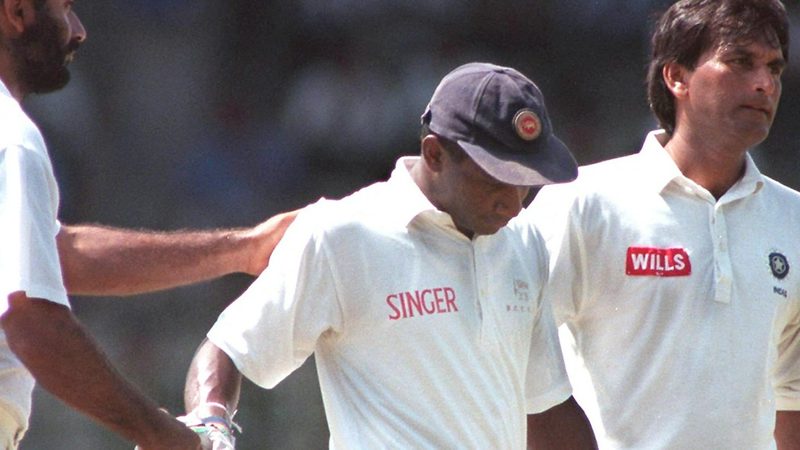
Former India off-spinner Rajesh Chauhan follows the Australian at second place in the list for most runs conceded by a bowler in one Test innings. It was during the first Test of India’s 1997 tour of Sri Lanka, at the R. Premadasa Stadium in Colombo, that the spinner conceded 276 runs in 78 overs while picking a single wicket.
Anil Kumble had it little better at the other end: 223 runs from 72 overs for one wicket, so India’s two spinners gave away 499 runs between them in a single innings.
History repeated itself almost 60 years after England had set the benchmark, as the second most expensive bowling spell in Test cricket came when Sri Lanka recorded 952/6d, which is still the highest team total in the longest format.
Before Fleetwood-Smith, the record for runs conceded in one Test innings belonged to West Indies’ Oscar Scott. The leg-spinner from Jamaica had conceded 266 runs in 80.2 overs, taking five wickets, in the fourth Test of England’s tour of West Indies in 1930, as England made 849 at Kingston.
The top three on this list share a pattern. Each of them bowled in one of the three highest totals in Test history – 952/6d at Colombo in 1997, 903/7d at The Oval in 1938 and 849 at Kingston in 1930.
There are only four bowlers in the history of Test cricket who have conceded more than 250 runs in one Test innings, with the fourth being Pakistan’s Khan Mohammad. Playing against West Indies at Kingston in 1958, Pakistan’s new-ball bowler went for 259 runs in 54 overs without taking a wicket, as Garfield Sobers made 365 not out in a total of 790/3d. In the very same match, his bowling partner Fazal Mahmood gave away 247 runs in 85.2 overs for two wickets, which completes the top five list for most runs conceded by a bowler in one Test innings.
Most runs conceded in a Test innings: the top 10
| Runs | Bowler | Overs | Wkts | Against | Year |
|---|---|---|---|---|---|
| 298 | Chuck Fleetwood-Smith (Aus) | 87 | 1 | England, The Oval | 1938 |
| 276 | Rajesh Chauhan (Ind) | 78 | 1 | Sri Lanka, Colombo | 1997 |
| 266 | Oscar Scott (WI) | 80.2 | 5 | England, Kingston | 1930 |
| 259 | Khan Mohammad (Pak) | 54 | 0 | West Indies, Kingston | 1958 |
| 247 | Fazal Mahmood (Pak) | 85.2 | 2 | West Indies, Kingston | 1958 |
| 246 | Mehidy Hasan Miraz (Ban) | 49 | 2 | New Zealand, Hamilton | 2019 |
| 240 | Rangana Herath (SL) | 53.3 | 3 | India, Mumbai (Brabourne) | 2009 |
| 237 | Saqlain Mushtaq (Pak) | 50 | 3 | South Africa, Cape Town | 2003 |
| 235 | Zahid Mahmood (Pak) | 33 | 4 | England, Rawalpindi | 2022 |
| 234 | Sonal Dinusha (SL) | 56 | 2 | West Indies, North Sound | 2026 |
The modern era
Since Chauhan in 1997, nobody has gone past 250. Bangladesh off-spinner Mehidy Hasan Miraz came closest with 246 runs in 49 overs as New Zealand made 715/6d at Hamilton in 2019. Pakistan leg-spinner Zahid Mahmood conceded 235 runs in just 33 overs on his Test debut at Rawalpindi in December 2022, when England scored 657 – at 7.12 runs an over, the most expensive rate in the top 10. The latest entry is Sri Lanka’s Sonal Dinusha, who went for 234 in 56 overs as West Indies made 626/9d at North Sound in June 2026.
Chauhan’s 276 is also the most runs conceded in a Test innings by an India bowler. The next highest is Vinoo Mankad’s 228 against West Indies at Kingston in 1953.
Source: ESPNcricinfo Statsguru, Test bowling innings sorted by runs conceded, and match scorecards (to 27 November 2026).
Featured photo: AFP / Sena Vidanagama