






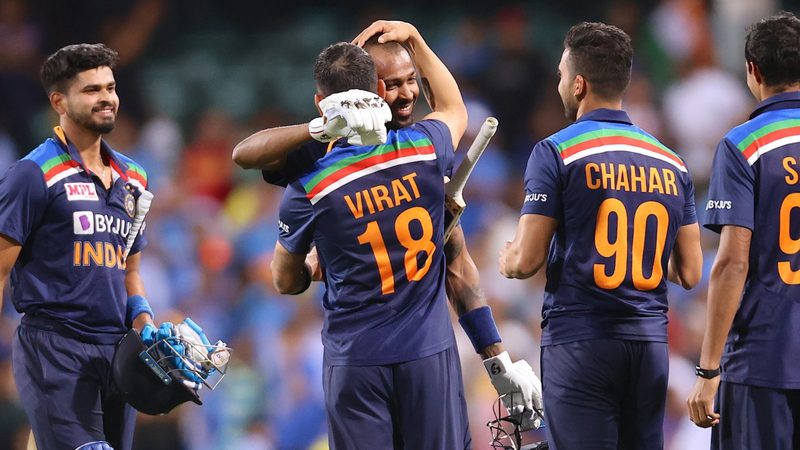
For more than four decades, India’s limited-overs kit has been one of the most recognisable in cricket. The colours and designs have changed with almost every major tournament, but the team has long been known as the Men in Blue.
This is the history of the Indian cricket jersey, from the first coloured kit in 1985 to the Adidas era. Kit makers and sponsors are taken from Wikipedia’s India national cricket team article, checked on 21 October 2026.
The first coloured Indian cricket jersey: 1985
The story starts at the 1985 Benson & Hedges World Championship of Cricket in Australia, played with coloured clothing, white balls and 50-over innings. India went through the tournament unbeaten and beat Pakistan by eight wickets in the final. Their light blue kit had yellow across the middle and on the collar, with no sponsor’s logo.
On this day in 1985 we won the World Championship of Cricket. This remains my favourite Indian ODI team ever, Gavaskar as captain. Srikkanth, Vengsarkar, Amarnath & a young Azhar as bats, Kapil & Binny with the new ball, Siva & Shastri as spinners & Sadanand Vishwanath keeping.
Joy Bhattacharjya (@joybhattacharj), March 10, 2020
Names on the shirt: 1991-92
By the 1991-92 Benson & Hedges World Series, a tri-series in Australia with the West Indies, the kit carried ‘India’ in running letters across the chest. The base colour was still light blue, with yellow and a white stripe along the body.
The first Indian World Cup kit: 1992
The 1992 World Cup in Australia and New Zealand was the first to feature coloured clothing, white balls and black sightscreens. India’s kit, made by ISC, was navy blue with multi-coloured stripes across the shoulders.
@sachin_rt @azharflicks @sanjaymanjrekar @RaviShastriOfc @KiranmoreIndia #praveenAmre #AjayJadeja.Down the Memory lane. 1992 World cup
Vinod Kambli (@vinodkambli349), March 20, 2018
That design came back as a retro kit on India’s tour of Australia in 2020-21, when MPL’s first India jersey borrowed from it.
New jersey, renewed motivation. Ready to go.
Shikhar Dhawan (@SDhawan25), November 24, 2020
Yellow and navy: 1994
On India’s 1994 tour of New Zealand, Sachin Tendulkar opened the batting in an ODI for the first time, at Auckland, and made 82 off 49 balls. The team wore a yellow and navy blue kit in that series.
Playing with @sachin_rt right from childhood gave me a chance to watch countless innings of his. 2 that stand out for me are:
1) vs @BLACKCAPS at Auckland in 1994 when he scored a blazing 82 of 49 balls as an opener for the 1st time in ODIs.#SachInnings
Vinod Kambli (@vinodkambli349), April 23, 2019
.
.
Bank of New Zealand Centenary Series: 1995
The 1995 Bank of New Zealand Centenary Series was a four-team tournament with India, Australia, South Africa and hosts New Zealand. India’s kit for it carried the tricolour, with the Ashoka Chakra on the sleeves.
The 1996 World Cup
The 1996 World Cup, sponsored by Wills, was held in India, Pakistan and Sri Lanka. India wore a light blue and yellow kit with yellow collars and rainbow-coloured arrows across the chest and down the sleeves. Their tournament ended in the semi-final, when Sri Lanka beat them at Eden Gardens in front of a crowd estimated at 110,000.
1996 world cup Bangalore vs Pakistan.Terrific match can’t forget the amir sohail n venkatesh prasad incident
Vinod Kambli (@vinodkambli349), March 20, 2016
Desert Storm: Sharjah 1998
The 1998 Coca-Cola Cup in Sharjah, a tri-series with Australia and New Zealand, is remembered for Tendulkar’s ‘Desert Storm’ innings: two hundreds against Australia in April 1998, the first in a must-win game that took India into the final and the second in the final itself. The team wore a light blue shirt with tricolour strips in rounded patterns and navy blue trousers.
I found this pic 1998 Sharjah my debut series.Paji @sachin_rt man of the series.sherry pa,azhu Bhai,dada,lax,jaddu
Harbhajan Turbanator (@harbhajan_singh), May 18, 2016
The classic World Cup jersey: 1999
The 1999 World Cup in England came three years after the previous one, breaking the usual four-year gap. India’s kit, made by Asics, was sky blue with a large yellow BCCI emblem and a diagonal yellow band with a black border across the chest, similar in spirit to 1996. It is still one of the most popular Indian kits.
#OnThisDay – 1999: Sourav Ganguly hits 183 as India beat Sri Lanka in the World Cup. It was the last full international hosted at Taunton
Somerset Cricket (@SomersetCCC), May 26, 2017
BCCI logo front and centre: 1999-2000
In the 1999-2000 Carlton and United Series in Australia, a tri-series with Pakistan, India’s shirt carried a large yellow and black BCCI logo in the middle of the chest.
The 2003 World Cup and the Sahara clash
Sahara became India’s team sponsor in June 2001, and at ICC events that caused a problem. Before the 2002 Champions Trophy, the ICC’s member countries voted 12-1 that Sahara clashed with the tournament sponsor, South African Airways, because of Sahara’s own airline business. At the 2003 World Cup in South Africa, India’s sleeve carried Aamby Valley, a Sahara township project, instead of the Sahara name. The kit was a slightly darker blue than before, with no yellow. Under Sourav Ganguly, India reached the final, which Australia won by 125 runs in Johannesburg.
The 2007 World Cup
The 2007 World Cup in the West Indies was the low point: India, one of the pre-tournament favourites, went out in the group stage, with Bangladesh beating them on the way to the Super 8. Nike had become the kit maker in January 2006, and the 2007 shirt was a light blue with the tricolour down the right side and ‘India’ in yellow across the middle.
The jersey for the first ODI double hundred: 2010
A darker version of the 2007 design followed, with tricolour swirls down the side and saffron trim at the neck. Tendulkar was wearing it when he made the first double hundred in ODI history, 200 not out off 147 balls against South Africa at Gwalior in February 2010.
200* runs
ICC (@ICC), February 24, 2019
147 balls
25 fours
3 sixes#OnThisDay in 2010, legendary India batsman @sachin_rt became the first batsman to score a double century in ODIs against South Africa in Gwalior.
Dressed like champions: 2011
India won the 2011 World Cup, 28 years after their first title, beating Sri Lanka by six wickets in the final at the Wankhede Stadium in Mumbai. MS Dhoni’s side wore a darker blue, with numbers and names in saffron, and that shade stayed with the team for most of the decade.
Recycled plastic bottles: 2015
Nike unveiled India’s kit for the 2015 World Cup at the Melbourne Cricket Ground in January 2015. It was made from 100% recycled polyester, about 33 plastic bottles for each shirt and trousers, according to the launch reports. The design was close to 2011, with darker blue patterns across the shirt and the team name in saffron with a white border. India reached the semi-finals, where eventual champions Australia beat them.
Team India’s new ODI kit. The boys will wear this in the World Cup
Shirin Sadikot (@ShirinSadikot), January 15, 2015
India’s first away kit: 2019
For the 2019 World Cup, the ICC required every team except hosts England to bring two different coloured kits. England played in blue, so India needed an alternative, and Nike produced an orange away kit. India wore it once, against England at Edgbaston on 30 June 2019, and lost by 31 runs, their first defeat of the tournament.
orange is the new blue! first look at the ‘away’ jersey india will be wearing on sunday against england via @Nike – looks quite spiffy! #CWC19
Gaurav Kalra (@gauravkalra75), June 28, 2019
From MPL to Adidas: 2020 to 2023
Nike’s long run as kit maker ended in September 2020. MPL Sports, part of the online gaming company Mobile Premier League, took over in November 2020, starting with the retro kit for the tour of Australia, and made India’s kits for the 2021 and 2022 T20 World Cups. MPL left the deal early, and Killer Jeans supplied the kit as an interim sponsor from January to May 2023.
Adidas began a five-year deal in June 2023, starting with the World Test Championship final, and its contract runs to March 2028. Its first World Cup kit was for the 2023 World Cup in India, where the team reached the final in Ahmedabad and lost to Australia by six wickets.
The Adidas years: three titles in three years
In Adidas kit, India won the 2024 T20 World Cup, beating South Africa in the final, and the 2025 Champions Trophy. On 8 March 2026 they won the T20 World Cup again, at home, beating New Zealand by 96 runs in the final: the first team to win two T20 World Cups in a row and the first to win it three times.
The name on the front has changed too. Dream11 became team sponsor in July 2023, but pulled out in August 2025 after the Online Gaming Act was passed. Apollo Tyres has been the team sponsor since 16 September 2025, on a deal that runs to 2027, so the 2026 T20 World Cup kit carried the Apollo Tyres name.
Kit makers and shirt sponsors
| Period | Kit maker | Shirt sponsor |
|---|---|---|
| 1992 World Cup | ISC | – |
| 1993-2001 | – | ITC (Wills, ITC Hotels) |
| 1999 World Cup | Asics | ITC (Wills, ITC Hotels) |
| 2001-2005 | Omtex | Sahara |
| 2006-2013 | Nike | Sahara |
| 2014-2017 | Nike | Star India |
| 2017-2019 | Nike | Oppo |
| 2019-2020 | Nike | Byju’s |
| 2020-2022 | MPL Sports | Byju’s |
| 2023 | Killer Jeans | Byju’s |
| 2023-2025 | Adidas | Dream11 |
| 2025-present | Adidas | Apollo Tyres |