




Four of India’s Hangzhou gold medallists made the Asian Games squad, and Naveen Kumar did not
India named their men’s and women’s kabaddi squads for the Asian Games on Sunday. Eight of the twelve men who won gold in Hangzhou are not on the plane to Japan.
Aug 24, 2026
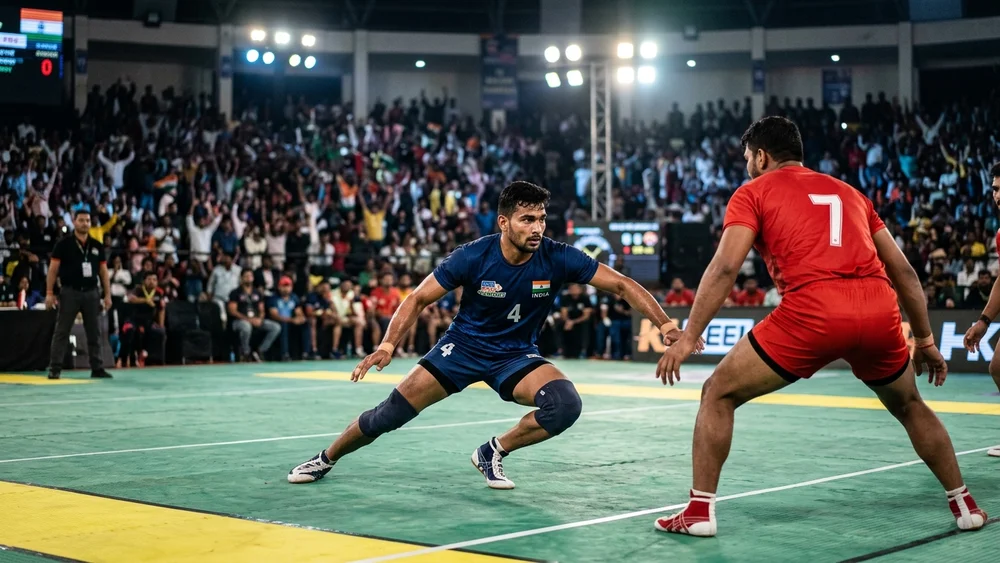
India will go to Japan next month defending both kabaddi gold medals, and the men’s team picked to do it barely resembles the one that won the last one. Of the twelve names released on Sunday, four were part of the side that beat Iran 33-29 in the Hangzhou final in 2023. The other eight places went elsewhere.
Arjun Deshwal, Sunil Kumar, Pawan Sehrawat and Aslam Inamdar are the survivors. Everyone else is heading to a first Asian Games, or coming back after missing the last one.
The two biggest raiders of the last Pro Kabaddi season are in
Ayan Lohchab and Devank Dalal come in as the headline raiders, and the numbers behind the picks are not subtle. Lohchab finished PKL 12 as the leading raider with 316 raid points from 22 matches. Dalal took 271 from 16, which gave him the better average of the two. Ashu Malik and Deshwal complete a four-man raiding unit, with Sehrawat and Inamdar listed as all-rounders, so India can push five or six bodies into a raid rotation if a match turns.
That is a lot of attacking depth for a twelve-man squad, and it says something about how the selectors read the tournament. Kabaddi at the Asian Games is squeezed into six days. Raiders take the physical punishment, and having replacements for them matters more than carrying a specialist for every corner position.
Naveen Kumar is not going
The name missing is the one Indian kabaddi built entire broadcast packages around. Naveen Kumar, who put together a record 28 consecutive Super 10s in Pro Kabaddi between 2019 and 2022, has been left out. So have Surjeet Singh, Aditya Shinde, Shubham Shinde, Yogesh Dahiya and Parvesh Bhainswal.
Anyone following the camps could see the squeeze coming. India took 45 men into the first national camp, cut that to 29 for the second, which ran from 8 June to 7 July, and had to get from 29 to 12 after it. That last cut was always going to cost somebody a reputation.
The defence is where the continuity sits
Sunil Kumar is back, and around him are Jaideep Dahiya, Rahul Sethpal, Gaurav Khatri, Sumit Sangwan and Ankit Jaglan. Six defenders in a twelve-man squad is the conventional split. Sunil Kumar was on the mat in Hangzhou; most of the rest are being asked to hold a corner at the biggest event they have played.
The women’s team, which won its own gold in Hangzhou by a single point against Chinese Taipei, goes with Ritu Negi, Pushpa Rana, Sonali Shingate, Sanju Devi, Pooja Kajla, Ritu Sheoran, Jyoti Thakur, Pinki Roy, Manisha Kumari, Bhavna Thakur, Rajrani and Nikita Kumari. That 26-25 win was India’s third women’s kabaddi gold, after Guangzhou in 2010 and Incheon in 2014.
Six days in Aichi, and Iran on two different timelines
The kabaddi competition runs from 21 to 26 September, inside a Games that opens on 19 September and closes on 4 October. Group matches take the first four days, semi-finals are on 25 September, both finals on 26 September. Ten men’s teams are split into two groups of five, eight women’s teams into two groups of four.
The draw separated the men from Iran and threw the women straight at them. India’s men are in Group A with Bangladesh, South Korea, Chinese Taipei and Japan, so Iran can only appear in a semi-final or the final. India’s women share Group A with Iran, Japan and Bangladesh, and Iran are the side that beat them in the 2018 final.
The men have their own version of that memory. India have won the Asian Games men’s title eight times since kabaddi was added in 1990, and the one edition they did not, in 2018, Iran knocked them out 27-18 in the semi-final and India came home with bronze. It was the first time India had failed to reach the final. Iran have spent part of August training in Islamabad with Pakistan, who they have been drawn alongside in Group B.
Five weeks, then, to turn twelve names into a team that can defend a title eight of them have never won.