







Summer is traditionally the busiest time for football transfers, when clubs strengthen their squads ahead of a new season. In Spain, though, a club cannot simply sign a player and put him on the pitch. Every new signing has to be registered with La Liga, and the league will only register him if the club has room under its spending limit.
That system is called Economic Control (LALIGA now calls it Financial Control), and its key tool is the Squad Cost Limit, or SCL. Here is how the La Liga transfer market works, based on the rules LALIGA published in July 2025.
What is La Liga’s Economic Control?
Economic Control is a set of rules that the clubs and SADs (sports public limited companies) of La Liga imposed on themselves in 2013 to keep the competition and its clubs financially sustainable. It applies to both professional divisions: LALIGA EA SPORTS (the top flight) and LALIGA HYPERMOTION (the second tier).
What makes it different from most other leagues is that it works in advance. Clubs know before the window how much they are allowed to spend, and the league checks every registration against that figure. Rules that look back at accounts after the season, like UEFA’s Financial Fair Play (now called Financial Sustainability), sit alongside it.
What is the Squad Cost Limit?
The Squad Cost Limit is the maximum a club can spend on its whole sporting squad in a season. It covers two groups:
- The registrable squad: first-team players wearing numbers 1 to 25, the head coach, assistant coach and fitness coach, plus players who are no longer in any team but still cost the club money, such as severance payments.
- The non-registrable squad: every other player and coach at the club, including reserve and affiliate teams and other sports sections.
The cost is far more than basic wages. It includes variable pay, image rights, agents’ fees, the amortisation of transfer fees, loan fees, social security, severance pay and 25% of a purchase-option price when the option is very likely to be triggered.
How is the limit calculated?
Each club’s SCL comes from a simple sum: its budgeted income, minus its budgeted non-sporting expenses, minus the debt it has to repay and any losses it must recover that season. Whatever is left is what the club can spend on its squad.
Because transfer income is hard to predict, clubs can budget the average profit they made from player sales over the last three seasons, capped at 25% of net business revenue in the top flight and 10% in LALIGA HYPERMOTION. For the 2025/26 season, LALIGA also set a floor: a top-flight club’s SCL can never be less than 30% of its net business revenue.
How a signing is registered
When a club signs a player, it sends the paperwork to LALIGA, whose Financial Control and Competitions departments approve or reject the registration against the club’s limit on that date. A Validation Body, using independent expert reports, can adjust the value of any deal that does not reflect market value or make economic sense. Player costs are also checked by an independent auditor twice a season.
Clubs that disagree with a decision can go to LALIGA’s Economic Control Committee, then to a second-instance committee at the Spanish football federation (RFEF), and finally to the ordinary courts.
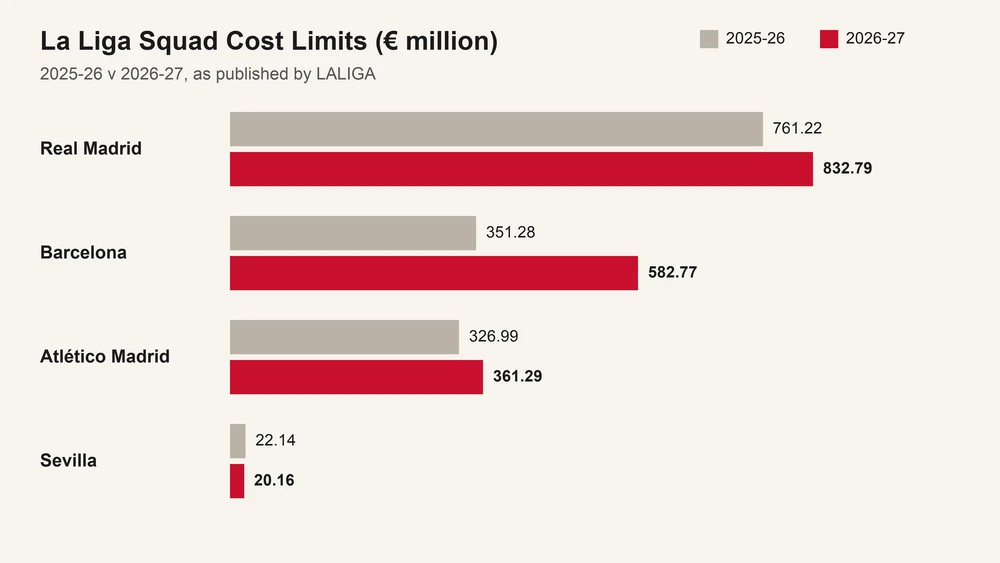
La Liga Squad Cost Limits for 2026-27
LALIGA publishes every club’s limit after each transfer window. The limits for the 2026-27 season, published in September 2026, added up to €3,109.67 million for the top flight, up 15% from €2,704.68 million in 2025-26.
| Club | SCL 2025-26 | SCL 2026-27 |
| Real Madrid | €761.22m | €832.79m |
| Barcelona | €351.28m | €582.77m |
| Atlético Madrid | €326.99m | €361.29m |
| Sevilla | €22.14m | €20.16m |
Barcelona had the biggest increase in the division, 65.9%. Sevilla have the lowest limit in the top flight.
The special rules in the La Liga transfer market
The framework is the same for every club, but it has a number of exceptions for particular situations. LALIGA adjusts these regularly. These are the main ones in the 2025 rules.
What happens if a club is over its limit?
A club that is over its SCL is not frozen out of the market, but it can only re-spend part of what it saves. Normally it can spend at most 50% of the cost it has cut, and for the 2024/25 and 2025/26 seasons that was raised temporarily to 60% when registering a normal player.
For a “franchise player”, one who accounts for at least 5% of the club’s total squad cost, the figure is 60%, raised temporarily to 70% for 2024/25 and 2025/26. A club over its limit also cannot raise a new player’s fixed salary by more than 20% from one season to the next.
How are player swaps counted?
A swap between two clubs is treated as two separate deals: one signing by each club. An independent Valuation Committee can review and adjust the values both clubs put on the players. The same applies to loans between related clubs, for example clubs in the same ownership group.
Can clubs use their savings from previous years?
Yes, but only financially healthy clubs. A club can go over its SCL using part of its accumulated net equity, as long as it stays above the “acceptable ratio” in LALIGA’s financial indicators. From 2025/26 this was extended to clubs with restructured debt that have paid off at least 75% of it, and whose outstanding debt is no more than 15% of their revenue.
Can owners put in money to raise the limit?
Yes. If a SAD approves a capital increase, part of it can go on signings: 100%, 90%, 70% or 0%, depending on the club’s financial health, from best to worst. The money has to be spread over two years, and capital increases and accumulated equity used to raise the limit together cannot exceed 25% of the club’s revenue.
Can a long-term injury free up room?
Yes. If a player is expected to be out for four months or more, the club can use 80% of his squad cost (excluding amortisation), prorated from the date of the injury, to register one replacement. A goalkeeper can only be replaced by a goalkeeper.
Can a club keep a breakout young player without room under the limit?
In some cases. Clubs can renew players under 24 who have been with them for at least the last three seasons, and certain players whose value has jumped unexpectedly, even without room under the limit. In these cases the SCL can be exceeded by up to 4%, or 8% for one player per season.
Are there other exceptions?
A few more:
- Stadium works: clubs renovating their stadium can raise their SCL by the matchday and stadium income they lose during the works, up to 5% of revenue, and must claw it back over the three seasons after the work ends.
- Guarantees: a club can bring forward expected income by lodging a cash deposit or bank guarantee from a shareholder or third party, never the club itself, up to 5% of revenue. It must restore the position within the same season.
- Relegation payments: the financial help LALIGA gives relegated clubs counts 50% towards the SCL in the first season and 50% in the second, provided the club is still in LALIGA HYPERMOTION.
- Reserve players: reserve-team players cleared to play for the first team are counted as first-team players, depending on how much they play and what they earn.
Are there sanctions?
Yes. Clubs can be sanctioned for exceeding the SCL, missing deadlines, missing or incorrect documents, debts to other clubs, employees or public bodies, and failing financial indicators, among other things.
Has Economic Control worked?
LALIGA says it has. Debt owed by clubs to public bodies fell from €650 million in 2013, most of it overdue, to around €3 million, all of it up to date. Unpaid wages owed to players fell from €89 million to zero. On the pitch, Spanish clubs won 21 of the 39 European titles in the period since the rules came in, according to LALIGA.
Photo credit: Alamy