




WG Grace: the numbers, the doctor, and why his career figures are still argued over
WG Grace played 22 Tests and 870 first-class matches across 44 seasons – and the record books only agreed on his totals in 2022.
Dec 30, 2022 · Updated Sep 19, 2026
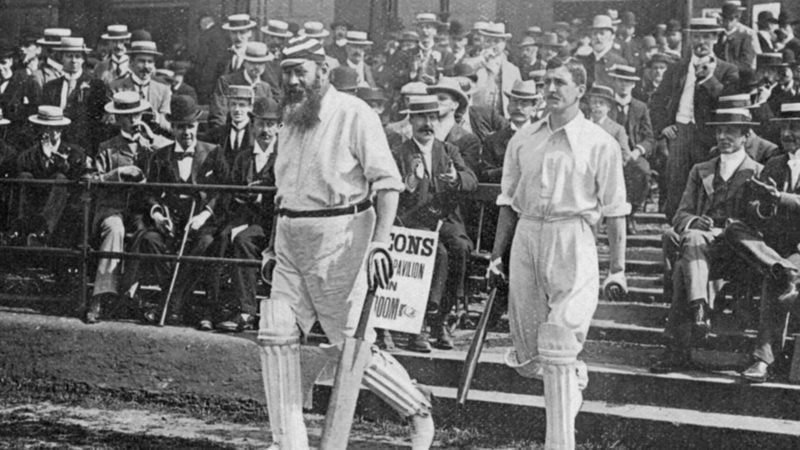
William Gilbert Grace (18 July 1848 – 23 October 1915) is the player cricket calls its father, and the title is not sentimental. His first-class career ran a record-equalling 44 seasons, from 1865 to 1908. Test cricket was invented in the middle of it. He was still scoring first-class hundreds at 54, and he played the last of his 22 Tests at 50, as captain.
He was also a working doctor, a shameless money-maker in an age that pretended to despise it, and the reason a cricket ground could charge double for admission on the days he turned up. He played in the decades when even the cricket ball was still being standardised.
WG Grace stats
| Level | Matches | Runs | Highest | Average | 100s | Wickets | Best | Bowl avg |
|---|---|---|---|---|---|---|---|---|
| Tests | 22 | 1,098 | 170 | 32.29 | 2 | 9 | 2/12 | 26.22 |
| First-class | 870 | 54,211 | 344 | 39.45 | 124 | 2,809 | 10/49 | 18.14 |
He was the first cricketer past 50,000 first-class runs, and he is the only one in the all-time top ten for both runs and wickets. He also held 876 first-class catches.
Why those numbers are an argument, not a fact
Every figure above comes with an asterisk, and it is worth understanding why before quoting any of them in a pub.
There was no official definition of first-class cricket for most of Grace’s career. The standard was agreed at a meeting at Lord’s in May 1894, between the MCC and the county clubs, and it took effect from the 1895 season — the year Grace turned 47. The ruling was not retrospective, so every match he played before it has only an unofficial status, assigned later by statisticians who did not always agree with each other. Grace counted his 1864 South Wales matches. The record books do not.
The disagreement outlived him by more than a century. Wisden only aligned its Grace statistics with the other major sources in 2022, 107 years after his death. That is why the most famous milestone of his career is always written carefully: in May 1895 he reached what was then calculated to be his hundredth first-class hundred.
1876: 839 runs in three innings
The single most absurd week of his career came in August 1876. Grace made 344 for MCC against Kent at the St Lawrence Ground, Canterbury — the first triple century in first-class cricket, and a score that broke a record for the highest individual innings in any class of cricket which William Ward had held for 56 years with 278.
Two days later he made 177 for Gloucestershire against Nottinghamshire. Two days after that, 318 not out against Yorkshire. Three consecutive innings, 839 runs, dismissed twice, against two of the strongest bowling attacks in the country. He broke Ward’s 56-year-old record and then beat it again himself inside a week.
1895: the Indian Summer
He was 46 when the 1895 season started and had been written off for years. What followed is the most improbable stretch of the whole career.
He reached his hundredth hundred for Gloucestershire against Somerset in May. Charles Townsend, batting with him, said that as Grace approached three figures, “this was the one and only time I ever saw him flustered”; Sammy Woods then bowled a full toss and Grace drove it for four.
He kept going. Between 9 and 30 May he scored 13, 103, 18, 25, 288, 52, 257, 73 not out, 18 and 169 — 1,016 runs in the month, the first time anyone had made a thousand first-class runs before the end of May. His aggregate for the season was 2,346 at 51.00 with nine centuries, and Wisden made him the sole Cricketer of the Year for 1896. That award normally goes to five players; it has been restricted to one man only three times.
The 1880 Oval Test and the three Grace brothers
Grace’s Test debut, on 6 September 1880 at The Oval, is retrospectively recognised as the first Test match played in England. He made 152 from 294 balls in England’s 420 — England’s first Test century, and the innings sits near the top of any list of landmark Test scores from the game’s first decade.
His elder brother E. M. Grace and younger brother Fred were in the same side. It was the first time three brothers played together in a Test match. Fred died of pneumonia a fortnight later, on 22 September 1880, aged 29.
All 22 of Grace’s Tests were against Australia. He toured only once, to Australia in 1891-92, and his last Test began on 1 June 1899 at Trent Bridge, weeks short of his 51st birthday. He captained England in it, then stood down and handed both his place and the captaincy to Archie MacLaren.
Was WG Grace really a doctor?
Yes, and the cricket delayed it badly. He began studying medicine as a young man but did not complete the qualification until November 1879, when he was 31, receiving his diploma from the University of Edinburgh as a Licentiate of the Royal College of Physicians and a Member of the Royal College of Surgeons.
He then ran a practice at Stapleton Road in Easton, a poor district of Bristol, employing two locums so he could keep playing through the summer. He was the local Public Vaccinator and Medical Officer to the Barton Regis Union, which meant treating patients in the workhouse. One account from his patients: “Poor families knew that they did not need to worry about calling him in, as the bills would never arrive”.
The amateur who was paid more than the professionals
Grace played as an amateur, which in Victorian cricket meant a gentleman who did not take a wage. In practice he made a great deal of money from the game through expenses, testimonials and appearance fees, and he was open enough about it that it became the standing criticism of his career.
John Arlott recorded the sign that used to appear outside grounds, which settles the argument about what he was worth better than any figure:
CRICKET MATCH
Admission 6d
If W. G. Grace plays
Admission 1/–
He was also, by several accounts, generous with other people’s benefit matches. When Alfred Shaw’s benefit was ruined by rain in 1879, Grace handed over the proceeds of a match that had been arranged for his own testimonial fund.
What Ranjitsinhji actually wrote about him
The best contemporary analysis of Grace’s batting is in The Jubilee Book of Cricket (1897), written by K. S. Ranjitsinhji with C. B. Fry. Ranjitsinhji’s verdict was that Grace “revolutionised batting” by “converting it from an accomplishment into a science”, and that before him batters played either forward or back and specialised in one stroke, while Grace played whichever the ball deserved.
The line everybody quotes is his: Grace “turned the old one-stringed instrument into a many-chorded lyre”. He also called him “not only the finest player born or unborn, but the maker of modern batting”.
WG Grace FAQs
How many runs did WG Grace score? 54,211 in first-class cricket and 1,098 in Tests, on the figures the major sources settled on in 2022.
Why is WG Grace called the father of cricket? Because his career spans the game’s transformation: he started in 1865, when first-class cricket was barely defined, and finished in 1908, by which time Test cricket, the County Championship and the modern batting technique he largely invented were all in place.
Did WG Grace play Test cricket? Yes, 22 Tests between 1880 and 1899, all of them against Australia. He toured only once, to Australia in 1891-92.
How old was WG Grace when he retired? He played his last first-class match in 1908, the season he turned 60. His final Gentlemen v Players appearance was in July 1906 at The Oval, in a match that coincided with his 58th birthday; he saved it with a dogged 74.
What was WG Grace’s highest score? 344, for MCC against Kent at Canterbury in August 1876 — the first triple century in first-class cricket.
Photo Credit: Alamy